

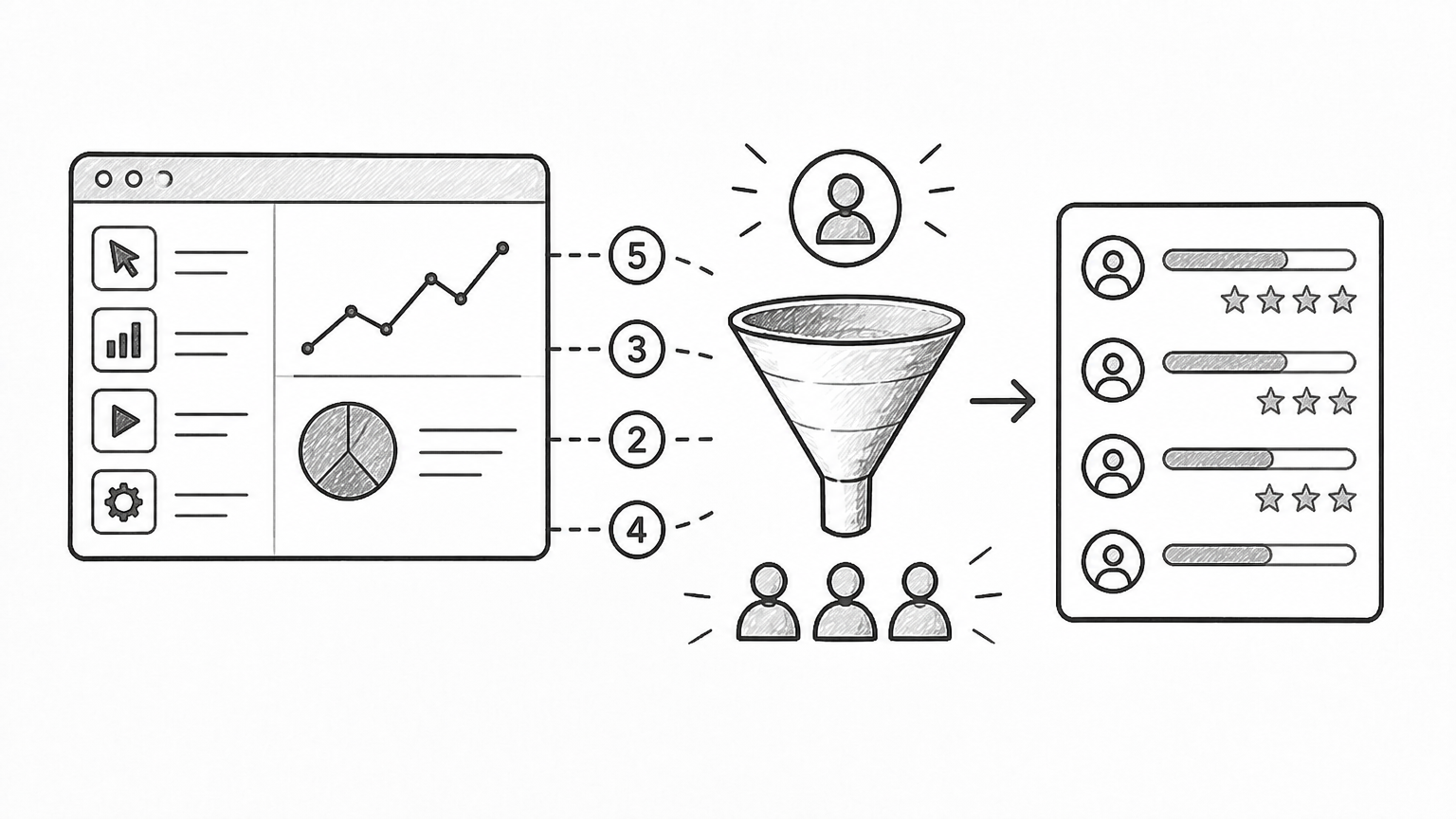
Your CRM is probably full of leads that look good on paper and go nowhere in practice. A VP title signs up. A famous logo starts a trial. A team downloads a whitepaper. Sales gets excited, then the account stalls because nobody actually uses the product.
That is the core problem product-led SaaS teams run into. Traditional lead scoring favors firmographics, form fills, and email engagement. Useful, yes. Sufficient, no. If you sell software, the strongest buying signal often comes from the product itself: what users did, how often they did it, and whether their behavior resembles accounts that convert, expand, and stay.
A better approach is to build a SaaS lead scoring model around product usage signals, then weight those signals based on their real relationship to revenue. Done right, this gives your sales, growth, and data teams one shared view of intent. It also cuts noise. You stop chasing curiosity and start prioritizing readiness.
What lead scoring for SaaS with product usage signals actually means
Lead scoring in SaaS is the process of assigning value to accounts, users, or opportunities based on their likelihood to convert. The twist is that in a modern SaaS environment, you are not limited to marketing and CRM data. You can score leads using in-app behavior.
This matters because product usage reveals intent with far more precision than surface-level engagement. Opening five emails is weak evidence. Inviting three teammates, integrating a data source, and returning four times in a week is stronger evidence. Those actions show effort, adoption, and momentum.
When people talk about lead scoring models for SaaS that weight product usage signals, they are really talking about three decisions. First, which behaviors matter. Second, how much each one should count. Third, how those behaviors combine with sales and marketing context.
Why classic scoring models break in product-led SaaS
Many scoring systems were built for top-of-funnel marketing. They reward website visits, ebook downloads, demo requests, and company size. Those inputs still matter, but they break down when your product itself is part of the buying journey.
In SaaS, users often evaluate before they talk to sales. Some become active champions long before procurement appears. Others match your ideal customer profile perfectly but never reach first value. If your scoring model ignores this, you will over-prioritize impressive accounts with weak engagement and under-prioritize smaller accounts with real adoption.
The result is predictable. Sales complains about bad leads. Growth teams optimize for signups instead of qualified usage. Data teams get asked to explain why conversion rates look inconsistent. The issue is not usually the people. It is the model.
Product usage signals are not just activity logs
A common mistake is to treat every event as a signal. That floods the model with noise. Logging in once is not the same as completing onboarding. Clicking around is not the same as activating a key workflow. Opening settings is not the same as connecting an integration.
Useful product signals have business meaning. They map to value realization, collaboration, stickiness, or buying intent. In other words, they answer a commercial question, not just an analytics question.

body 1 55a73320-2cf2-47c9-bc27-187257d9a2c6
A strong signal usually fits one of four buckets: activation, engagement depth, collaboration, or expansion potential. Activation tells you whether the user reached first value. Engagement depth shows whether usage is habitual. Collaboration reveals whether the product is spreading inside the account. Expansion potential points to use cases, limits, or advanced features linked to paid conversion.
Key aspects of weighting product usage signals in SaaS lead scoring
The quality of your scoring model depends less on math than on judgment. You need the right signals, clean definitions, and weights grounded in outcomes. Fancy models cannot rescue weak inputs.
Start with the customer journey, not the event stream
Before assigning points, define the path from signup to revenue. What behaviors happen before a self-serve upgrade? What behaviors show up before a sales-assisted close? What separates retained customers from churned ones?
This is where many teams move too fast. They start by exporting events from Segment, Mixpanel, Amplitude, Snowflake, or the application database. But raw events do not tell you what matters. Your funnel does. Build from the moments that mark progress.
For example, a project management SaaS company might define the journey this way: signup, workspace created, first project created, two teammates invited, ten tasks completed, integration connected, weekly active use for three weeks. Each step means something. Each can become a candidate score component.
Weight behaviors by commercial importance
Not all product actions deserve equal treatment. A good weighting system reflects how strongly a behavior predicts business outcomes. If users who connect an integration convert at 4x the baseline rate, that action should carry more weight than simply logging in.
This sounds obvious, but teams often default to arbitrary scoring. Ten points for a login. Twenty for an invite. Thirty for an export. The numbers feel tidy and are usually wrong. Weighting should come from evidence, even if the first version is directional.
A practical way to think about weights is to separate signals into high-intent, supporting, and noise-control categories. High-intent actions get the most weight because they correlate strongly with conversion or expansion. Supporting actions matter, but only in context. Noise-control rules prevent inflated scores from repetitive low-value activity.
Here is a simple example of how signal weighting might look in a SaaS model:
Product Usage Signal | Why It Matters | Example Weight | Notes |
Account created | Basic entry event | 5 | Low value on its own |
First key workflow completed | Reached initial value | 25 | Strong activation marker |
Teammate invited | Indicates collaboration | 15 | Stronger when repeated by distinct users |
Integration connected | Setup effort and intent | 30 | Often highly predictive |
Used product 3 times in 7 days | Early habit formation | 20 | Better than raw session count |
Viewed pricing or billing | Commercial interest | 10 | Useful but should not dominate |
Hit usage limit | Potential expansion signal | 20 | Best for product-qualified leads |
Repeated low-value page views | Weak engagement | 0 to 2 | Prevent score inflation |
The exact values will differ by business. The principle stays the same, weight actions according to outcome relevance, not convenience.
Use frequency, recency, and depth together
One event rarely tells the whole story. The power comes from combinations. A user who created one dashboard six weeks ago is different from a user who created three dashboards this week and shared them with a teammate.
That is why mature SaaS lead scoring models evaluate three dimensions together. Recency tells you whether intent is current. Frequency shows whether the behavior is repeated. Depth reveals whether the user is moving into core workflows or advanced use cases.
If you ignore recency, stale accounts can stay artificially hot. If you ignore frequency, one-off curiosity looks like intent. If you ignore depth, shallow activity can outrank real adoption. The best models avoid all three traps.
Score at the right level: user, account, and buying group
A signup is usually an individual event. A deal is usually an account decision. That gap matters.
If you only score users, you can miss account-level momentum. One power user may be driving genuine expansion, but sales needs to know whether the broader team is engaged. If you only score accounts, you can miss who the champion is and what they actually did.
In practice, SaaS teams usually need layered scoring. User-level scores help lifecycle campaigns and in-app nudges. Account-level scores help sales prioritize outreach. In larger deals, buying-group signals matter too, especially when multiple stakeholders touch the product in different ways.
Blend fit and behavior instead of choosing one
Product usage tells you who is active. Firmographics tell you whether the account is worth pursuing. You need both.
A startup with five employees may be deeply engaged but below your sales threshold. A 2,000-person company may fit your ideal customer profile but show weak adoption. Your model should reflect this tension rather than pretend one side wins.
The cleanest approach is to combine fit score and behavior score into a unified priority score. Some teams keep the two separate and route based on a matrix. That often works better operationally because sales can see whether an account is “high fit, low usage” or “low fit, high usage” and act differently.
Here is a practical comparison:
Scoring Dimension | What It Captures | Best Data Sources | Common Risk |
Fit score | ICP alignment, deal size potential | CRM, enrichment tools, firmographic data | Pursuing accounts with no real intent |
Behavior score | Actual product interest and momentum | Product analytics, event streams, CDP | Overvaluing small but active accounts |
Combined score | Revenue potential plus usage intent | Unified customer data layer | Poor calibration if weights are arbitrary |
Negative scoring is essential
Most lead scoring models are too optimistic. They add points freely and subtract almost nothing. That creates bloated scores and stale priorities.
In SaaS, negative signals are often highly informative. A user who abandons onboarding, goes inactive for 21 days, removes an integration, or repeatedly hits setup errors may be less sales-ready than their earlier behavior suggests. Your model should reflect that.
Negative scoring is also useful for guarding against false positives. Imagine an account with lots of logins but no completion of a value-driving workflow. Or a trial with many invited users but no meaningful use after day seven. Those patterns should either lose points or fail to gain them.
Map scores to operational actions
A score with no downstream action is just decoration. The model only matters if it changes what your teams do.
That means setting score thresholds with clear outcomes. Below a certain level, the user stays in onboarding nurture. Above another level, the account becomes a product-qualified lead. If expansion signals appear in a customer account, customer success or sales gets a task. If fit is high but activation is weak, the account enters a targeted assist sequence.
The best scoring systems are less about ranking and more about routing. They help the right team act at the right time.
How to choose the right product usage signals
This is where rigor matters. The best signals are not the most obvious ones. They are the ones tied to value and conversion.
Look for milestone events, not vanity events
A milestone event marks progress in the customer journey. It signals that the user crossed a meaningful threshold. Think “first report published,” “first API connected,” or “second active team member invited.”
Vanity events look busy but say little. Session starts, random clicks, help center page views, and generic screen views often fall into this category unless paired with stronger context. You can track them, but do not let them drive scoring on their own.
A useful test is simple, if this event doubled, would sales care? If the answer is no, it probably should not carry much weight.
Validate signals against conversion and retention data
Do not guess if you can test. Pull closed-won, self-serve converted, expanded, and retained cohorts. Then compare their early product behaviors against non-converting or churned cohorts.
You are looking for patterns with separation. Which actions occur earlier and more often in successful accounts? Which combinations show the biggest lift? Which events seem important but actually have little predictive value?
This analysis does not need to start with machine learning. Even a basic cohort table can reveal strong signals. If 68 percent of converted trials completed a key workflow in the first seven days, versus 18 percent of non-converted trials, you have something worth weighting heavily.
Watch for role-based differences
Not every user should be scored the same way. An admin, end user, analyst, and executive sponsor interact with the product differently. A signal that matters for one role may be irrelevant for another.
For instance, in a developer tool, creating an API key might be a strong activation signal for an engineer but meaningless for a finance stakeholder. In a collaboration platform, inviting teammates may matter more for a manager than for an individual contributor.
Role-aware scoring makes the model more precise. It also helps lifecycle messaging feel smarter because the follow-up can match what the user is trying to do.
Common mistakes that wreck SaaS lead scoring models
You do not need a broken data stack to get bad scoring. A few common decisions can do the job quickly.
Mistaking volume for intent
More activity is not always better. A user can generate dozens of events while struggling through setup. Another can take three clean, decisive actions that show genuine value realization.
This is why event count alone is weak. Weighting needs context. Completion beats motion. Progress beats noise.
Ignoring time decay
A lead that was hot last month may be cold today. Product intent expires.
Time decay solves this by reducing the impact of older events. Recent product actions should carry more influence than stale ones, especially in fast-moving trial and PQL workflows. Without decay, your queue fills with ghosts.
Building a model nobody trusts
If sales cannot understand why an account scored 87, they will ignore it. If growth cannot see which events drive the score, they cannot improve activation. If data teams cannot audit the logic, maintenance becomes painful.
Transparency matters. Even when you use statistical methods, keep the scoring logic explainable. Show the contributing signals. Make thresholding visible. Let teams inspect why a lead surfaced.
Overcomplicating the first version
You do not need a perfect model to get value. In fact, the fastest way to stall is to wait for a perfect model.
Start with a rules-based system using clearly defined events and directional weights. Once you collect outcomes and feedback, calibrate. Then test more advanced approaches if the complexity pays for itself.
How to get started with SaaS lead scoring based on product usage
The fastest path is not glamorous. It is disciplined.
Begin with a narrow business question
Pick one commercial use case first. Maybe you want to identify product-qualified leads during trial. Maybe you want to flag expansion-ready customer accounts. Maybe you want to prioritize sales-assisted outreach for freemium teams showing adoption.
Choose one. That keeps the model focused and easier to validate.
Define the events that represent value
Work backward from conversion. What actions consistently happen before the outcome you care about? Which events indicate setup completion, repeated use, collaboration, or commercial intent?
Keep the first version tight. You do not need fifty events. You need a handful that map clearly to customer value.
A practical starter set often includes the following:
Activation event: The user completes the first meaningful workflow.
Adoption event: The account returns and repeats core usage.
Collaboration event: Another user joins or engages.
Intent event: The account touches pricing, billing, or usage limits.
That is enough to build a useful first model.
Assign initial weights, then calibrate fast
Your first weights can be based on historical patterns, stakeholder knowledge, or both. What matters is that they are explicit and testable.
Then review performance quickly. Are high-scoring leads actually converting at a higher rate? Are some signals overweighted? Are low-fit but active accounts flooding sales? Calibration is not a quarterly ceremony. Early on, it should be frequent.
Connect the score to systems people already use
A strong model dies quietly if it lives in a dashboard nobody opens. Push scores into the CRM, marketing automation platform, customer data platform, and internal alerting systems.
Sales should see the score and the top contributing behaviors. Growth should be able to trigger onboarding or upgrade campaigns from it. Customer success should spot healthy expansion patterns without asking an analyst for a custom report.
Measure business impact, not just score accuracy
The point is not to produce elegant numbers. The point is to improve outcomes.
Track whether scoring improves response time, demo-to-close rate, PQL conversion, sales efficiency, expansion identification, or retention. If the model does not change decisions and results, refine it until it does.
A simple maturity model for SaaS lead scoring
Most teams evolve through stages. Knowing your stage helps you avoid overbuilding.
Maturity Stage | Model Type | Typical Inputs | Best For | Main Limitation |
Stage 1 | Manual or rules-based | CRM fields, basic product events | Early startups | Limited nuance |
Stage 2 | Weighted rules with decay | Activation, adoption, collaboration signals | PLG and hybrid GTM teams | Requires regular tuning |
Stage 3 | Cohort-validated scoring | Historical conversion data, account rollups | Scaling SaaS companies | More data dependency |
Stage 4 | Predictive scoring | Statistical or ML models across channels | Mature teams with strong data ops | Harder to explain and govern |
Most startups should live happily in Stage 2 for a while. It is powerful enough to drive better routing and simple enough to trust. You do not need machine learning just because you have event data.
Conclusion
The best SaaS lead scoring models do not reward busyness. They reward meaningful product progress. That means weighting product usage signals based on how strongly they predict activation, conversion, expansion, and retention.
If you want a model your teams will actually use, keep it grounded in the customer journey. Choose milestone events. Blend fit with behavior. Add negative scoring and time decay. Then tie every threshold to a real action.
Start small. Pick one use case, define a few high-value signals, and push the score into the workflow where decisions happen. Once your model starts helping sales chase the right accounts and helping growth focus on real adoption, you will not want to go back to form-fill scoring alone.
Learn more about SaaS Lead Generation.
Written by
Bastian W.
Content Manager / ManyPI