

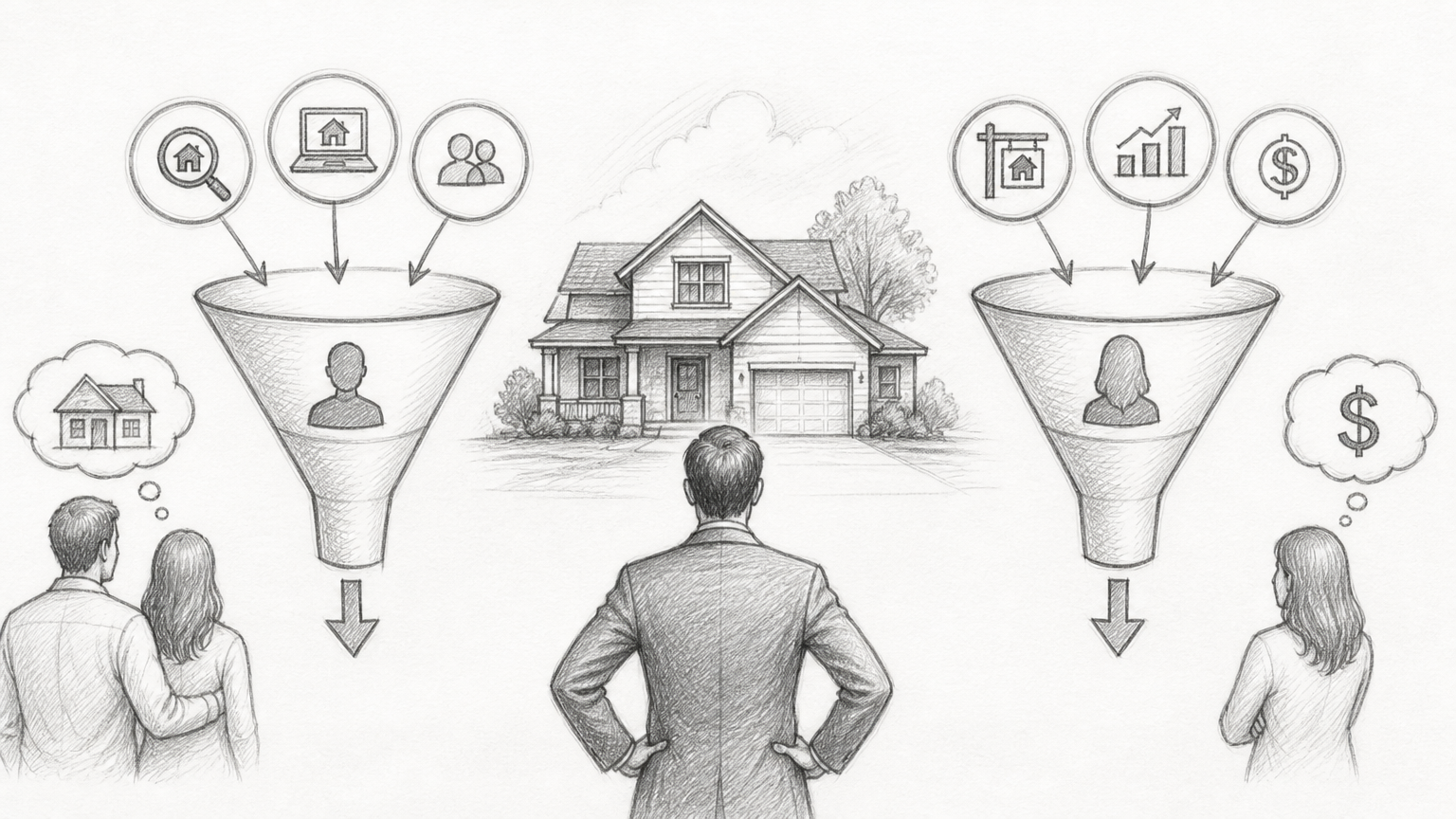
Most real estate lead gen fails for one simple reason, agents push buyers and sellers into the same funnel, then wonder why conversion stalls.
That mismatch is expensive. Buyers usually need education, financing clarity, neighborhood confidence, and time. Sellers need pricing confidence, timing strategy, trust, and a clear path to results. Different motives, different urgency, different objections. If you market to both with the same message, form, follow-up, and offer, you create friction where there should be momentum.
A smarter approach is to build separate lead funnels for realtor buyer leads and seller leads. When the entry point, messaging, and follow-up match intent, lead quality improves, response rates rise, and your pipeline becomes easier to manage. This is the core of effective lead generation for realtors, understanding the difference between buyer and seller funnels and designing each one to move people to the next step.
What Buyer and Seller Lead Funnels Mean for Realtors
At a basic level, a real estate lead funnel is the path a prospect takes from first contact to appointment, and then to client. In practice, that path looks very different for buyers and sellers.
A buyer funnel usually starts with curiosity. A prospect sees listings, a first-time buyer guide, a mortgage calculator, or a local market update. They are often early in the process. Some are just browsing. Some are serious but unprepared. Some are relocating and need fast answers. The funnel must capture attention, qualify readiness, and keep the conversation alive until they are ready to tour homes or talk financing.
A seller funnel usually starts with a trigger. A homeowner is wondering what their home is worth, whether now is the right time to list, how much equity they have, or how to move without losing leverage. Their questions are more strategic and more personal. The funnel must build trust quickly, prove local expertise, and reduce the perceived risk of choosing the wrong agent.
That is why buyer and seller lead generation for realtors should never be treated as a single campaign. You are not just collecting names. You are guiding two very different decisions.
Why funnel separation matters
When funnels are split by audience, your message becomes more precise. A buyer does not want a home valuation offer. A seller does not want a list of starter homes unless they have already decided to move. Intent drives relevance, and relevance drives conversion.
Separation also improves your data. You can track source quality, conversion rate, speed to appointment, and close rate by funnel. That gives your marketing and operations teams a cleaner system. Instead of a generic lead bucket, you get segmented workflows that are easier to automate and optimize.
The business case for distinct funnels
For growth-minded teams, separate funnels create leverage. Your paid campaigns become easier to target. Your CRM workflows become easier to personalize, and your retargeting becomes more accurate. Your agents spend less time chasing weak leads and more time working ready-to-act prospects.
This matters even more if you operate as a team, brokerage, or startup serving real estate clients. The cost of lead acquisition is too high to waste on vague messaging. Better segmentation usually means better economics.
Key Aspects of Buyer vs. Seller Lead Funnels
The biggest difference between buyer and seller funnels is not format, it is psychology.
Buyers are pursuing possibility. Sellers are managing consequence. Buyers ask, "What can I get?" Sellers ask, "What will this cost me, and who can I trust?" Your funnel has to answer those questions in the right order.
Buyer funnels start with access and guidance
A strong buyer funnel usually opens with something practical and immediate: new listings, a neighborhood guide, a first-time buyer checklist, or an instant payment estimate calculated with a mortgage calculator. The prospect wants useful information now, not a hard sell.
From there, the funnel should qualify without overwhelming. Ask where they want to buy, their timeline, budget range, and whether they are pre-approved. Those questions do two jobs: they help you segment the lead, and they signal that you understand the process.
The follow-up cadence matters. Buyer leads often need longer nurturing, especially if they are six to twelve months out. That means your content has to keep earning attention. Market updates, financing tips, school district insights, and inventory alerts keep the relationship alive without feeling pushy.
Seller funnels start with trust and certainty
Seller funnels work best when they begin with a high-intent offer tied to a real concern. A home valuation request is common, but by itself it can be too generic. A better angle is specificity: pricing strategy, net proceeds estimate, neighborhood trend report, or a custom selling timeline.
The seller is not just asking what the home is worth, they are testing whether you understand their property, their market, and their next move. The funnel must signal expertise fast. Case studies, local statistics, before-and-after listing examples, and concise consultation offers do more than capture contact info. They lower the trust barrier.
Seller leads also tend to reward speed and confidence. If someone requests a valuation or pricing review, the response cannot feel automated or vague. The handoff from form fill to conversation should be tight, clear, and personal.
The funnel stages are similar, but the pressure points differ
Both buyer and seller funnels move through familiar stages: awareness, interest, consideration, conversion, and nurture. What slows progress differs in each funnel.
For buyers, the main friction points are financial readiness, search overwhelm, and commitment. For sellers, they are timing, pricing anxiety, home prep, and fear of making a costly mistake. Same funnel structure, different friction.
That distinction should shape your landing pages, forms, email sequences, ad copy, SMS follow-up, and even your call scripts. If you are not mapping friction by audience, you are optimizing the wrong thing.
A side-by-side comparison
Funnel Element | Buyer Lead Funnel | Seller Lead Funnel |
|---|---|---|
Primary motivation | Find the right home | Sell at the right price and time |
Typical entry offer | Listings, guides, mortgage tools, neighborhood info | Valuation, equity estimate, net sheet, market analysis |
Intent timing | Often early or mid-journey | Often closer to decision |
Key objection | Affordability, readiness, too many choices | Trust, pricing, disruption, uncertainty |
Best follow-up style | Educational, steady, consultative | Fast, specific, credibility-led |
Core qualification data | Budget, location, timeline, financing status | Address, timing, motivation, property condition |
Sales cycle length | Often longer | Often shorter, but higher stakes |
Most effective proof | Area knowledge, financing guidance, responsiveness | Local comps, listing results, strategy, negotiation skill |
Lead magnets should match intent, not just volume
A lot of realtor lead gen campaigns chase volume with broad offers. That usually creates noisy pipelines. Better to use lead magnets that signal genuine intent.
For buyers, useful offers include a relocation guide, a first-time buyer roadmap, a neighborhood comparison report, or instant listing alerts. For sellers, stronger offers include a local home value review, seller timing report, pre-listing checklist, or estimated net proceeds breakdown.
The goal is not to collect more leads, it is to collect more qualified leads. A smaller number of high-fit prospects beats a large database full of people who never move.
How to Build Buyer and Seller Funnels That Actually Convert
If you want better lead generation for real estate agents, start by removing unnecessary complexity. One audience per funnel, one core offer per landing page, one next step per campaign.
That clarity improves both conversion and measurement. It also forces discipline. You stop trying to say everything to everyone.
Start with traffic source and intent alignment
Every funnel begins with traffic, but source quality varies. Paid social can work well for top-of-funnel buyer education and broad seller awareness. Search traffic often performs better for high-intent seller terms such as home valuation or agent comparison. Portal leads can fill the pipeline, but they usually require faster response and stronger qualification.
The key is alignment. If the traffic source captures low-intent attention, your offer should be educational and low-friction. If the source captures active intent, your call to action can be more direct, such as booking a consultation or requesting a custom analysis.
Build focused landing pages
A buyer landing page should feel like a guided next step: clear headline, specific promise, short form, a visual or simple proof point, and a direct call to action. If the page is about downtown condos, everything on that page should support that topic. Do not dilute it with seller messaging.
A seller landing page should reduce uncertainty fast. Explain what the homeowner gets, how quickly they get it, and why your process is useful. If you offer a valuation, clarify whether it is automated, agent-reviewed, or paired with a strategy call. Specificity builds trust.
Keep forms short, but ask smarter questions
Too many forms either ask for nothing useful or ask for too much too soon. The right balance depends on funnel stage.
Early buyer forms should gather basic intent data without causing drop-off. Later-stage forms can ask about financing, move timeline, or must-have criteria. Seller forms should capture address and timing early, because those inputs dramatically improve follow-up quality.
Use progressive qualification if your stack supports it. Start small, learn more over time. That reduces friction while preserving data quality.
Follow-up should feel like continuation, not restart
This is where many funnels break. A lead clicks an ad for neighborhood listings, fills out a form, and gets a generic message that ignores the original intent. Or a homeowner requests a valuation and receives a canned drip sequence with no local context. That gap kills trust.
Good follow-up continues the conversation the lead already started. If a buyer asked for homes in a school district, respond with relevant inventory and one clear next step. If a seller asked about pricing, respond with context, not just a raw number. The message should make the prospect feel seen.
Use automation carefully
Automation is powerful when it supports speed and consistency, it is harmful when it makes your process feel robotic. For buyers, automation can handle listing alerts, educational drips, and milestone reminders. For sellers, automation can confirm requests, schedule consultations, and deliver structured prep content.
But high-intent moments need human judgment. A seller lead who requests a valuation should not disappear into a generic seven-email sequence. A serious buyer asking for a showing should not wait until tomorrow. Use systems to accelerate response, not replace relevance.
How to Get Started with Realtor Lead Generation Funnels
You do not need a giant tech stack to improve results. You need a cleaner structure and better decisions. Start by auditing what you already have.
If your website, ads, and CRM currently send buyers and sellers into the same intake path, that is the first fix. Split the experience. Create separate offers, separate landing pages, and separate follow-up logic. That one change often improves lead quality immediately.
Audit your current funnel
Look at the last 90 days of leads and ask simple questions. Where did they come from? Were they buyer or seller leads? How quickly did someone respond? How many booked an appointment? How many actually closed?
Patterns show up fast. You may find that your buyer leads need more nurturing than your team is giving them. You may find that your seller leads convert well when contacted within five minutes, but poorly after an hour. Those are not small details, they define your economics.
Define one buyer offer and one seller offer first
Do not start with six campaigns. Start with one strong buyer offer and one strong seller offer. Make each offer useful, clear, and easy to say yes to.
A buyer offer might be a curated local listings alert or a first-time buyer consultation. A seller offer might be a custom pricing review or a net proceeds estimate. Keep the promise narrow enough to be believable and valuable enough to motivate action.
Map the next step before launching traffic
A funnel is not just an ad and a form, it is the full path after the click. Before you spend on traffic, decide what happens in the first five minutes, the first 24 hours, and the first seven days after lead capture.
That means assigning ownership, writing follow-up messages, setting routing rules, and deciding when a lead moves from nurture to direct outreach. If you skip that work, traffic will expose operational weakness.
Track the metrics that matter
You do not need a bloated dashboard. You need a few honest metrics tied to business outcomes.
Lead-to-contact rate
Contact-to-appointment rate
Appointment-to-client rate
Client-to-close rate
Cost per closed buyer and seller client
Track those separately for buyer and seller funnels. If you combine them, the data becomes misleading. Seller leads often cost more upfront but may convert faster. Buyer leads may require more touches but produce repeat and referral value. You need both views.
Tighten the handoff between marketing and sales
For teams, this is where performance compounds. Marketing should not just deliver names. Sales should not just complain about quality. Both sides need a shared definition of a qualified buyer lead and a qualified seller lead.
That means agreed fields, agreed response times, and agreed feedback loops. If sellers from a certain channel consistently lack intent, marketing should know. If buyers from another source convert after a longer nurture window, sales should know. Funnel performance improves when the handoff is operational, not emotional.
Common Mistakes That Hurt Conversion
The most common mistake is generic messaging. A headline like "Work with the best local realtor" says almost nothing. Strong funnels are specific about audience, problem, and next step.
Another common mistake is over-gating. Not every prospect will give a phone number, full address, timeline, and financing status on the first touch. If you demand too much too early, conversion drops. If you ask too little, qualification suffers. The right answer is staged data collection.
Teams also underestimate response speed. In real estate, momentum matters. A lead's intent decays quickly, especially when they submitted forms to multiple agents. Fast, relevant follow-up is a competitive advantage, not an administrative detail.
Finally, many agents focus on top-of-funnel volume and ignore nurture. That is especially costly with buyers, who often convert later. A lead that is not ready now is not worthless, it is simply on a different timeline.
Conclusion
Strong realtor lead generation gets simpler when you stop treating buyers and sellers as the same audience. Buyers need guidance, education, and steady nurturing. Sellers need trust, clarity, and fast strategic follow-up. Build separate funnels around those realities, and your conversion path becomes easier to manage and easier to improve.
Your next step is practical. Audit your current pipeline, split buyer and seller journeys, launch one focused offer for each, and track conversion stage by stage. That is how better real estate lead generation works, not by chasing more leads, but by building the right funnel for the right person at the right moment.
Written by
Bastian W.
Content Manager / ManyPI