


A lot of SaaS companies still assume lead generation starts when you hire SDRs. It does not. In many cases, a sales team is not the first growth engine. The product is. The website is. The content is. The onboarding flow is. If your funnel is built well, leads show up before a rep ever sends a cold email.
That matters more now because buyers do not want to talk to sales early. They want to self-educate, compare options, test the product, and decide if it fits their stack before they book a call. For developers, data teams, and startup operators, that behavior is even more pronounced. They want speed, proof, and low friction.
So, how do SaaS companies generate leads without a dedicated sales team? They build systems that attract the right traffic, convert that traffic into signups or qualified interest, and nurture demand automatically. Done right, this approach is efficient, scalable, and often better aligned with how modern software buyers actually buy.
What it means for SaaS companies to generate leads without a dedicated sales team
When people ask how SaaS companies generate leads without a dedicated sales team, they are really asking how software businesses create consistent pipeline through self-serve demand generation. That means fewer manual touchpoints and more leverage from channels, content, product experience, and automation.
In this model, a lead is not always a hand-raiser asking for a demo. It might be a free trial signup, a product-qualified lead, a newsletter subscriber, a user who connected data sources, or a team that invited multiple colleagues into an account. The exact definition depends on your pricing, complexity, and sales motion.
For simple or mid-market SaaS, this often looks like a clean website, strong SEO, comparison pages, educational content, free tools, a frictionless trial, and lifecycle emails that move users toward activation. For more technical products, it may also include docs-led acquisition, open-source distribution, API-first onboarding, and community-led growth.
The key shift is this, instead of paying people to explain the value one prospect at a time, you build assets that explain and prove the value at scale. One page, one workflow, one onboarding sequence. Repeated thousands of times.
The core mechanics behind salesless lead generation
Traffic comes from intent, not interruption
Without a sales team, you do not have people brute-forcing attention into the market. You need buyers to find you when they already have a problem. That is why high-intent acquisition channels matter so much.
Search is one of the strongest channels because it captures demand that already exists. A user searches for a category term, a competitor alternative, a use case, or a technical problem. If your site shows up with a clear answer and an obvious next step, you can turn that search into a lead without a human involved.
This is also why content works best when it sits close to buying intent. Thought leadership has value, but “what is customer data infrastructure” is usually weaker than “best ETL tools for SaaS,” “Segment alternative,” or “how to sync Stripe data to Snowflake.” The closer the content is to a real implementation need, the better it converts.
Paid acquisition can work too, but the same rule applies. Broad awareness campaigns are expensive when no sales team exists to nurture weak intent. Narrow targeting, strong landing pages, and a clear self-serve path tend to perform better.
The website does the job of an SDR
If no one is there to qualify, persuade, and route leads, your website has to do that work. It needs to answer basic questions quickly: what the product does, who it is for, what problem it solves, how it integrates, how much it costs, and what someone should do next.
Weak SaaS sites try to sound impressive. Strong ones reduce uncertainty. They show product screenshots, explain workflows, list integrations, clarify use cases, and remove ambiguity around setup effort. They make it easy for a visitor to think, “Yes, this is for a team like mine.”
This is especially important for technical buyers. Developers and data teams are skeptical by default. They want real detail, not vague claims. If your site hides pricing, skips implementation specifics, or buries documentation, many will leave before converting.
The product itself becomes the lead magnet
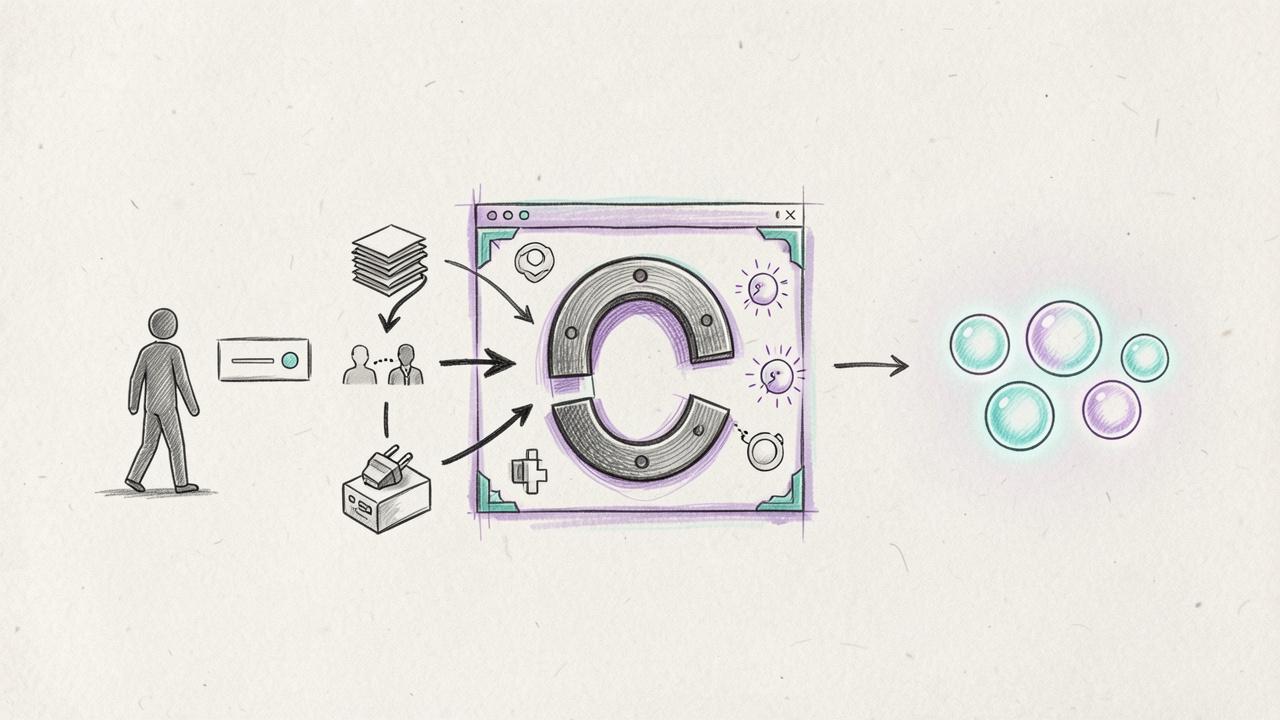
The best no-sales lead engine is often the product experience. A free trial, freemium plan, sandbox, interactive demo, or limited free tool can create far more qualified leads than a generic contact form.
Why? Because product interaction creates behavioral intent. Someone who signs up, imports data, connects an integration, or invites teammates is showing much stronger buying potential than someone who only downloaded a PDF.
That gives SaaS companies a major advantage. You do not have to guess interest based on demographics alone. You can qualify based on actions. Product-qualified leads are often more accurate than form-fill leads because they reveal urgency, fit, and seriousness through usage.
body 1 7943ba33-eb53-4edf-86d8-cc6d17ce4144
aspects of generating SaaS leads without a sales team
SEO is a compounding asset
Search engine optimization is one of the most reliable ways SaaS companies generate leads without a dedicated sales team. It takes time, but it compounds. A high-ranking page can bring in qualified traffic every week without added labor.
The most effective SaaS SEO strategies usually combine several page types. Category pages capture broad demand. Use case pages match specific jobs to be done. Competitor comparison pages intercept active evaluation. Integration pages attract users who want compatibility with tools they already use. Help content and templates capture practical, problem-driven searches.
Not all traffic is useful, though. If you target only informational terms with low purchase intent, you may grow pageviews without growing pipeline. The goal is not raw traffic. The goal is qualified discovery. That means choosing topics where the searcher can realistically become a user.
A simple way to think about it: write for moments when someone is trying to solve a problem your product can actually solve. That is where SEO turns from a branding tactic into a lead engine.
Content builds trust before the signup
Content marketing is not just blogging. For SaaS, it is pre-sales education. It answers objections before they arise. It explains use cases in plain English. It helps technical and non-technical stakeholders get aligned.
The strongest content usually sits in the middle of the funnel. Not too broad. Not too late. Buyers want enough detail to make a serious judgment, but they are not always ready for pricing or procurement yet. This is where tutorials, solution guides, migration pages, benchmark reports, implementation walkthroughs, and ROI explainers perform well.
For developer-focused or data-heavy products, documentation often doubles as marketing. If your docs are searchable, clear, and publicly available, they can attract engineers who are already evaluating implementation options. Good docs reduce friction. Great docs create demand.
Case studies also matter, but only when they are specific. “Increased efficiency” means little. “Cut dashboard build time from two days to 30 minutes” is useful. Precision sells.
Product-led growth turns usage into pipeline
Product-led growth is the clearest example of lead generation without a traditional sales team. You let users experience value first, then use product data to identify who is likely to convert.
This works best when the product has a short time to value. If users can get to a meaningful outcome quickly, they do not need hand-holding upfront. They can self-qualify. That makes the funnel faster and cheaper.
The challenge is not getting people to sign up. It is getting them activated. Many SaaS companies overfocus on top-of-funnel lead volume and underinvest in onboarding. That is a mistake. A no-sales motion lives or dies on how smoothly users move from curiosity to first success.
Activation events vary by product. It could be connecting a repo, syncing a database, publishing a workflow, creating a report, sending a campaign, or inviting a second user. Whatever it is, you need to design the product and lifecycle messaging around driving that action quickly.
Email automation replaces manual follow-up
In a traditional sales motion, reps chase leads, answer basic questions, and push next steps. In a no-sales model, email automation and in-app messaging take over much of that responsibility.
This is not about sending generic drip campaigns. It is about responding to behavior. If someone signs up but does not complete setup, they should get guidance tied to the exact step they missed. If they hit a usage threshold, they should see the next logical value unlock. If they go inactive, they should get a reason to return.
Behavior-based messaging makes the funnel feel personal without requiring a human on every account. It also scales far better than a manual follow-up process. For small SaaS teams, that leverage is critical.
The best lifecycle systems are tightly connected to product data. Marketing automation alone is not enough. You need to know what the user did, what they did not do, and what action most predicts retention or conversion.
Social proof lowers perceived risk
Without a salesperson to reassure prospects, you need other forms of credibility. Reviews, testimonials, customer logos, benchmarks, certifications, and third-party mentions all help reduce uncertainty.
This is especially important in B2B SaaS, where the buyer is often taking career risk, not just product risk. Choosing the wrong tool can waste budget, create implementation pain, or slow down a team. Prospects want evidence that companies like theirs have succeeded with your product.
The strongest social proof is relevant, not just impressive. A startup CTO may care more about a logo from a respected developer tool than a giant enterprise brand. A data team may care more about a real architecture example than a generic star rating.
Place proof close to decision points. On product pages. On pricing pages. Inside signup flows. Around integration pages. Trust works best when it appears exactly where doubt shows up.
Partnerships and ecosystems bring borrowed demand
Many SaaS companies grow leads without sales by plugging into existing ecosystems. Integrations, marketplaces, partner directories, co-marketing campaigns, and platform certifications can all put your product in front of users who already need adjacent solutions.
This works because you are not creating demand from scratch. You are aligning with workflows buyers already have. If your product works with Salesforce, Snowflake, HubSpot, Shopify, GitHub, or Slack, then each integration is also a discoverability asset.
A strong integration page is not just technical documentation. It is a landing page for demand capture. It should explain the use case, setup flow, value, and next action clearly. Too many companies treat integrations as support content when they should be treating them as growth pages.
Partnerships also create trust by association. In crowded categories, being visible in the right ecosystem can make your product feel safer and more established.
A practical framework for building a no-sales SaaS lead engine
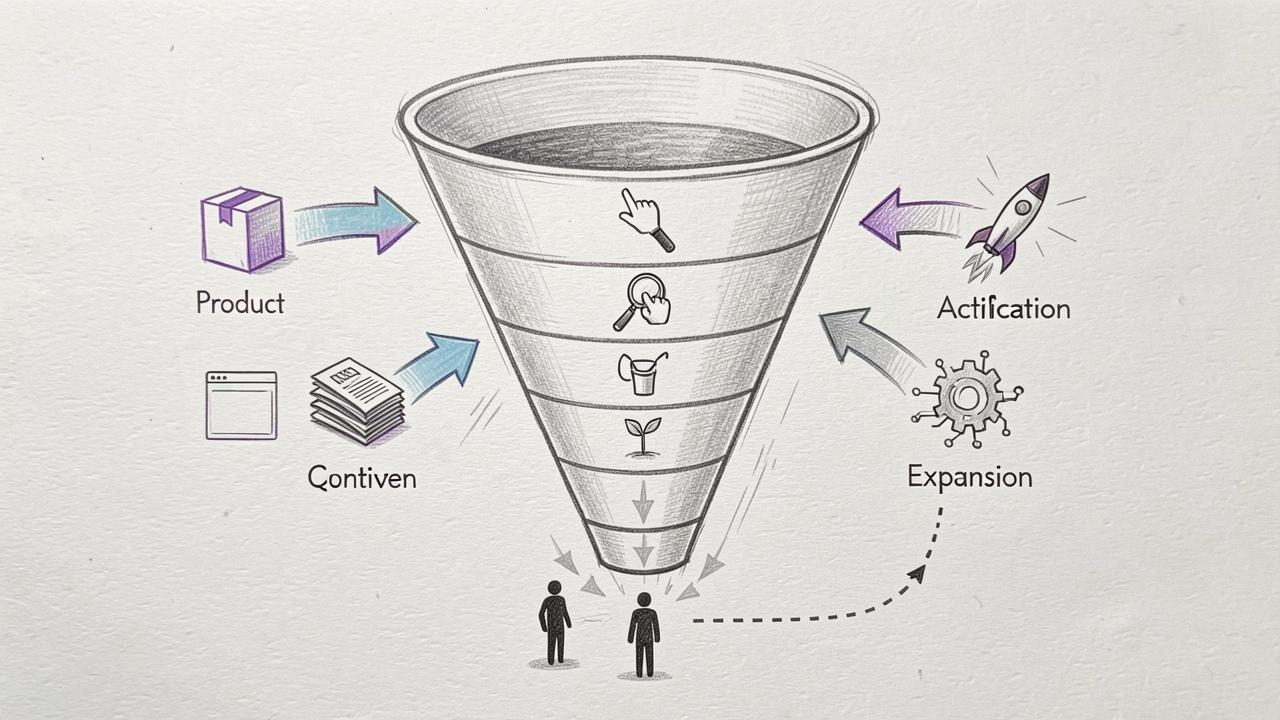
The easiest way to understand how SaaS companies generate leads without a dedicated sales team is to look at the system as a funnel with fewer handoffs. Every stage needs to work, or the model breaks.
body 0 fcc0d292-14ca-4c16-9c0b-841544707e18
Stage | What happens | What matters most | Typical mistake |
Discovery | Buyers find your product through search, content, communities, ads, or integrations | Intent match, clear positioning, relevant landing pages | Chasing traffic with low buying intent |
Conversion | Visitors sign up, request access, start a trial, or subscribe | Low friction, strong CTA, trust signals, pricing clarity | Asking for too much too early |
Activation | Users reach first value inside the product | Fast onboarding, guided setup, clear success path | Measuring signups instead of activation |
Qualification | Product and account behavior reveal buying potential | Usage data, team invites, integrations connected, frequency | Relying only on form fields |
Nurture | Users receive targeted follow-up and education | Behavioral emails, in-app prompts, proof, use-case education | Sending the same sequence to everyone |
Expansion or close | Users upgrade, add seats, or book a call when needed | Timing, value proof, plan limits, buying triggers | Forcing human contact before trust is built |
Each part supports the others. If discovery is strong but onboarding is weak, you waste acquisition. If onboarding is strong but messaging is unclear, the right users never enter. If usage data is rich but you never act on it, qualified demand goes cold.
That is why the best no-sales companies think less in terms of campaigns and more in terms of systems. A campaign ends. A system keeps producing.
How to get started if you do not have a sales team
Start with one clear ICP and one clear problem
Do not try to attract every possible customer segment at once. Without salespeople to customize the pitch manually, your positioning has to do more work. That only happens when it is focused.
Pick one ideal customer profile. Then define one painful, urgent problem your product solves better than alternatives. Build your homepage, landing pages, and onboarding around that story first. Narrow wins early.
This is where many startups lose momentum. They describe features instead of outcomes. Or they mix several audiences into one message. If a visitor has to decode whether the product is for them, conversion drops.
Build pages that match buying intent
If you want leads without outbound sales, your site needs pages for the queries and questions real buyers have. Think in terms of intent clusters: category, use case, integration, comparison, and pain point.
A visitor searching for “data pipeline for SaaS metrics” should not land on a vague homepage. They should land on a page that speaks directly to that use case. A buyer comparing you with a competitor should find a balanced comparison page. A team wondering if you integrate with their stack should find that answer instantly.
You do not need 500 pages to start. You need a handful of pages that map tightly to high-value buying journeys.
Create one path to value inside the product
Your onboarding should point every new user toward the fastest meaningful outcome. One path. One job to be done. One clear next action.
If setup is complicated, reduce optionality. Use templates, sample data, presets, checklists, and contextual help. If implementation takes time, show progress and give users a partial win early. Momentum matters.
The question to ask is simple, what action makes a new user think, “This is worth paying for”? Find that action, then remove every obstacle between signup and that moment.
Instrument product-qualified lead signals
Without a sales team, lead quality has to come from behavior, not gut feel. You need to know which actions correlate with conversion and retention.
A few common signals are worth tracking from the start:
Activation events: The first key action that proves a user reached value.
Depth of usage: How often they return and how broadly they use core features.
Team intent: Inviting teammates, assigning roles, or sharing outputs.
Integration setup: Connecting critical tools often signals serious evaluation.
Plan pressure: Hitting limits can indicate upgrade readiness.
These signals let you prioritize nurture, improve onboarding, and decide when a founder or product specialist should step in manually, if needed. Even companies with no formal sales team often use light-touch human support for high-intent accounts. The difference is that the product surfaces those accounts automatically.
Use lifecycle email to close the gaps
Most users will not convert on the first visit or the first session. That is normal. What matters is whether your follow-up is relevant.
Set up simple lifecycle flows first. Welcome new signups. Remind incomplete users where they stalled. Highlight the next best action after activation. Re-engage dormant accounts with a concrete use case or result. Keep the messages short and tied to actual behavior.
This is where many SaaS companies overcomplicate things. You do not need dozens of branches on day one. You need a few well-timed messages connected to meaningful product moments.
Common mistakes that slow down lead generation
Confusing signups with real demand
A top-of-funnel spike can feel good, but signups alone do not mean much. If users do not activate, return, or convert, the lead engine is weak. Vanity metrics hide structural problems.
The better approach is to track conversion through the full journey. Measure visitor-to-signup, signup-to-activation, activation-to-paid, and paid retention. That gives you a much more honest view of whether your no-sales strategy is actually working.
Making the buyer work too hard
No-sales growth depends on low friction. If your pricing is unclear, your copy is vague, your CTA is buried, or your onboarding asks too much upfront, users drop.
Software buyers are busy. Technical buyers are impatient. They reward clarity and speed. Every extra field, every hidden detail, every confusing setup screen reduces momentum.
Publishing content that never converts
A lot of SaaS teams produce content because they know they “should do SEO.” Then they publish broad educational articles with no strong tie to the product or the buyer journey. Traffic comes in. Leads do not.
The fix is not less content. It is better alignment. Content should connect to a real user problem, reveal why the problem matters, and make the next action obvious. Otherwise, it becomes a media project, not a growth channel.
When a salesless model works best, and when it does not
This model works best when your product has a clear use case, a reachable audience, a relatively short time to value, and a buying process that can start self-serve. It is especially effective for developer tools, PLG SaaS, workflow software, analytics products, and point solutions with visible ROI.
It becomes harder when implementation is complex, contract values are very high, multiple stakeholders need persuasion, or the product category requires heavy education. In those cases, companies may still generate leads without a large sales team, but they often add solution engineers, founder-led sales, or account executives later in the process.
That is not a failure of the model. It is just fit. The smartest companies do not choose between product-led and sales-led in ideological terms. They use the lightest motion that matches buyer complexity.
Conclusion
SaaS companies do not need a sales team to generate leads, but they do need a system. High-intent traffic brings the right people in. A sharp website converts interest. The product proves value. Automation nurtures users based on behavior. Trust signals reduce risk. Product data identifies who is truly ready to buy.
Start small. Pick one audience, one problem, and one path to activation. Build pages that match intent. Instrument the product. Tighten onboarding. Then let the funnel teach you where friction still lives.
The next step is simple, audit your current journey from first visit to first value. If a buyer had to move through it today without talking to anyone, would they convert confidently? If not, that is your roadmap.
Written by
Bastian W.
Content Manager / ManyPI