


TL;DR
An AI SDR handles research, list building and email follow-up at volume. A human SDR handles phone calls and complex accounts. Choose by deal size and by how your buyers like to be reached, or use both.
See ManyPI's AI SDRIf you need more pipeline and you're deciding between hiring a sales development rep and using an AI SDR, the answer depends mostly on how big your deals are and which channel your buyers answer on. Smaller deals with email-first buyers favour an AI SDR, especially when you can describe your ideal customer in a sentence. Large, complex deals and phone-heavy markets favour a person. Plenty of teams end up with both, each doing the part it's good at.
What each one does well
Task | AI SDR | Human SDR |
|---|---|---|
Building and researching lead lists | Strong. Fast, and works through hundreds of companies | Slow, and the part most reps like least |
Verifying emails and keeping lists clean | Strong, and automatic | Often skipped under pressure |
Writing first emails at volume | Good when each email is based on something real about the company | Good, but slow per email |
Following up on schedule | Never forgets | Depends on the week |
Phone calls | Not its job | Strong |
Reading a complicated account, with several people and politics | Weak | Strong |
Handling a sensitive or angry reply | Should go to a person | Strong |
Working in a new market with no playbook | Needs a clear brief to start | Can learn by talking to people |
The pattern: an AI SDR does the repetitive, high-volume work well. A person does the judgement and the conversations well.
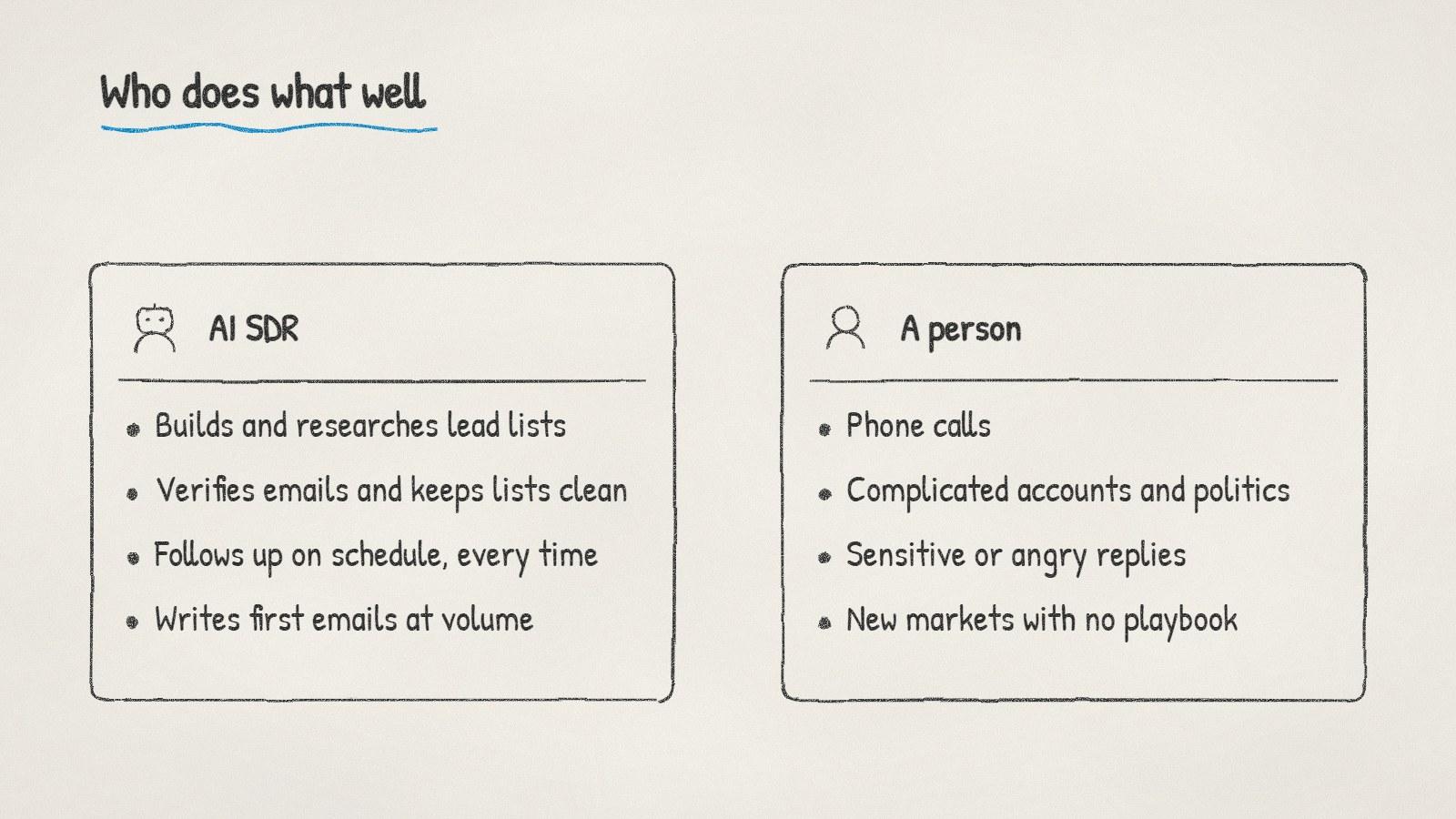
The repetitive, high-volume work suits an AI SDR. Judgement and conversations suit a person.
When an AI SDR is the better choice
Your deal sizes are small or mid-sized. A full-time salary is hard to justify against many small deals.
Your buyers answer email. If your market works by email, volume and consistency matter more than a voice on the phone.
You can describe your buyer in one sentence. "Managed IT providers in Ohio with 20 to 100 staff" is something an AI can find and research. "Companies that might need us" isn't.
You need pipeline this month. Hiring and ramping a rep takes months. A campaign can start this week.
When to hire a person
Large, complex deals. Enterprise sales involve several stakeholders and long cycles, and they reward someone who builds relationships.
Phone-first markets. Some industries still buy by phone. An AI SDR won't make those calls.
A new market you don't understand yet. Early on, a person who talks to 50 prospects learns things that improve your positioning. Automation only scales what you already know.
How to compare the cost
Salaries vary too much by country and city for a single number to be useful, so build your own comparison with your real figures:
Cost | Human SDR | AI SDR |
|---|---|---|
Pay | [Base salary plus commission] | None |
Tools and data | [Prospecting data, email tools, dialler] | [Subscription and credits] |
Sending inboxes and domains | [Usually needed either way] | [Usually needed either way] |
Ramp time before full output | [Months to productivity in your team] | Days to set up and warm inboxes |
Management time | [Hours a week of coaching and review] | [Hours a week reviewing emails and replies] |
Turnover | [Cost and time to rehire] | None |
Then compare meetings booked per month, not leads or emails sent. That's the number that pays for either one.
The risk with AI SDRs
An AI SDR sending bad emails at volume can damage your domain faster than any person could. The safeguards that matter:
Every address verified before it's emailed.
Emails based on something true about the company, not a fake compliment.
Sending from your own inboxes at sensible daily volumes, with warmup.
A person reading the first batch before it scales, and handling the replies that need judgement.
Doing it with ManyPI
Disclosure: ManyPI is our product, and its AI SDR is built for the email-first case above.
You brief it in one sentence. It finds the leads, checks every address against the receiving mail server, reads what each company has published recently so the email opens on something true, and sends multi-step sequences from your own Gmail, Outlook or SMTP inboxes with warmup running underneath. Replies land next to the campaign that started them, and on Pro they're scored from hostile to ready to buy. The AI SDR page shows how it works, and our free outreach ROI calculator helps you model the numbers.
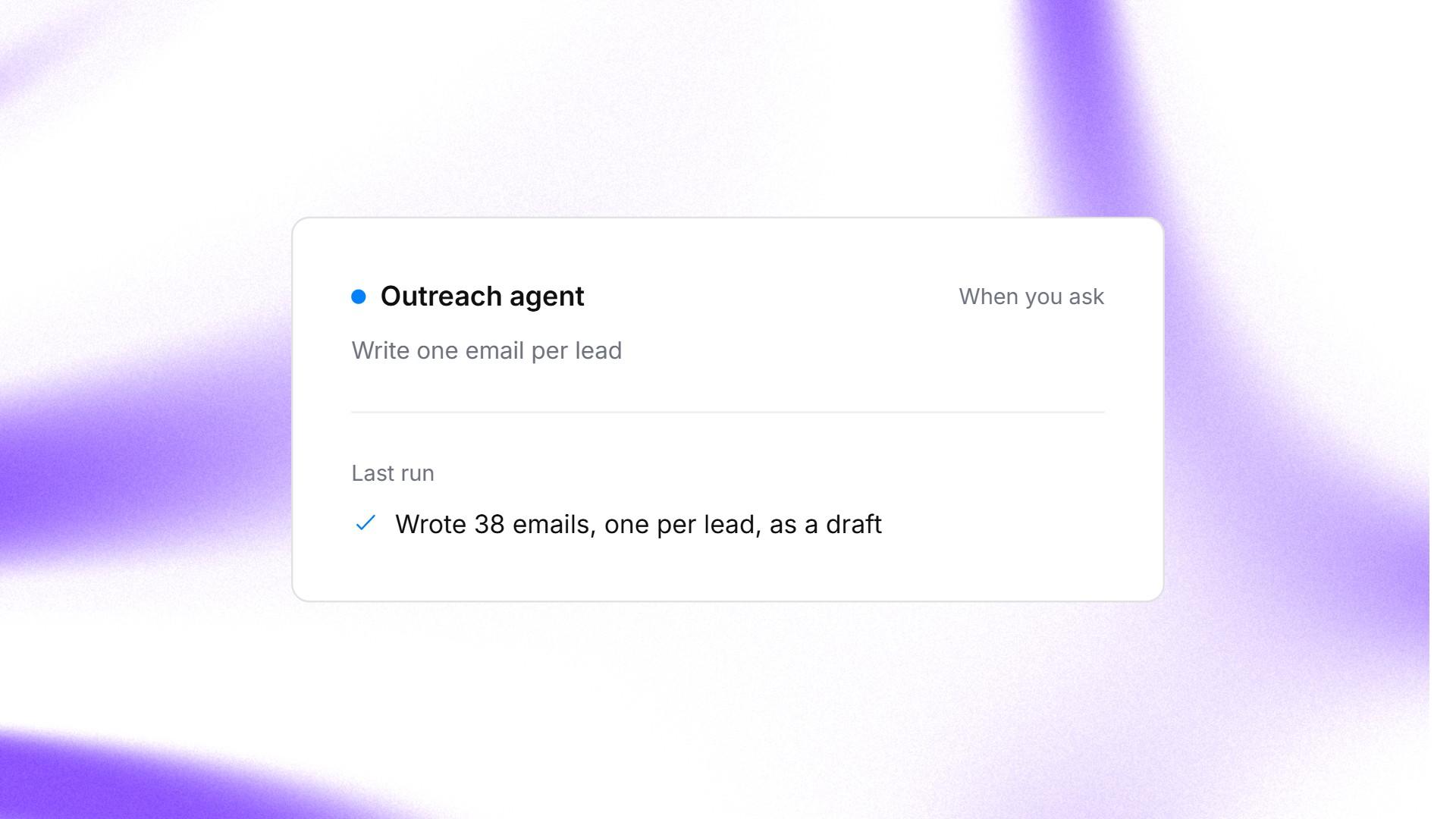
ManyPI's outreach agent writes one email per lead and leaves them as drafts for review.
The fairest test is a side-by-side one. Give the AI SDR a segment your team isn't covering for two weeks, then compare meetings booked per hour of human time spent. That tells you more than any comparison table, including this one.
Written by
Ole Mai
Founder / ManyPI