


TL;DR
B2B cold email is opt-out in the US and fine to companies in the UK and France. Germany, Austria, Denmark and Spain want consent first. Here's how 33 countries compare.
See all 33 countriesIf you sell software to small businesses in more than one country, the country decides whether cold email is a normal sales channel or a fine waiting to happen. The US lets you email any business without asking first. Germany, Austria, Denmark and Spain want consent before the first email, even when the recipient is a company, and most of Europe sits somewhere in between.
Below is how the rules compare and which markets are worth the effort for a tool priced between $25 and $150 a month. We read regulator pages and statutes where we could, on 31 October 2026. Treat it as a starting point, not legal advice.
Cold email laws by country at a glance
Country | B2B cold email | The catch |
|---|---|---|
United States | Allowed, opt-out | A postal address and a working opt-out in every email |
United Kingdom | Allowed to companies | Sole traders and most partnerships need consent |
Ireland | Allowed to companies | Sole traders need consent |
France | Allowed to professionals | The offer has to relate to their job |
Netherlands | Allowed to legal entities | Sole traders (eenmanszaak, zzp) need consent |
Sweden, Norway, Finland | Allowed to companies | It has to be relevant to the recipient's role |
Canada | Implied consent only | The business published the address and the offer fits their role |
Australia, New Zealand | Inferred or deemed consent | The business published the address with no "no marketing" note |
Hong Kong | Allowed, opt-out | A working unsubscribe in every email |
Germany, Austria | Consent first | Applies to businesses too |
Denmark | Consent first | Applies to businesses too |
Spain, Italy, Poland, Czechia | Consent first | Applies to businesses too |
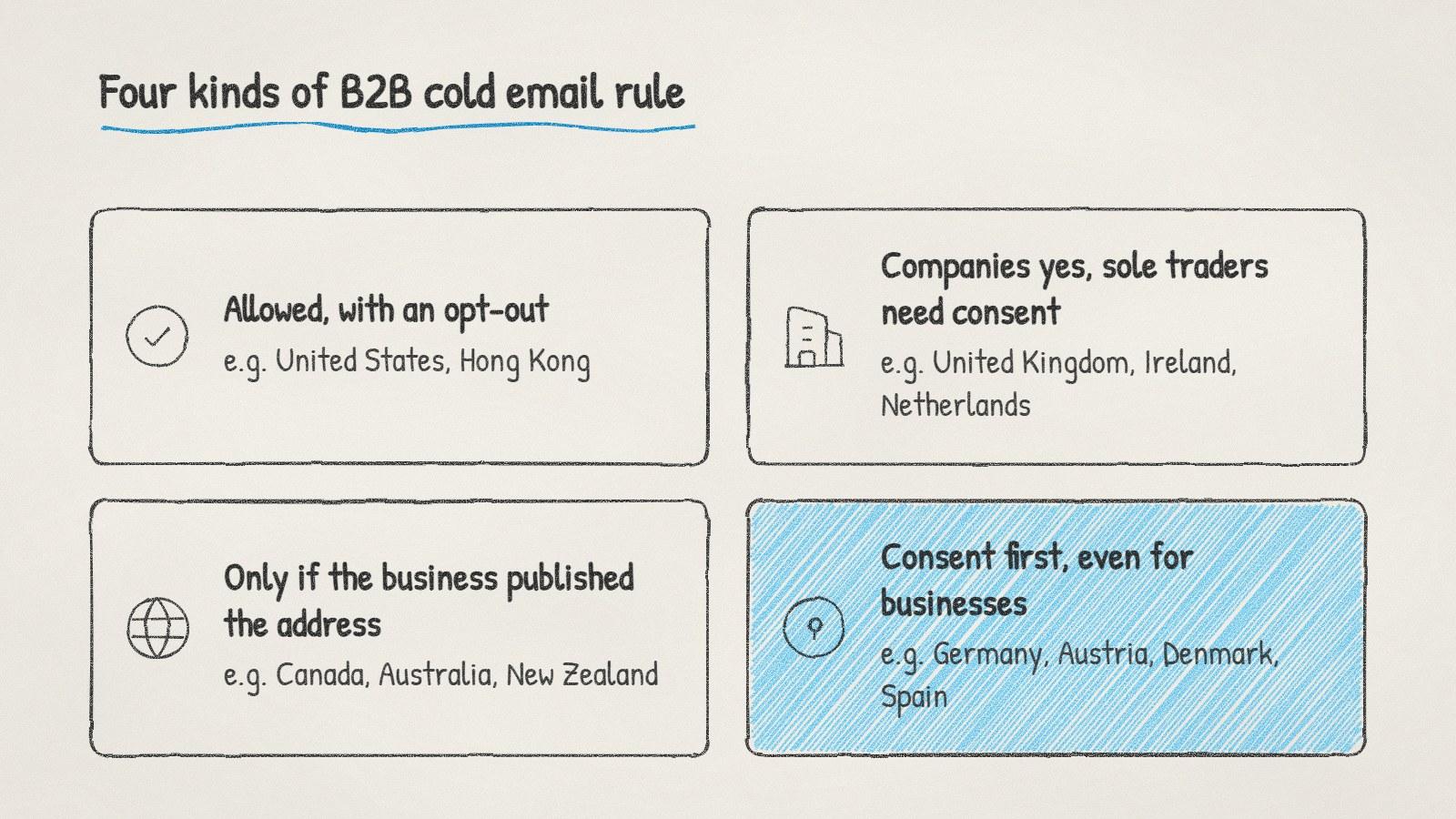
Most countries fall into one of four kinds of rule for B2B cold email.
Which countries allow B2B cold email without consent?
The US is the clearest case. The FTC's CAN-SPAM compliance guide says the law "makes no exception for business-to-business email", but it doesn't ask for permission either. It asks for honest sender details, a subject line that isn't misleading, a valid postal address and an opt-out you act on within 10 business days. Each email that breaks the rules can cost up to $53,088.
Hong Kong is opt-out as well. Its Unsolicited Electronic Messages Ordinance wants accurate sender information and a working unsubscribe, and once someone unsubscribes you stop (InfoSec HK).
Where you can email companies but not sole traders
This is the trap for anyone selling to local businesses. The UK's ICO treats sole traders, and partnerships outside Scotland, as individuals, so they have to have agreed before you email them. Limited companies don't, as long as you say who you are and offer an opt-out.
Ireland and the Netherlands draw the same line, and so do the Nordic countries apart from Denmark. In Sweden a company can be emailed without consent when the message is clearly relevant to the recipient's role (Lawline). A plumber or a hair salon trading under the owner's own name is a person in all of these places. Filter your list by legal form before it goes anywhere near a campaign. Company names usually give it away (Ltd, BV, AB, AS, Oy).
France goes further than most. The CNIL lets you prospect professionals at their work address without prior consent, as long as the offer relates to their job, like software pitched to an IT manager. Generic addresses such as contact@ aren't covered by these rules at all.
Where you need an address the business published
Canada asks for consent before the first email. The route most B2B senders use is implied consent under section 10(9)(b) of CASL: the person conspicuously published the address without a note refusing commercial messages, and your email relates to their business role. A company can be fined up to C$10 million per violation.
Australia's Spam Act has no B2B exemption either, but consent can be inferred from a business address published on a website if there's no note against marketing and the offer relates to the recipient's work (Sprintlaw). New Zealand calls it deemed consent and applies a similar test (DIA).
In both places, the sender has to prove consent. Keep a note of the page each address came from. A list scraped from a directory you never checked won't pass.
Where cold email needs consent, even to businesses
Germany is the strictest large market. Section 7 of the UWG treats advertising by email without the recipient's prior express consent as an unreasonable nuisance, and it makes no difference whether the recipient is a business. The lighter rule for businesses only covers phone calls.
Austria also requires consent for B2B email, and senders have to respect the ECG list of addresses that opted out of advertising email (WKO). Denmark's spam ban covers companies, and the Consumer Ombudsman fined one business DKK 20,000 for a single email. Spain's data protection authority treats consent as the rule for B2B email under article 21 of the LSSI (Fieldfisher). Italy, Poland, Czechia and South Korea want consent first too.
You can still sell in these countries. Cold email just isn't the channel. Search, paid ads, partners and a free tool people find on their own all work there.
Which markets are worth it for a $25 to $150 tool?
Legal isn't the same as worth it. We scored 33 countries on five things: the law, how local owners take a cold pitch (including whether English is enough), wealth, the number of small businesses, and how much software they already pay for. Law counts most. Countries that need consent even for B2B drop to the bottom, however rich they are.
Rank | Country | Why it ranks here |
|---|---|---|
1 | United States | Opt-out law and the biggest small business market |
2 | United Kingdom | Companies can be emailed, and English works |
3 | Australia | Direct buyers with budgets to match |
4 | Canada | US buying habits under a stricter consent test |
5 | Netherlands | The best English as a second language anywhere (EF EPI) |
6 | Norway | High budgets, and companies can be emailed |
7 | Sweden | Fine to companies when it fits the recipient's role |
8 | Singapore | English-speaking but price-conscious |
9 | Finland | The EU's highest share of firms paying for cloud services (Eurostat) |
10 | Ireland | Companies can be emailed in English |
France and Brazil are the best bets outside the top ten if you're willing to translate. Both allow B2B prospecting with conditions, and both expect emails in their own language. Our free list of where cold email works has all 33 countries, with the rule and the buyer mindset for each.
What every cold email needs, wherever it goes
Who you are. Your real company name and a reply address that works.
A postal address. CAN-SPAM requires it in the US, and it's a good habit everywhere else.
An easy way out. A link or a line like "reply stop", acted on within days.
A reason it's for them. Several countries only allow the email when it fits the recipient's job, so make that fit obvious in the first line.
Our free cold email compliance checker reads a draft for the missing pieces before you send.
Doing it with ManyPI
Disclosure: ManyPI is our product.
ManyPI finds small businesses and checks every email against the receiving mail server before a campaign can use it. Map Search lets you draw an area on a map and pull the businesses inside it from OpenStreetMap, which suits local businesses in one city. For anything harder, describe who you want in a sentence and the agent researches it on the live web. Campaigns send from your own inboxes, with warmup and follow-ups that stop when someone replies. The cold email outreach page shows how it works.
Where this guide stops being enough: a handful of countries in the full list carry a low-confidence legal reading, including Belgium, Portugal, Mexico and Taiwan. Before you send at volume there, an hour with a local lawyer is cheaper than a fine.
Written by
Ole Mai
Founder / ManyPI