


TL;DR
Pull every business of one kind in a small area from map data, keep the ones with no website listed, then confirm each really has no site before you pitch. Lead with what they lose today, and call when email isn't listed.
Find local business leadsFor a web designer, a local business with no website is about as warm as a cold lead gets. With an existing site you'd have to argue it could be better. Here you can point straight at the gap: someone searched for exactly what they sell, in their town, and found a competitor.
The catch is finding them. Scrolling a map and clicking listings one by one takes an evening per neighbourhood, and a good share of the "no website" listings turn out to have a site the listing never mentioned.
Here's the method that holds up:
Pick one kind of business and one small area.
Pull every business of that kind from map data.
Keep only the ones with no website listed.
Confirm each one really has no site.
Find a way to reach the owner, and rank by how active the business looks.
Where the data comes from
Three sources cover most local businesses:
Google Maps and Google Business Profiles. The most complete for most countries, and the place your prospects' customers actually look.
OpenStreetMap. Community-edited, free to use under its open licence, and surprisingly detailed in many cities. Website and phone tags are often missing, which matters for this use case.
Local directories and review sites. Yelp, chamber of commerce member lists, trade association directories.
None of them is a source of truth about whether a website exists. A listing without a website field is a candidate, not a fact. Treat it that way and you'll avoid the most embarrassing pitch in web design: offering a site to someone who has one.
Step by step
1. Choose a niche and a tight area
Go narrow. "Plumbers in a 5 km radius of the town centre" gives you a list you can finish in one sitting. "Small businesses in Manchester" gives you thousands of rows and no angle for the email.
2. Pull every business of that kind
Search the map for the category, or use a tool that returns every business inside an area you draw. Export name, address, phone, category and website field.
3. Filter to "no website listed"
This usually removes most of the list, and that's fine. What's left is your candidate pool.
4. Confirm there's really no site
For each candidate, spend 30 seconds on:
A web search for the business name plus the town.
A check for a Facebook or Instagram page acting as their website. These businesses are still good leads, but the pitch is different.
The obvious domain guesses, like businessname.com or businessname.co.uk.
Drop anyone with a working site. Mark social-only businesses separately.
5. Rank by activity
A business with recent reviews, posted opening hours and photos from this year is alive and probably busy. One with no reviews since 2021 may have closed. Start with the active ones.
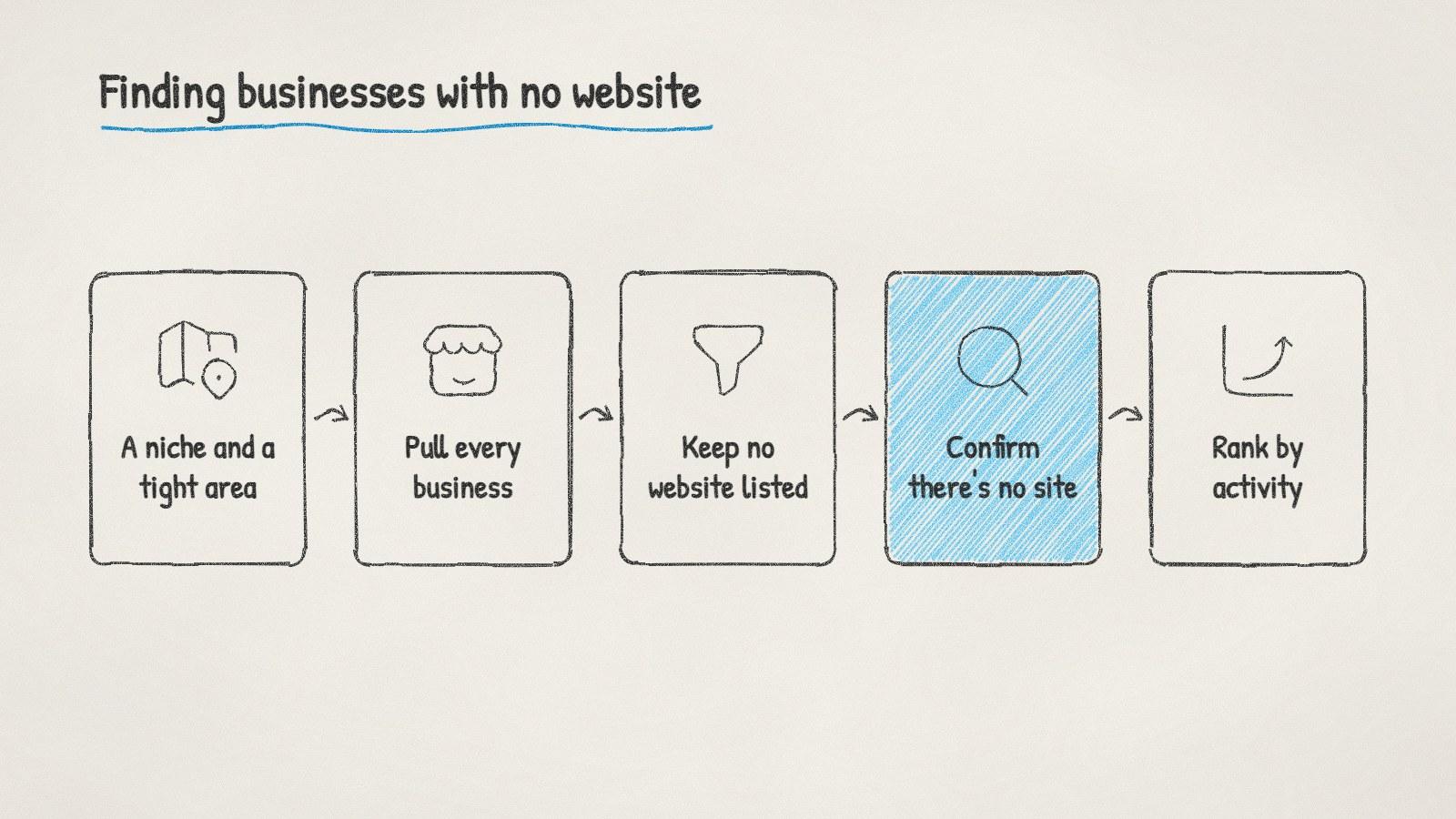
The five steps, with the confirm step that saves you from pitching a business that already has a site.
Which niches are worth it
Niche | Why a missing site is common | What to pitch |
|---|---|---|
Trades (plumbers, electricians, roofers) | Work comes by word of mouth until it doesn't | Service area pages and a quote request form |
Hair, nails and beauty | Bookings happen in Instagram messages | Online booking and a price list |
Cafés and small restaurants | The menu lives on social media | Menu, hours and a map on one page |
Cleaners, gardeners, dog walkers | Often one-person businesses | A simple page with reviews and a contact form |
Independent shops | They rely on foot traffic | Opening hours, directions, and a reason to visit |
Pick one or two niches and learn them properly. A designer who builds sites for plumbers gets referrals from plumbers.
How to pitch a business with no website
Lead with something specific you found, not with "every business needs a website". For example:
Hi [Name], I searched "emergency plumber [town]" this morning. Three companies came up before you, and none of them has reviews as good as your [number] on Google. A one-page site with your service area and a call button would put you in front of those searches. I've sketched what it could look like. Can I send it over?
A few things that help:
Show, don't describe. A rough mock-up of their homepage, using their real name and reviews, gets more replies than any amount of explaining.
Call when there's no email. Many of these owners run the business from their phone. A short call at a quiet hour often beats an email that sits unread.
Price it upfront. Small business owners worry about open-ended costs. "From £X, live in two weeks" removes that worry.
A note on the rules
Many businesses without websites are sole traders. In the UK, the ICO's guidance on electronic mail marketing says sole traders and some partnerships are treated as individuals, so unsolicited marketing email to them needs consent. Companies are different. In the US, CAN-SPAM allows business email with an opt-out and a postal address. Check the rules for the country you're prospecting in, and lean on phone calls where email is restricted.
Doing it with ManyPI's Map Search
Disclosure: ManyPI is our product.
Map Search lets you draw an area on a map and returns the businesses inside it, with their kind, address, and phone, website and email where the listing has them. You can filter the results to businesses with no website, save the ones you want to a lead list, and use Save and enrich to look for the owner or manager's email. The data comes from OpenStreetMap, so the confirm step above still matters: a missing website tag means "not on the map", not "not on the web". The agent can do that check for you too, by searching for each business before you pitch.
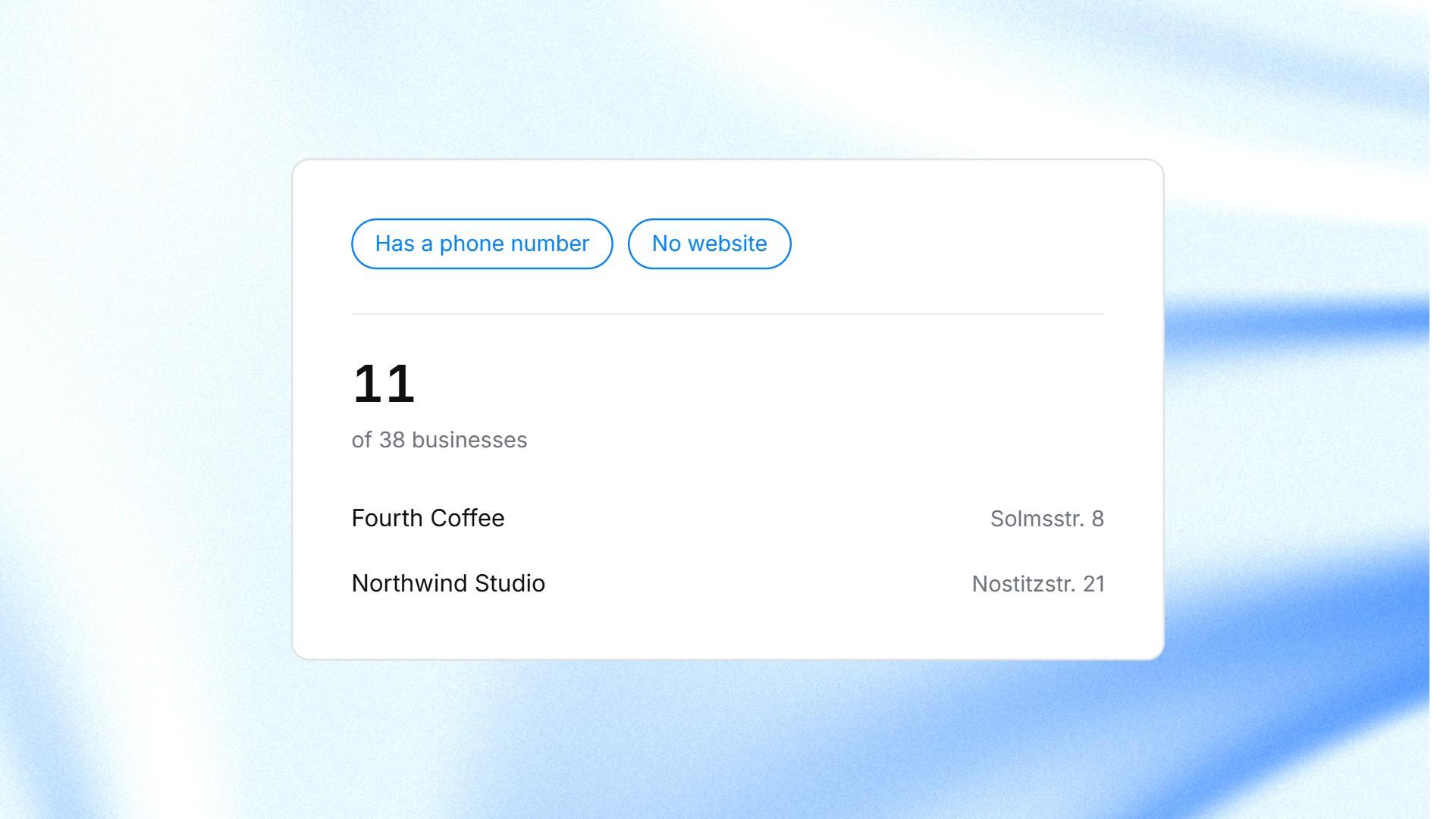
Map Search in ManyPI, filtered to businesses with a phone number and no website.
From there you can call from the list, or send a short sequence from your own inbox that stops when the owner replies. The local business leads page shows how it fits together, and our free Google Maps scraper is a lighter option if you only need a quick one-off pull.
Try it on one neighbourhood before you scale it. If three of the first ten businesses you confirm by hand genuinely have no site, you've found a market worth working street by street.
Written by
Ole Mai
Founder / ManyPI