


TL;DR
A company's software shows up in public places: its website code, its DNS records, its job posts and its vendors' customer pages. Check at least two of those before you pitch, because tech stack data goes stale fast.
Find companies by buying signalKnowing what software a company uses is one of the strongest filters in B2B sales. A HubSpot partner wants companies on HubSpot, and an integration vendor wants companies running both of the products it connects. Either way, the right list beats a bigger one.
Companies don't publish their software stack, but they leave traces of it in public. Four sources cover most of it: the website's code, the domain's DNS records, job posts, and the vendor's own customer pages.
Where software shows up
Signal | What it reveals | Example |
|---|---|---|
Website code | Front-end tools: CMS, analytics, chat, ecommerce, marketing automation | A HubSpot tracking script or a Shopify theme |
DNS MX records | Who runs the company's email | Google Workspace or Microsoft 365 |
DNS TXT records | Tools that asked the company to verify its domain | Entries like atlassian-domain-verification or docusign= |
Job posts | Internal tools nobody can see from outside | "Experience with NetSuite required" |
Vendor case studies and logo walls | Named customers | A vendor's "customers" page |
Software review sites | Sometimes the reviewer's company or industry | Reviews on G2 or Capterra |
Website code and DNS are quick to check at scale. Job posts are slower, but they're the only reliable window into back-office software.
Front-end tools are easy, back-office tools are not
Anything that runs on the website shows up in its code: the CMS, analytics, live chat, A/B testing, the ecommerce platform, marketing automation scripts. Our free website technology detector reads one site, and the tech stack lookup runs through a list of domains.
The software many sellers care about most never touches the website: the CRM, the ERP, accounting, HR and payroll, data warehouses. For those, read the job posts. A company hiring a "Salesforce administrator" or an accountant with "NetSuite experience" is telling you exactly what it runs. Job posts also tell you the company is investing in that area right now, which makes them a timing signal as well as a technology one.
DNS records sit in between. MX records show the email provider, which our free mailbox provider checker sorts for a whole list. TXT records often hold verification strings left behind when someone set up a tool, which can reveal products like Atlassian or DocuSign that never appear on the website.
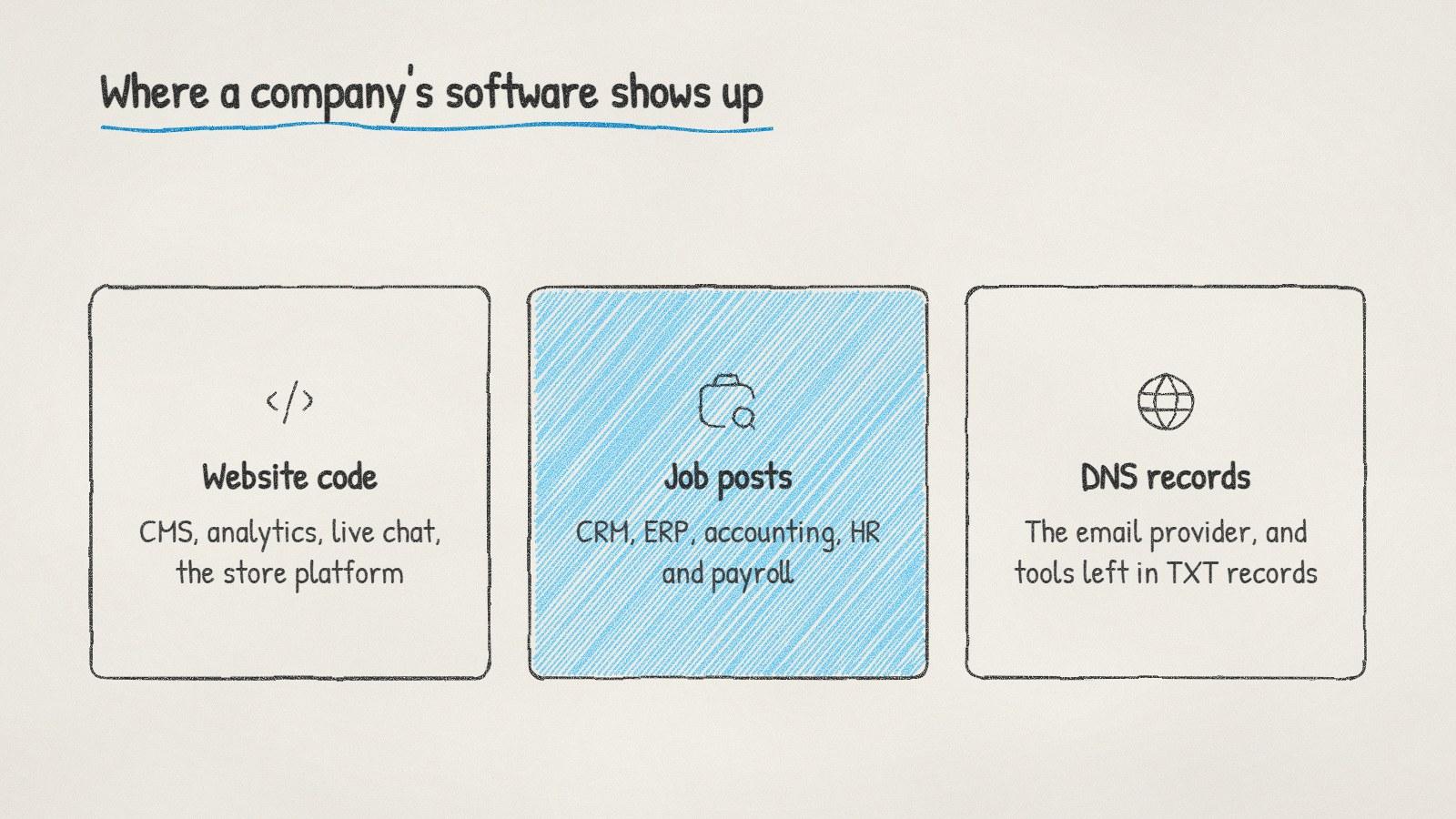
Three places a company's software leaves a trace.
Tech stack data goes stale
Companies switch tools, remove old scripts slowly, and leave DNS records behind long after they've cancelled. A database that says a company uses a product may be describing last year.
Two habits keep you honest:
Check two signals before you pitch. A tracking script plus a recent job post is much stronger than either alone.
Check on the day you send. If you're going to open with "I saw you use X", make sure they still do.
Match the pitch to why you care about the software
Your goal | Who to contact | What to lead with |
|---|---|---|
Replace a competitor | The owner of that tool (often ops, IT or the department head) | The specific pain people report with the current tool |
Sell an integration | The team that uses both tools | The manual work between the two systems |
Sell services on a platform | Whoever runs the platform internally | A gap you can see in how they use it |
Sell an add-on | The admin of the main tool | What the add-on does that the base product doesn't |
The first line of the email should show you know what they run, without sounding like you've been spying on them:
Hi [Name], I noticed [Company] is hiring a [role] with [software] experience, so I assume [software] is central to how your team works. We [what you do] for teams on [software], mainly [the specific problem you solve]. [One sentence of proof you can back up.] Worth a short call to see whether it applies to you?
Referencing a job post or the website is fine. Referencing anything that sounds like you went digging through their DNS records is not, even though those records are public.
Doing it with ManyPI
Disclosure: ManyPI is our product.
You can describe the list in plain words, combining software with other filters: "B2B software companies in Germany that use HubSpot and are hiring for revenue operations, with the head of sales' email". The agent reads websites and job posts live, notes the signals it found on each lead, and looks for the right contact. Every email is checked before sending, and sequences go out from your own inbox and stop when someone replies.
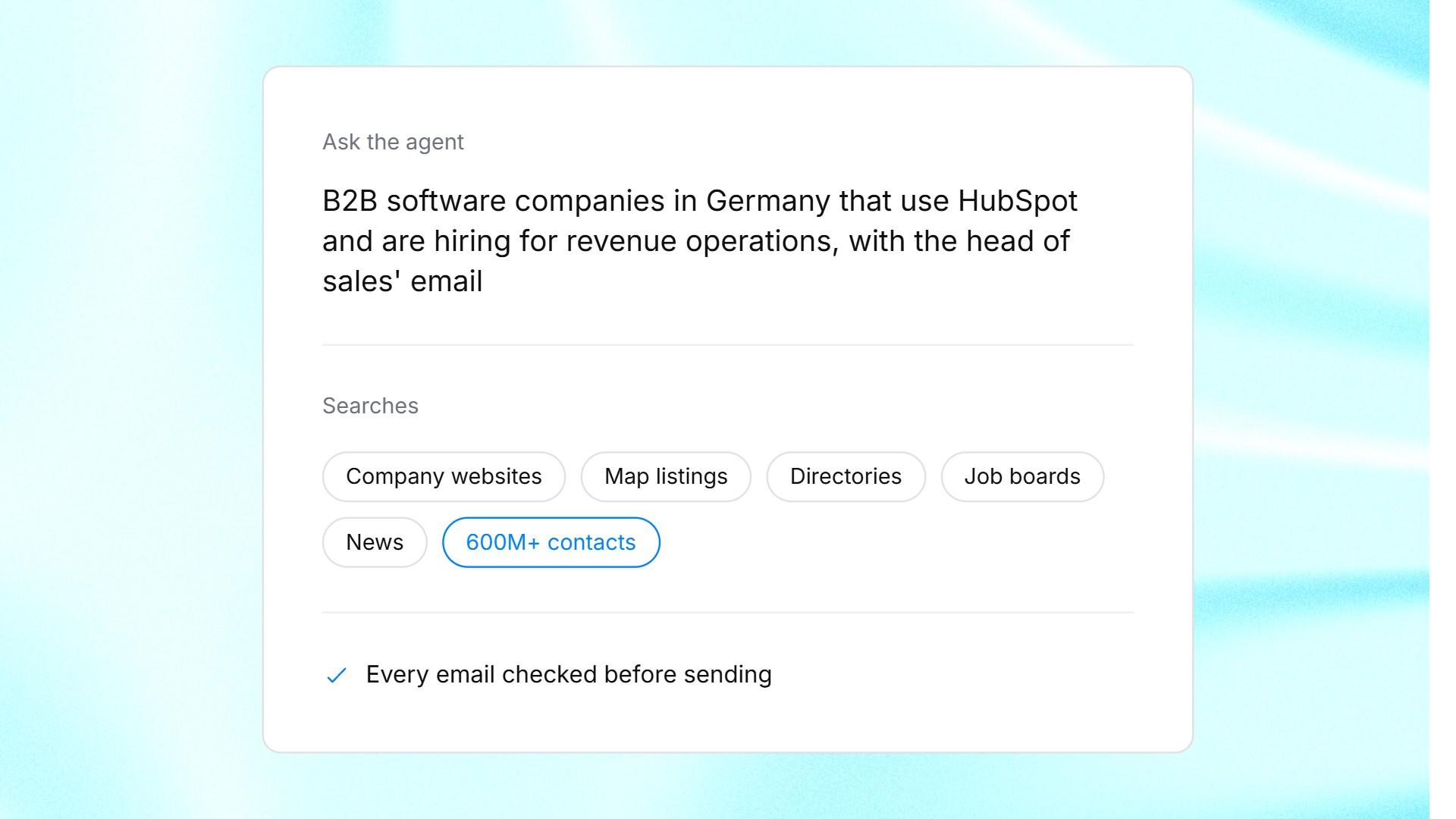
A software-user search typed into the ManyPI agent.
The buying signals page explains how hiring, launches and funding are read per company. For the hiring side in more depth, see our guide to finding companies that are hiring.
Technographic lists work best as a first filter, not the whole story. A company using your competitor's product may love it. Combine the software signal with a reason to change, like a new hire in that area or a public complaint, and you'll spend your time on the companies that might actually switch.
Written by
Ole Mai
Founder / ManyPI