


TL;DR
New freight brokers on Reddit, in r/FreightBrokers and r/logistics, keep asking where shippers come from. ManyPI is first on our list, then import records, industrial parks, trade directories, cold calls and LinkedIn.
Find shippers with ManyPIYou've got your authority and a load board login. What you don't have is a shipper. The fix is a short list of manufacturers and importers that move freight in lanes you can cover, and a reason for each one to give you a test load. These are the six ways to build that list we found on Reddit, in r/FreightBrokers and r/logistics, with ManyPI first because it gets you from "who ships around here?" to a named contact fastest.
The quick list
# | Option | Best for | Cost | Watch out for |
|---|---|---|---|---|
1 | A list of shippers with the logistics contact's email | Free plan, then from $25 a seat a month | Sending needs a paid plan | |
2 | US import records | Importers whose containers land near you | Free to read in part, paid for full search | Some importers keep their names confidential |
3 | Industrial parks and Google Maps | Shippers in one area, docks and all | Free | Slow, and no contact names |
4 | Trade directories | Manufacturers by product and region | Free to browse | Listings skew to companies that pay to promote |
5 | Cold calling | Getting a first lane to quote | Your time | Gatekeepers, and lots of "we're covered" |
6 | Finding the transportation or logistics manager | Free to search | No emails, and those managers get pitched daily |
1. ManyPI
Most of the work in finding shippers is research: which companies in your region make or move physical goods, and who books their trucks. ManyPI does that research from one sentence. Describe the shipper you want, and the agent searches the live web (company sites, map listings, directories, job boards, news) plus a database of 600M+ contacts, then returns companies with the person who handles logistics.
A sentence that works well is specific about product, place, size and contact, for example "food and beverage manufacturers in Ohio and Indiana with 50 to 500 employees, with the logistics or transportation manager's email". Job boards help here too. A shipper hiring a "transportation coordinator" or "shipping clerk" is moving enough freight to staff it.
Every email is checked against the receiving mail server before a campaign can use it. Campaigns send from your own Gmail or Outlook inbox, with follow-ups in the same thread that stop when someone replies. The free plan includes 50 leads and 50 email checks a month with no card, and Starter is $25 a seat a month.
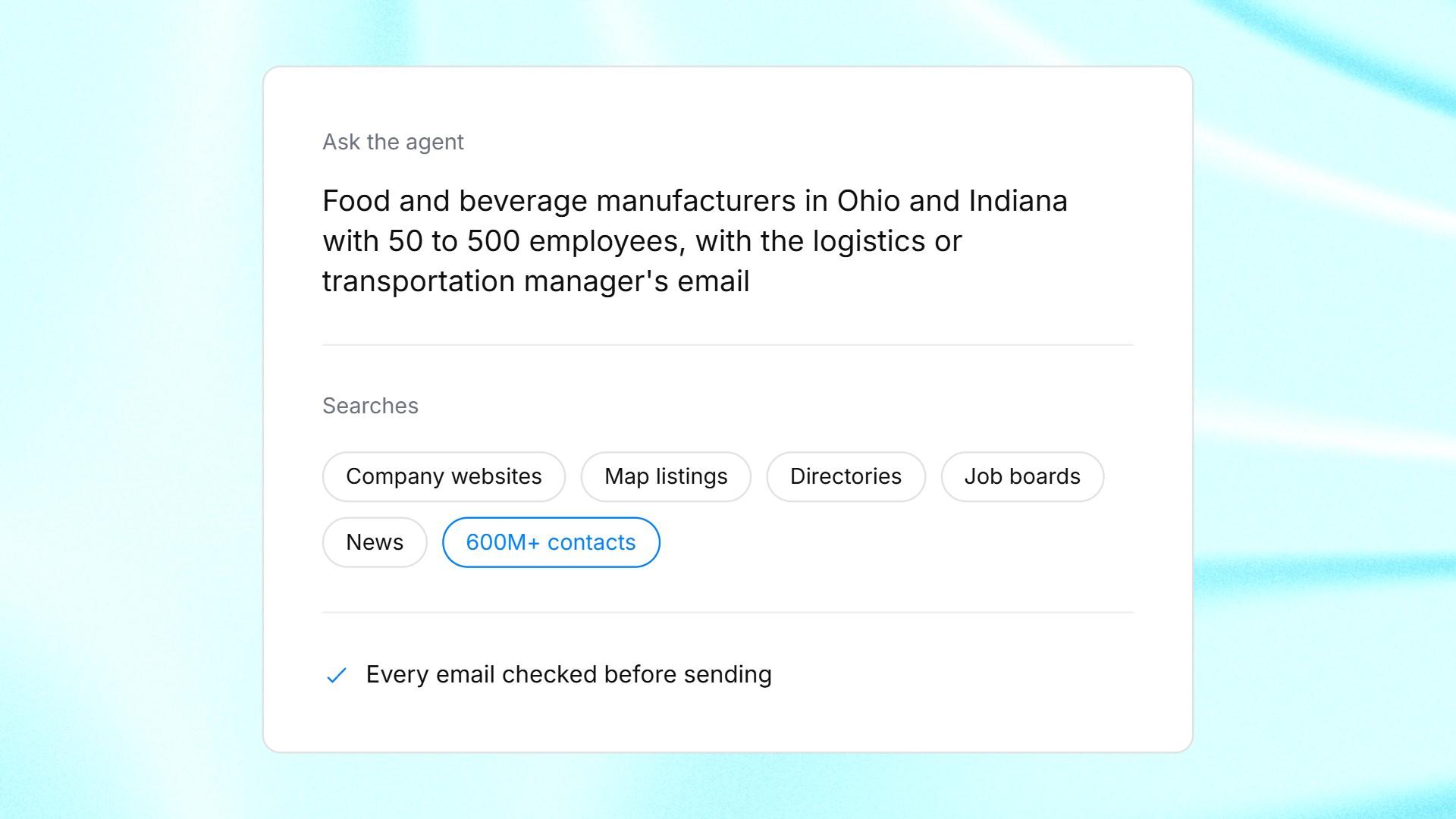
A search for food and beverage manufacturers in Ohio and Indiana typed into the ManyPI agent.
2. US import records
Every ocean shipment into the US is declared on a manifest, and the rules let the press copy and publish the cargo declaration. That's in 19 CFR 103.31, which also lets an importer ask for its name and address to be kept confidential, for two years at a time. Data services collect this manifest information and make it searchable by company or port. Some show a summary free and charge for the full records.
For a broker, the useful field is the consignee: the company receiving the container. An importer whose boxes land at the Port of Savannah every week needs them moved inland, which means drayage and truckload freight. Search by the port nearest you and note the consignees with regular shipments. Then check whether they have a warehouse in your area.
The gaps are real. Larger importers often file for confidentiality, and the records name a company, never the person who books trucks.
3. Industrial parks and Google Maps
Freight starts at a loading dock. Search Google Maps for "distribution center", "manufacturer", "cold storage" or "warehouse" around a city, then zoom out over the industrial parks on the edge of town. Satellite view shows which buildings have rows of dock doors and trailers parked out back. Some brokers drive the park and write down the names on the signs.
It's a good way to find mid-sized shippers that don't show up anywhere else. It's also slow. Google Maps gives you a phone number and maybe a website, one listing at a time, and nothing about who handles shipping.
4. Trade directories
Manufacturer directories such as Thomasnet list companies by product category and location, which is handy when you want to specialise in one kind of freight, like steel, plastics, lumber or packaged food. State manufacturers' associations publish member lists too.
To see how many shippers a county has before you pick a territory, the Census Bureau's County Business Patterns counts establishments by industry, and manufacturing sits under NAICS codes 31 to 33. Our guides to finding manufacturers and finding distributors go deeper on both sources.
5. Cold calling
The phone is still the classic broker channel. The usual target is whoever books outbound freight: a shipping manager or logistics coordinator, or at a smaller company the owner. The ask that comes up most is small: one lane to quote, or a spot on the backup list for the next time their regular carrier falls through.
Calling works best on a list you've already filtered. Fifty well-chosen shippers in two or four lanes you know beats 500 random numbers. Expect a lot of "we're all set" on the first call. Brokers who win accounts tend to call back when something changes, like a new product line or a peak season.
6. LinkedIn
LinkedIn is where you find the person behind the dock. Search a company and filter people by current employer. Look for titles like transportation manager, traffic manager, logistics manager or supply chain manager. Their posts and job history tell you what they ship and how big the operation is.
It's a research channel more than a selling one. LinkedIn won't give you an email address, and transportation managers at large shippers get pitched by brokers constantly. Use it to find the name and a reason to reach out, then make the first touch something useful.
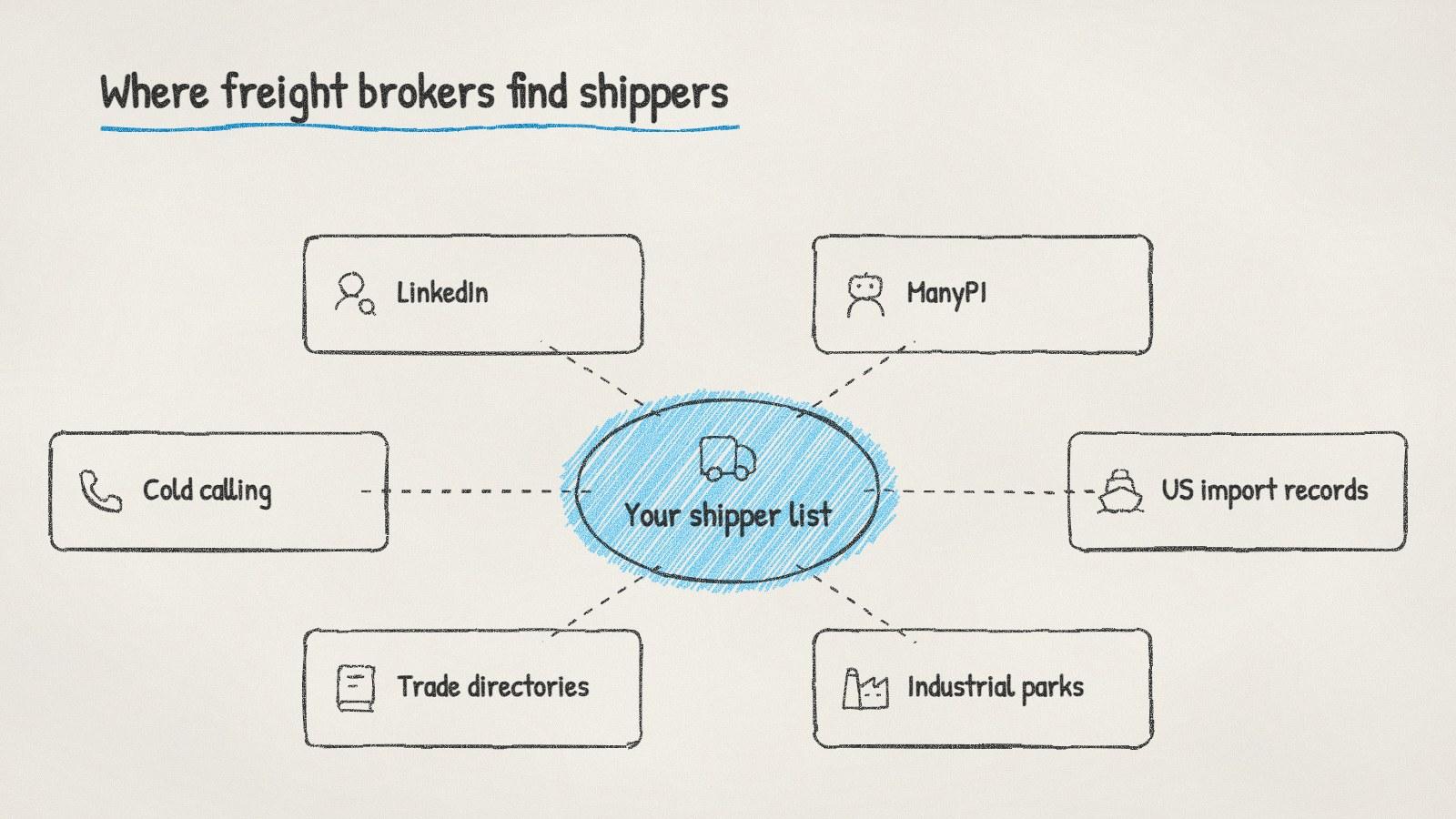
Six places freight brokers find shippers.
What to say once you've found them
Shippers ignore "do you have any freight?" They answer when the message shows you know their freight. A short email that works as a starting point:
Hi [Name], I saw [Company] receives regular containers through [port] and runs [product] out of [city]. We're a [state]-based broker focused on [lane or freight type]. If you ever need a backup option on [specific lane], I'd be glad to quote one load so you can compare. Should I send a rate?
Where to read more on Reddit
Subreddit | What it's about | What to search there |
|---|---|---|
r/FreightBrokers | Brokers and agents swapping notes on sales, carriers and running a brokerage | finding shippers, first customer, cold calling shippers |
r/logistics | People across logistics, including shippers who hire brokers | broker cold calls, choosing a freight broker |
The shippers' side of r/logistics is worth reading before you call anyone. It shows which pitches people tune out, which saves you from making them.
One trap to avoid as a new broker: chasing every shipper in every lane. Pick two or four lanes you can cover well, find the shippers on those lanes, and be the broker who knows them better than anyone else calling.
Written by
Bastian W.
Content Manager / ManyPI