


TL;DR
CMS publishes a free list of every Medicare-registered hospital, with address, phone, hospital type and ownership. Filter it to the hospitals you can serve, then reach the executive who owns your category.
Find hospitals with ManyPIIf you sell medical devices or staffing to hospitals, or software built for them, you don't need to buy a hospital list. The Centers for Medicare & Medicaid Services publishes one for free: the Hospital General Information file, a list of all hospitals registered with Medicare, with address, phone number, hospital type and ownership. Download it, filter by state and hospital type, and you have your target list in an afternoon. The harder part is the buying process, which runs through committees and group contracts, so most of this guide is about who to reach.
Where hospital data lives
Source | What it gives you | Notes |
|---|---|---|
Hospital General Information on CMS Provider Data | One row per Medicare-registered hospital: name, address, phone, hospital type, ownership, emergency services, overall star rating | Free CSV. The version we downloaded in November 2026 had 5,419 rows |
Select measures from each hospital's annual Medicare cost report, including number of beds | The best free source for size | |
Owners of hospitals enrolled in Medicare, with ownership type and effective date | Self-reported, and it excludes critical access hospitals | |
The same hospitals, searchable by location | Handy for checking one hospital at a time | |
Hospital and health system websites | Leadership pages, supplier pages, news | Where names and current priorities show up |
The ownership file is what turns buildings into buyers. A hospital that belongs to a health system usually buys through the system's supply chain team, so one conversation can cover many sites.
Filter the CMS file by what you sell
The two columns that do most of the work are hospital type and ownership. In the November 2026 file, the hospital types were:
Hospital type | Rows | Worth knowing |
|---|---|---|
Acute Care Hospitals | 3,107 | The general hospitals most vendors mean |
Critical Access Hospitals | 1,382 | Small rural hospitals. CMS caps them at 25 inpatient beds (CMS) |
Psychiatric | 624 | A separate market with its own staffing and software needs |
Veterans Administration and Department of Defense | 164 | Federal buying rules apply |
Childrens | 94 | Pediatric-specific equipment and staffing |
Rural Emergency Hospital | 43 | A newer type with no inpatient care |
On ownership, private nonprofits are the largest group, then for-profit ("Proprietary") hospitals, then a long tail of government-owned hospitals. Government hospitals often buy through public procurement, so expect bids and posted solicitations rather than a sales call.
Critical access hospitals deserve a second look. They're small and often independent, and the CEO may also run purchasing, which shortens the path for staffing agencies and software vendors that fit a small budget.
Who decides in a hospital
Role | What they usually own |
|---|---|
Chief executive officer | Strategic purchases and anything that changes how the hospital runs. At small hospitals, much more |
Chief nursing officer | Nursing staffing and clinical workflow |
Chief financial officer | Revenue cycle and anything with a large price tag |
Chief information officer | Software and security reviews |
Supply chain or materials management director | Purchasing processes and vendor contracts |
Department heads (surgery, imaging, lab, pharmacy) | What their department uses day to day |
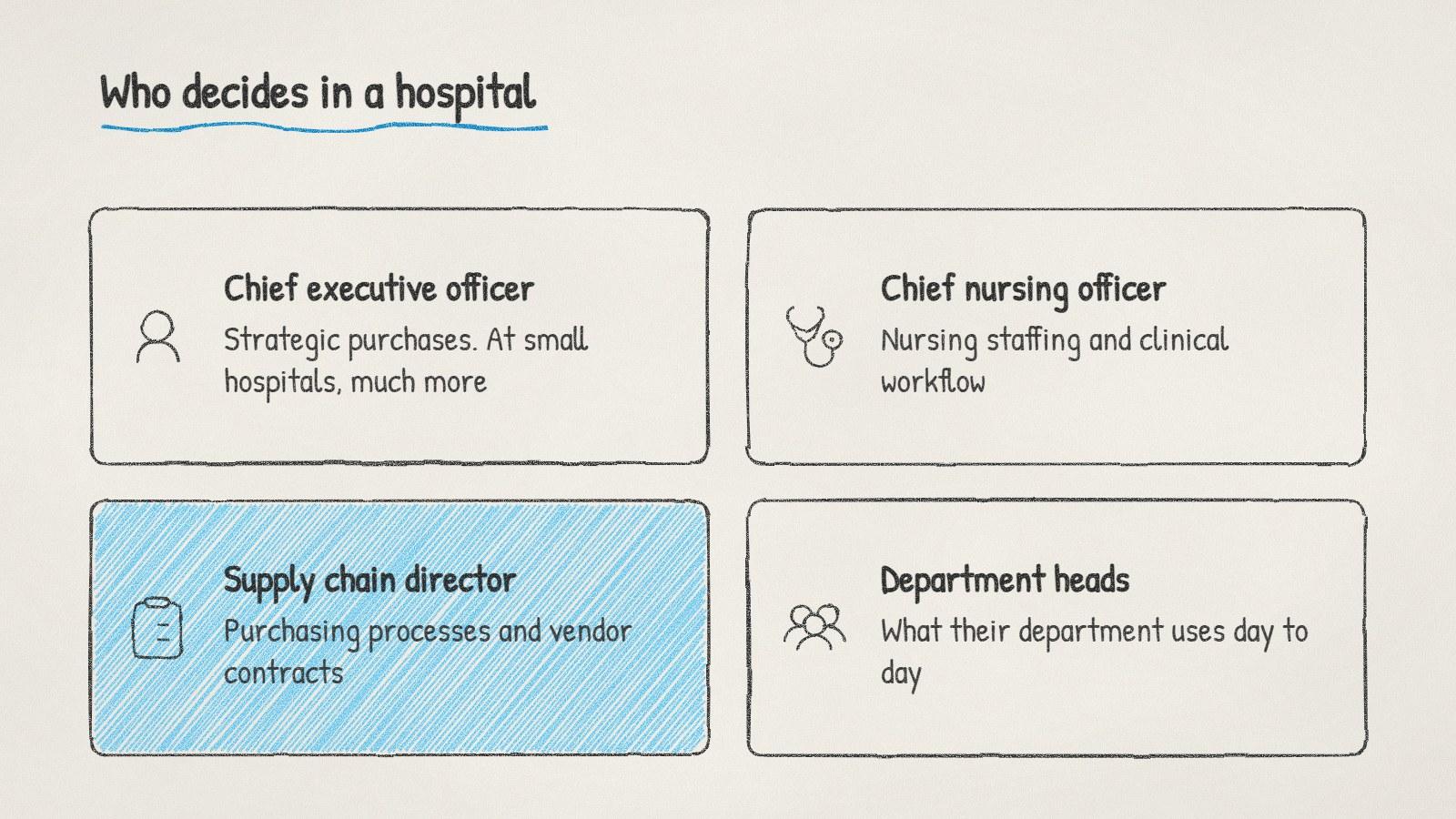
Who decides what in a hospital.
New medical products often go through a value analysis committee before anyone signs. Find the clinical champion in the department that will use your product first, then the supply chain lead who runs the process. Many hospitals buy supplies through group purchasing organisations, so ask early whether your product needs to be on a GPO contract to be bought at all.
Medtech reps trade notes on hospital buying in r/MedicalDevices and r/sales.
What to say
Hospital leaders hear from a lot of vendors. Lead with something from their own world and keep it short:
Hi [Name], I saw that [Hospital] [specific public signal: opened a new surgical wing / is hiring travel nurses for the ICU]. We work with [type of hospital, such as critical access hospitals in the Midwest] on [what you do], mainly [the problem in their words]. [A proof point you can back up.] Would it help if I sent a one-page summary for your team?
Never open with the star rating, even if it's low. Nobody wants a stranger pointing at their quality scores.
If anything you sell touches patient data, expect a security review and a business associate agreement under HIPAA. Our guide to finding medical billing clients covers how to be ready for those questions, and the nursing home guide applies the same CMS approach to long-term care.
Doing it with ManyPI
Disclosure: ManyPI is our product.
Describe the hospitals and the role you want in one sentence, for example "critical access hospitals in Montana and Wyoming, with the CEO's and chief nursing officer's email", and the agent searches the live web, including hospital websites, map listings, directories and news, plus a database of 600M+ contacts. If you've already filtered the CMS file, import it and the agent finds each hospital's site and contacts, noting where each one came from. Every email is checked against the receiving mail server before a campaign can use it, and follow-ups go out in the same thread from your own inbox and stop when someone replies. The lead generation page covers the setup.
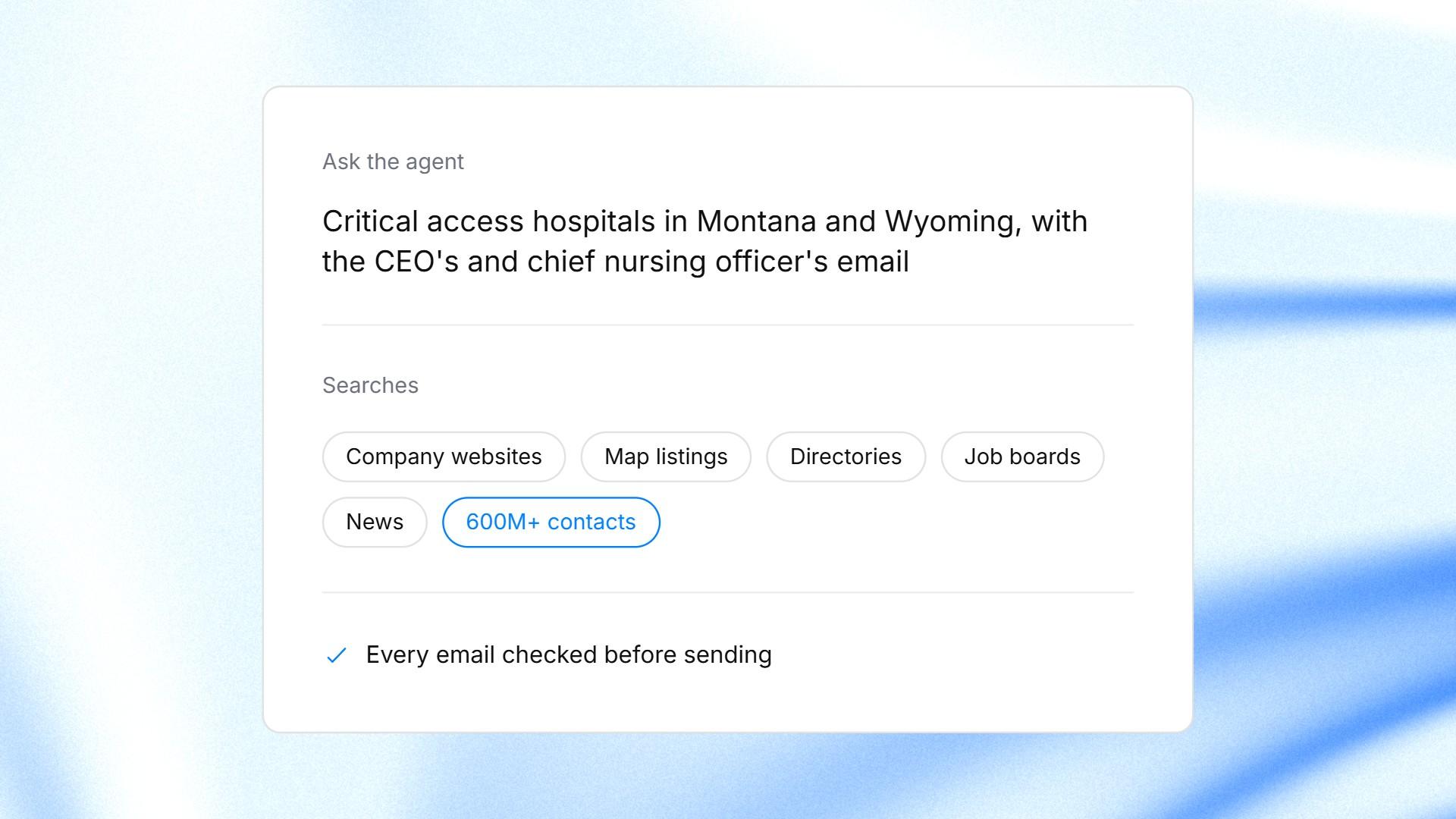
A hospital search typed into the ManyPI agent.
One trap: the hospital's name in the CMS file is the legal or registered name, which can differ from the brand on its website. Match on address and phone, not name, when you join the CMS data to anything else.
Written by
Bastian W.
Content Manager / ManyPI