

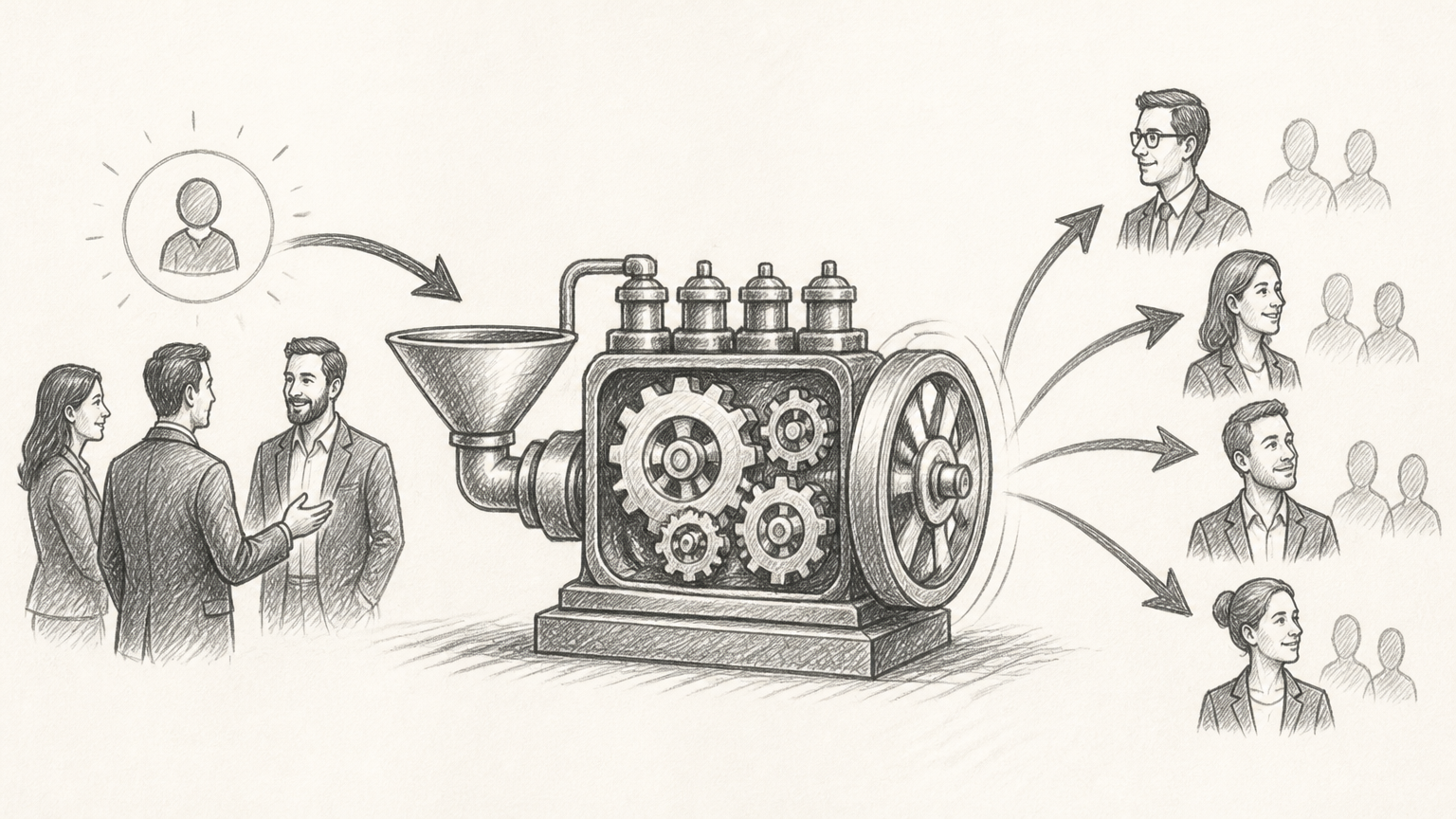
Referrals feel organic when they happen. But in most professional services firms, they are anything but systematic.
A partner finishes a strong engagement, the client is happy, and everyone assumes new business will follow. Sometimes it does. Often it does not. Goodwill sits idle because nobody captured it, shaped it, or turned it into a repeatable pipeline. That is the gap.
If you want sustainable growth, you cannot treat referrals like luck. You need a process. You need clear triggers, better timing, shared ownership, and a way to measure what is working.
That is what building a referral engine for a professional services firm really means: turning reputation into revenue, consistently.
Turning referrals into a system is a regular topic in r/consulting and r/smallbusiness.
What it means to build a referral engine for a professional services firm
A referral engine is not a one-off ask at the end of a project. It is a structured system that helps the right people recommend your firm, at the right moment, for the right kind of work.
In professional services, that distinction matters. You are not selling an impulse purchase. You are selling trust, judgment, and outcomes that often carry real financial, legal, operational, or strategic consequences. Referrals do not happen because your firm is merely competent. They happen because someone believes referring you makes them look smart and safe.
That is why building a referral engine for a professional services firm starts with a simple truth: people refer clarity more than capability. If your positioning is fuzzy, your service mix is sprawling, or your value is hard to explain in one sentence, referrals stall. Even loyal clients struggle to introduce you well.
A working referral engine solves for that. It gives clients, partners, alumni, and peers a clean story to tell. It makes your ideal buyer easy to identify. It creates natural moments to ask. And it gives your team a repeatable operating model, not just good intentions.
Why referrals matter more in services than in many other businesses
Professional services firms live on trust transfer. A warm introduction can compress months of skepticism into one credible conversation.
That is powerful because most service purchases carry hidden risk. The buyer is not just evaluating cost. They are evaluating disruption, politics, reputation, and execution. A referral lowers all of that friction. It acts like borrowed confidence.
Referrals also tend to improve deal quality. Referred prospects often close faster, fit better, and stay longer because they arrive with context. They already expect expertise. They have heard a story about your work before they ever speak to you.
The difference between passive referrals and an actual engine
Many firms get referrals. Few have a referral engine.
A passive referral model depends on memory, chance, and individual relationships. One rainmaker gets introductions because they know everyone. One delivery lead gets praised by clients but never turns that praise into opportunities. One partner asks occasionally, but only when revenue dips.
An engine is different. It has inputs, process, outputs, and feedback loops. You know who is likely to refer. You know what they should refer. You know when your team should ask. You know how to follow up. And you know how to track results without making the relationship feel transactional.
That is the shift from random growth to managed growth.

body 0 4ff8d159-f87f-49e5-a30b-f6ce7aab860f
Key aspects of building a referral engine for a professional services firm
A referral engine stands on a few non-negotiables. Miss one, and the whole thing becomes inconsistent.
Start with a sharply defined ideal client and problem set
Referrals break down when your firm tries to be too many things to too many people.
If you want more introductions, narrow the story. Define the specific buyers, industries, company sizes, and business problems where your firm is strongest. A client should be able to say, without effort, “You should talk to them if you are dealing with this exact issue.”
That does not mean your firm can only do one thing. It means your market-facing message must be more precise than your internal capabilities map. Breadth may help delivery. Precision helps referrals.
A law firm, for example, might handle many commercial matters. But referrals rise when the market knows them for helping SaaS companies navigate contract risk during rapid scaling. An accounting firm may offer broad advisory services, but referrals accelerate when clients understand they are especially strong at helping founder-led businesses prepare for acquisition.
Start by defining your ideal client and the exact problems you want friends, partners, and clients to mention.
Build referral moments into the client lifecycle
Most firms ask for referrals too late, too vaguely, or not at all.
The best time to ask is rarely at the very end of the relationship in a generic satisfaction email. The best time is when the client has just experienced a clear win, felt visible relief, or publicly acknowledged your value. That is when confidence is highest and the story is freshest.
You need to map those moments on purpose. This could be after a successful project milestone, after resolving a difficult issue, after a board presentation goes well, or after you help the client avoid a costly mistake. The point is not to ask constantly. The point is to ask when the evidence is strongest.
This is where many firms underperform. They wait for referrals instead of engineering the moments that make referrals natural.

body 1 a3bc6d5a-a25f-4cf2-abb0-467898c9170e
Turn satisfaction into language people can repeat
Happy clients are not enough. They need words.
A referral engine works better when your firm gives clients simple language for describing what you do, who you help, and what outcomes you create. Without that, even advocates stumble. They say things like, “They do strategy stuff,” or “They are great, hard to explain, but you should talk.”
That is a missed opportunity.
You need concise referral messaging. Not scripts that sound robotic, but clear phrasing that clients and partners can borrow. Think in terms of problem, buyer, and outcome. For example: “They help multi-location healthcare groups fix operational bottlenecks before expansion.” That is easier to pass along than a paragraph about integrated advisory excellence.
Identify your best referral sources, not just your happiest clients
A common mistake is assuming every satisfied client is equally likely to refer. They are not.
Some clients love your work but have no network overlap with your target market. Others are well-connected but refer rarely. Some alliance partners, former clients, alumni, industry consultants, bankers, attorneys, software implementers, and niche agencies may actually be stronger referral channels than your current accounts.
A serious referral strategy segments sources based on two factors, ability to refer and credibility with your ideal buyer. The sweet spot is people who both know the right prospects and have a reason to recommend you confidently.
That is where focused effort pays off. Instead of broadly “asking everyone,” you invest in the relationships most likely to generate high-fit introductions.
Make referral generation a firm capability, not a partner hobby
If referrals depend on one senior rainmaker, you do not have an engine. You have a personality-driven sales model.
The strongest firms operationalize referral behavior across roles. Partners open strategic relationships. Account leads recognize success moments. Delivery teams surface advocates. Marketing supports with case stories, proof points, and outreach assets. Operations or revenue teams track source performance and follow-up.
This matters because referral opportunities often appear closest to the work. A client may tell a project lead, not a managing partner, that a peer at another firm is struggling with the same issue. If your team is not trained to notice and route that signal, it disappears.
Remove friction from the handoff
Many referrals die in the transition between “You should talk” and the first real meeting.
Sometimes the referral source is unsure how to frame the introduction. Sometimes the prospect receives a vague email and ignores it. Sometimes your team responds slowly or handles the intro like a cold lead. Those details matter more than firms think.
A healthy engine makes the handoff easy. That means giving referral sources a simple way to connect you, responding quickly, acknowledging the source appropriately, and making the prospect’s next step obvious. Warm leads cool off fast when process gets sloppy.
Track referral performance like a growth channel
Referrals may feel relationship-driven, but they still need measurement.
If you do not track where referrals come from, which sources convert, what services generate the most introductions, and how quickly referred opportunities move, you are managing by anecdote. That leads to false assumptions. The loudest source may not be the most valuable source. The most social client may not produce the best-fit work.
At minimum, firms should capture a few core metrics consistently.
Metric | What it tells you | Why it matters |
|---|---|---|
Referral source | Who introduced the opportunity | Helps you identify high-value relationships |
Referral type | Client, partner, alumni, peer, vendor, etc. | Shows which channels deserve investment |
Service line referred | What kind of work is being mentioned | Reveals market clarity and cross-sell patterns |
Conversion rate | How often referred leads become clients | Separates low-quality volume from real opportunity |
Sales cycle length | Time from intro to signed engagement | Shows the operational value of referrals |
Revenue and margin | Financial impact of referred work | Connects referral activity to firm economics |
Once you measure referrals this way, you can improve them with discipline, not guesswork.
How to build a referral engine in a professional services firm
This is where strategy becomes operating rhythm. You do not need a giant program on day one. You need a practical system your firm will actually use.
Step 1: Clarify what you want to be referred for
Before you ask for more referrals, define the work you want more of.
This sounds obvious, but many firms skip it. They say they want “more referrals” when what they really need is more referrals for a profitable service line, a specific industry niche, or a certain deal size. Without that focus, the market sends mixed-fit opportunities, and your team mistakes activity for progress.
Write a short referral positioning statement for each priority service area. It should name the buyer, the problem, and the outcome. If your people cannot explain this clearly in conversation, fix that first.
Step 2: Audit your current referral ecosystem
Look backward before you build forward.
Review the last 12 to 24 months of new business and identify which opportunities came through referrals, who sent them, what type of work they involved, and whether they closed. This gives you a baseline. It also shows where hidden strength already exists.
Often, firms discover that a small number of relationships generate a disproportionate share of valuable introductions. They also find dead zones, clients who love the firm but never refer, or teams that create loyalty without ever converting that loyalty into pipeline.
This audit turns referrals from a vague growth hope into a visible system you can improve.
Step 3: Prioritize source categories
Not all referral channels deserve equal attention at the same stage.
For most professional services firms, the strongest early categories include current clients, former clients, complementary service providers, and well-placed industry peers. Alumni can also become powerful referral sources, especially in specialized sectors where career mobility is high and trust travels.
Choose a manageable set of source categories first. Build process depth before you build channel breadth. One disciplined motion with ten strong sources beats a loose motion with a hundred.
Step 4: Design the ask so it feels natural
The fear of “asking for referrals” usually comes from bad examples.
A clumsy ask feels self-serving because it is disconnected from value. A strong ask feels like a continuation of the client relationship. It is specific, relevant, and easy to act on.
Good referral asks tend to have three traits. They are anchored in a recent result. They clarify exactly who you help. And they make the next step simple. Instead of saying, “Know anyone who needs our services?” you might say, “If you talk with other CFOs dealing with post-acquisition reporting headaches, happy to be a resource.”
That difference is everything. One creates pressure. The other creates utility.
Step 5: Equip your team with proof they can share
Referrals rise when your advocates have credible material behind the introduction.
They do not need a heavy brochure. They need lightweight proof: a relevant case story, a short client result, a sharp service summary, or a practical point of view that makes you look useful before the first call. This gives both the source and the prospect confidence.
Your internal team needs the same support. If account leads and partners are expected to generate introductions, give them concise materials they can actually use in email and conversation. Keep it short. Keep it specific. Keep it tied to business outcomes.
Step 6: Create a follow-up path that respects the source
A referral is a trust transfer. Treat it that way.
That means responding quickly, updating the source appropriately, and handling the referred prospect with care. If someone puts their name behind your firm and the handoff goes quiet, you damage more than one opportunity. You weaken the future channel.
The follow-up process should be visible and consistent. Who reaches out first? How fast? What message do they send? When does the referral source hear back? These are operating questions, not etiquette details.
Step 7: Review, refine, repeat
A referral engine improves through iteration.
Look at patterns every quarter. Which sources send ideal buyers? Which asks perform best? Which teams create the most advocacy? Which service lines are easiest to refer? Which introductions stall after first contact? The answers will help you sharpen your positioning and your process.
Firms that do this well keep improving the system without making it feel mechanical. The relationship stays human. The execution gets tighter.
Common mistakes that slow referral growth
Referral programs often fail quietly. Not because the idea is wrong, but because the execution is vague.
One major mistake is asking too broadly. When your firm tells clients to “keep us in mind,” you have not created a useful referral prompt. You have outsourced your positioning problem to someone else. Specificity wins.
Another mistake is waiting only for the end of the engagement. By then, momentum may be gone. The strongest referral energy often appears in the middle of the relationship, right after a visible success.
Some firms also make the process too transactional. They chase referrals before they have earned advocacy, or they over-automate what should still feel personal. Professional services buyers can sense that immediately. Trust weakens when the ask feels templated.
Then there is the operational mistake: failing to track and learn. Without data, your firm cannot distinguish polite introductions from revenue-producing referral sources. You end up overvaluing anecdotal wins and underinvesting in channels that actually work.
How technology supports a referral engine
Technology does not create trust. It helps you scale the habits that trust depends on.
Your CRM should capture referral source data cleanly and consistently. Your client success or account teams should be able to flag advocacy moments. Your marketing systems should support timely follow-up, relevant content sharing, and visibility into conversion. If those systems are disconnected, referral opportunities leak.
This is where startups and growth teams inside service businesses can add real leverage. Point your data stack at referral behavior. Track source influence, closed-won rates, time-to-close, and service-line fit. Build simple dashboards. Surface patterns your relationship teams can act on.
Done right, this gives you a referral motion that is both human and measurable. One system, not scattered spreadsheets and memory.
How to know your referral engine is working
A working engine does not just produce more names. It produces better opportunities.
You should see more introductions from the right sources, more prospects arriving with clearer context, and a higher percentage of referred leads matching your ideal client profile. You should also notice shorter sales cycles and less friction in first meetings because credibility arrives earlier.
Internally, the signs are just as important. Your team starts using the same language about who you help. Account leads know when to ask. Marketing knows what proof to provide. Leadership can see referral contribution by source and service line. That is when referrals stop being accidental and start becoming operational.
A simple maturity view can help benchmark where your firm stands today.
Stage | What it looks like | Typical problem |
|---|---|---|
Ad hoc | Referrals happen occasionally through individual relationships | No visibility, no repeatability |
Emerging | Some teams ask intentionally after good outcomes | Inconsistent messaging and follow-up |
Structured | Referral sources, asks, and handoffs are defined | Measurement may still be limited |
Scaled | Referral generation is embedded across teams and tracked by channel | Requires ongoing governance and refinement |
Most firms sit between ad hoc and emerging for far too long. The upside comes when you push into structured behavior.
The leadership role in referral culture
Referral growth is not just a business development tactic. It is a leadership decision.
If firm leaders treat referrals as something that “should just happen,” the organization follows suit. If leaders make referral quality, client advocacy, and relationship stewardship visible priorities, behavior changes. Teams notice what gets discussed, rewarded, and reviewed.
That does not mean turning every meeting into a sales check-in. It means normalizing a few simple disciplines: discussing client wins, identifying likely advocates, sharing useful language, and reviewing referral performance as part of firm growth. Culture forms around repeated attention.
In professional services, people often resist systems because they fear losing authenticity. The opposite is usually true. A good system protects authenticity by making sure valuable relationships are supported, not neglected.
Building a referral engine starts with precision
The firms that win with referrals are rarely the loudest. They are the clearest.
They know what they want to be known for. They recognize when client trust is strongest. They make introductions easy. They follow up well. And they measure enough to improve without turning the process into a script.
If you are serious about building a referral engine for your professional services firm, start small but start deliberately. Clarify your best-fit work. Audit who already refers you. Design better moments to ask. Tighten the handoff. Track what converts.
That is the next step. Not another generic networking push. A real operating system for trust.
Click here to find out more about Lead Generation for Marketing Agencies.
Written by
Bastian W.
Content Manager / ManyPI