

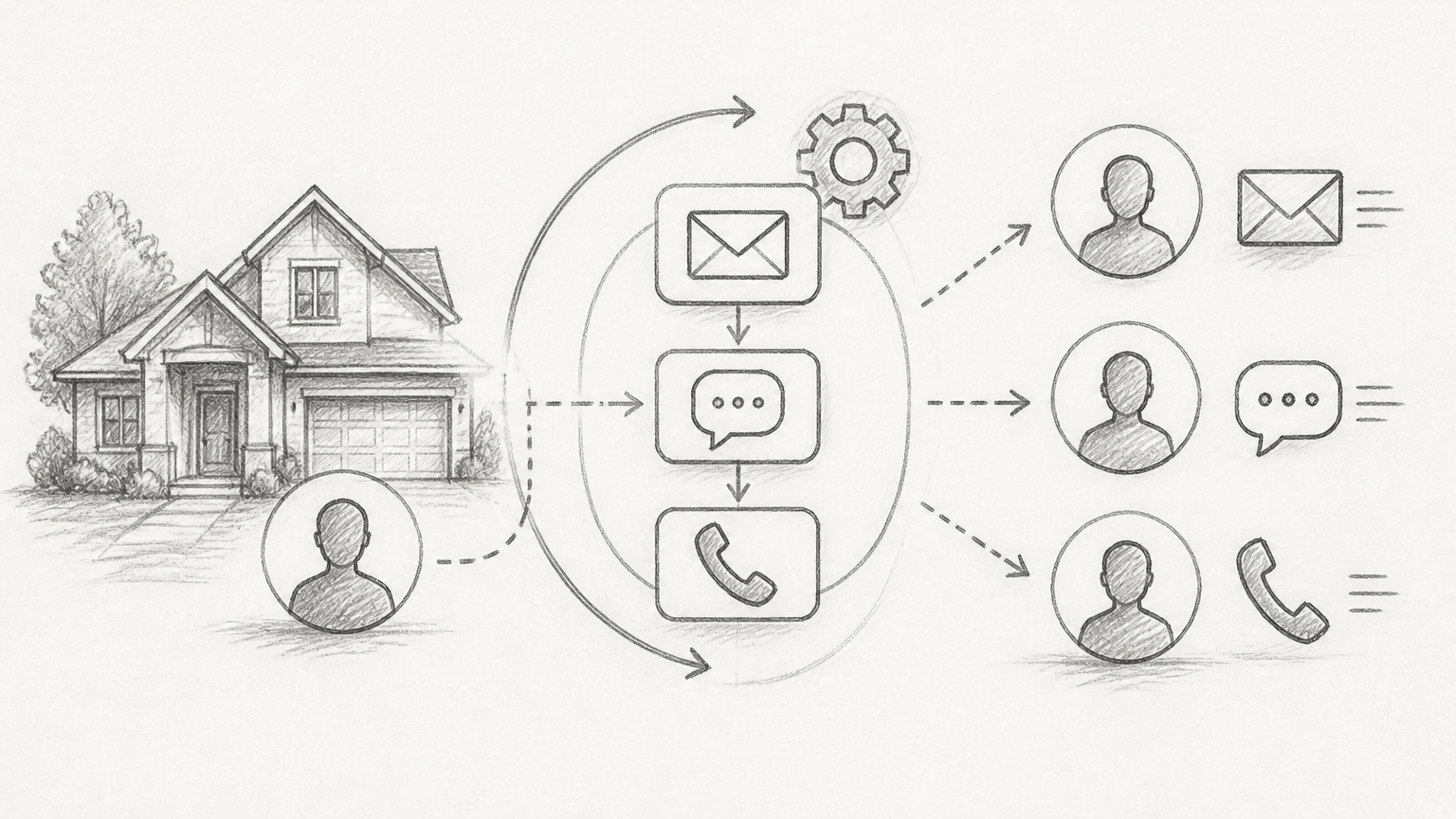
Leads go cold fast in real estate. Not because people lose interest overnight, but because life gets noisy, inboxes fill up, and most agents stop following up long before the prospect is ready to move.

body 0 e89ab56d-8857-4291-ae0f-8f910c094b29
That is where a strong automated follow-up system changes the game. Instead of relying on memory, sticky notes, or one-off texts, you build a repeatable sequence that keeps every lead engaged at the right pace.

body 1 1f8158d7-ad2b-4bd2-a3b9-ee1a07a94554
The result is simple, fewer missed deals, faster response times, and more conversations with people who are actually ready to buy or sell.
If you handle inbound leads, paid traffic, portal inquiries, or long-cycle nurture, you need more than a CRM that stores names. You need automated follow-up sequences that trigger automatically, adapt to behavior, and keep your pipeline warm without creating more manual work.
What are automated follow-up sequences for real estate leads?
Automated follow-up sequences for real estate leads are pre-built chains of communication that send messages based on timing, lead source, behavior, or stage in the buying and selling journey. Think of them as a systemized conversation path. A new buyer lead submits a form, gets an instant text, receives an email with listings, then gets a check-in two days later if they do not respond. That sequence runs automatically.
The point is not to replace the agent. The point is to make sure the agent shows up consistently, even when the day gets crowded. In real estate, speed matters, but persistence matters just as much. Most leads do not convert on the first touch. Many need multiple touches across several days or weeks before they reply in a meaningful way.
A good sequence gives structure to that reality. It handles first contact, early nurturing, re-engagement, and long-term drip communication. It can also route hot leads for immediate human action. When someone clicks a property link three times in one day or replies with financing questions, the automation should not keep drifting out generic content, it should flag intent and hand the lead to a person.
This is why the best automated follow-up for real estate is not just scheduled messaging, it is a workflow. It combines timing, messaging logic, segmentation, and escalation rules so each lead gets relevant outreach instead of a blast campaign that feels robotic.
Key aspects of follow-up sequences for real estate leads
Speed-to-Lead is the first competitive advantage
The first few minutes after an inquiry are critical, which is why Speed-to-Lead is the first competitive advantage. A lead who just requested a showing or asked for property details is in decision mode right now. Wait an hour, and you are competing with other agents, other listings, and a fading sense of urgency.
Automation fixes that instantly. The moment a form is submitted, the system can send a confirmation text, a thank-you email, and a booking link. That first response does two things at once. It reassures the lead that someone is paying attention, and it buys you time to respond personally without going dark.
This matters even more for paid leads. If you are spending on Google Ads, Meta, Zillow, or other lead sources, every slow response erodes return on ad spend. Fast automation protects the top of funnel before human follow-up takes over.
Timing and cadence matter more than volume
Most weak follow-up systems fail in one of two ways. They stop too early, or they message too often with no real purpose. Neither works.
A strong real estate lead follow-up sequence uses pacing that matches intent. New high-intent leads may need several touches in the first 48 hours. Colder leads from a home valuation tool may need a slower cadence over weeks. The goal is not to maximize message count, the goal is to stay present without becoming noise.
Think in phases. Early messages should focus on contact and clarity. Mid-sequence messages should build trust and uncover needs. Later messages should re-engage attention with something useful, such as updated listings, neighborhood insights, financing guidance, or seasonal seller timing.
Segmentation makes automation feel human
Not all real estate leads should enter the same sequence. A first-time buyer, an investor, a seller exploring home value, and a renter thinking about buying have different motivations and timelines. Treat them all the same, and your automation becomes background clutter.
Segmentation is what turns basic automation into a conversion tool. You can segment by source, geography, budget, property type, timeline, financing readiness, and engagement behavior. A lead looking in a downtown condo market should not get suburban family-home messaging. A seller lead should not receive buyer nurture content.
The more relevant the sequence, the more natural it feels. That does not mean building dozens of bloated workflows. It means defining a few smart paths that reflect real lead intent.
Message quality drives replies
Automation often fails because the messages sound automated. Stiff language, generic templates, and too many asks kill response rates.
Good follow-up copy sounds like a real person who understands context. It is short. Specific. Useful. It does not push for a call in every message. Sometimes the best next step is a simple question. Sometimes it is a property match. Sometimes it is a helpful answer before the lead even asks.
You also need channel awareness. SMS should be conversational and direct. Email can carry more detail and richer content. Voicemail drops, if used, should feel timely and personal. The sequence works best when each message format does the job it is best at doing.
Behavior-based triggers improve conversion
Time-based automation is useful, behavior-based automation is where performance jumps.
When a lead opens every email but never replies, that tells you something. When they click listings in a specific zip code, that tells you more. When they revisit a home valuation page or start a mortgage calculator, you are looking at fresh buying or selling intent.
Your sequence should adapt to those signals. A lead who engages heavily may need a faster handoff to an agent. A lead who ignores the first five touches may need a different angle, a longer pause, or a reactivation sequence later. This is where marketing teams and data teams can add real leverage. Event tracking, scoring, and CRM synchronization turn static drips into responsive workflows.
Automation needs a human exit ramp
The goal is not full autopilot. Real estate is too relationship-driven for that. Every sequence needs a clear rule for when a human steps in.
That may be based on reply keywords, appointment requests, financing questions, listing views, or a lead score threshold. Once interest becomes active, the automation should support the agent, not compete with them. That means pausing generic messages, surfacing lead history, and giving the agent context for a better conversation.
Done right, automation handles the repetitive work and sets up the human interaction to be more relevant. It does not depersonalize the experience. It removes the dead air between touches.
How to get started with automated follow-up for real estate leads
Start with your lead sources and journey mapping
Before you build anything, map where your leads come from and what they expect next. This is where many teams skip ahead too fast. They buy software, load templates, and send sequences without defining the lead journey.
A Facebook seller lead is not the same as a referral lead who requested a market analysis. A portal buyer lead is not the same as a website visitor who saved three listings. Start by identifying your main entry points and the likely intent behind each one.
Then map the first 30 days. What should happen in the first minute, first hour, first day, first week, and first month? Which touches are automated? Which ones require agent action? Where do leads branch based on behavior? This exercise exposes gaps fast.
Build a simple sequence first
You do not need a massive workflow library on day one. Start with one high-volume, high-value sequence. For most teams, that means inbound buyer leads or home valuation seller leads.
A practical starter flow usually includes these actions:
Instant response: Send a text and email immediately after form submission.
Early follow-up: Trigger one or two follow-ups in the first 48 hours if there is no reply.
Value-based nurture: Share useful content or listings over the next 7 to 14 days.
Re-engagement: Attempt a lighter check-in after a quiet period.
Agent handoff: Alert a human when the lead replies or shows strong intent.
Keep it tight. The first version should be easy to measure and easy to improve. Complexity is not sophistication. Clarity is.
Choose the right data and tooling
Your CRM is the center of gravity, but it should not be the whole system. Effective automation often depends on clean integrations between forms, ad platforms, CRM records, email, SMS, calendar booking, and reporting layers.
For growth and data teams, the key question is simple, can your stack track lead source, engagement events, stage changes, and agent actions in one place? If not, your automations will fire blindly. That creates duplicate outreach, missed handoffs, and bad attribution.
The table below shows what to prioritize when evaluating your setup.
Capability | Why It Matters | What to Watch For |
|---|---|---|
CRM integration | Keeps lead status, notes, and stage changes current | One-way syncs, delayed updates |
SMS and email automation | Supports multi-channel follow-up from one workflow | Separate tools with no shared history |
Behavior tracking | Enables triggers based on opens, clicks, page visits, or replies | Limited event data, weak tracking fidelity |
Lead routing | Sends hot leads to the right agent fast | Manual assignment or unclear ownership |
Reporting and attribution | Shows which sequences and sources drive conversion | Last-click bias, missing source data |
Pause/resume logic | Prevents awkward messages after a live conversation starts | No suppression rules |
If your team is technical, focus early on field hygiene and event naming. Bad data breaks good automation. If lead status values are inconsistent or source names change every week, sequence performance becomes impossible to trust.
Write messages that sound local and useful
Templates should do the heavy lifting, but they still need to sound like your market and your audience. Real estate is local. Your sequence should reflect that.
Use neighborhood names, price bands, school-area references, market timing, and property context where possible. Replace generic phrasing with useful specificity. “Are you still looking?” is weak. “Want a short list of new three-bedroom homes under your budget in North Park?” is better because it gives the lead something concrete to respond to.
Keep each message focused on one next step. Too many options create friction. Ask one question. Offer one asset. Suggest one action. That discipline lifts reply rates.
Set rules for agent involvement
Automation without operations discipline creates chaos. You need clear ownership rules for who responds, how fast they respond, and what happens after a reply.
This is especially important on distributed teams. If two agents contact the same lead, trust drops. If no one follows up after the lead replies to an automated text, the sequence becomes a liability. Define service levels up front. For example, a new reply gets agent attention within 15 minutes during business hours, and the automation pauses automatically once the conversation starts.
This is where startup-style rigor helps. Treat lead response like incident response. Fast acknowledgement. Clear routing. Logged actions. Measured outcomes.
Measure what actually predicts revenue
Open rates and click rates are useful, but they are not the finish line. The metrics that matter most tie automation to pipeline movement and closed business.
Watch speed-to-lead, reply rate, appointment rate, contact-to-conversion rate, nurture reactivation rate, and time-to-opportunity. Also compare performance by source. Some channels need aggressive early follow-up. Others respond better to longer educational nurture.
A simple measurement stack should cover:
Speed-to-lead: Time from inquiry to first contact.
Reply rate: Percentage of leads who respond to sequence messages.
Appointment rate: Percentage of leads who book or accept a meeting.
Conversion by source: Which channels produce real opportunities and closings.
Reactivation rate: How often older leads return to active status.
Once you have baseline performance, test one variable at a time. Subject line. First SMS wording. Delay intervals. Call-to-action type. Sequence length. That is how you improve without losing signal.
Avoid the most common failure modes
Most real estate automation problems are operational, not technical. Teams send too many messages, use weak copy, forget to segment, or fail to connect automation with live sales behavior.
Another common issue is over-automation. If every lead gets the same ten-message sequence regardless of context, the system becomes lazy at scale. You are not building automation to avoid thinking. You are building it to apply good thinking consistently.
Watch for silent failures too. Broken webhooks. Duplicate records. Unassigned leads. SMS compliance issues. Messages firing after opt-out. These are not minor annoyances. They directly impact conversion, brand trust, and legal risk.
Conclusion
Automated follow-up sequences for real estate leads work because they solve a simple, expensive problem, most opportunities are lost in the gap between inquiry and consistent contact. When you automate that gap with smart timing, clear segmentation, useful messaging, and strong handoff rules, your pipeline gets healthier fast.
Start small. Map one lead journey. Build one sequence. Track replies, appointments, and conversion by source. Then improve from real data, not guesswork. The teams that win with real estate lead automation are not the ones sending the most messages, they are the ones making every follow-up timely, relevant, and easy to act on.
Written by
Bastian W.
Content Manager / ManyPI