


TL;DR
Short on time? Start with companies that sponsored similar events in the past year, then add vendors who sell to your attendees. Email whoever owns the budget with one priced package and a deadline, and follow up twice.
Find sponsors with ManyPISponsorship sales normally run on long lead times. Some university sponsorship guides, like this one from CSU San Marcos, suggest reaching out at least four months before the event. If you're reading this with six weeks to go, that advice doesn't help much.
What helps is narrowing the list to companies that can say yes quickly. That means companies that already have a sponsorship budget and need to reach your audience in the next few months anyway.
Here's the plan for a short runway:
Collect every company that sponsored a comparable event in the last year or two.
Add vendors that sell to your attendees and local businesses near the venue.
Find the person who owns the budget at each one.
Send a short email with one specific, priced package and a decision date.
Follow up twice, then move on.
Which sponsors can say yes fast
Not every sponsor is worth chasing on a short timeline. A company that has never sponsored anything needs internal approval, a budget line and a lot of convincing. One that sponsored three similar events last year just needs to know yours exists.
Sponsor type | Why they move quickly | Where to find them |
|---|---|---|
Past sponsors of comparable events | The budget line and approval process already exist | Sponsor pages of similar events, including past years |
Vendors selling to your attendees | Your audience is their pipeline | Exhibitor lists of larger events in your niche |
Companies hiring your attendees | Sponsorship doubles as recruiting | Job boards, filtered by the roles your attendees hold |
Companies launching in your city | They need local awareness now | Local business news, new office announcements |
Businesses near the venue | Foot traffic and goodwill | A map search around the venue |
Start at the top of that table and work down. The first two rows usually produce most of the yeses.
Build the list from comparable events
This is the fastest source of warm sponsor leads, and most organisers only half do it.
List 10 to 20 events with a similar audience, size and region. Include last year's editions, not just upcoming ones.
Open each event's sponsors or partners page and collect every company name.
For events whose old pages are gone, check the Wayback Machine. Sponsor pages from previous years are often archived.
Put everything in one sheet and count how many events each company appears at.
Companies that show up at three or more events are your first wave. They sponsor as a habit, and someone at that company has "events" in their job description.
Find the person who owns the budget
Who to email depends on company size:
Small companies (under about 50 people): the founder or the marketing lead. Often the same person.
Mid-size companies: the events manager, field marketing manager, community lead or partnerships manager.
Large companies: regional field marketing, or the team that handles your industry vertical. A generic sponsorships@ address is fine here, because large companies route those internally and someone does read them.
If you can't find a named person in a few minutes, send to the shared address and ask who handles event partnerships. That reply is usually fast.
Write an email a busy marketer can answer in a minute
Sponsor emails fail when they read like a deck. Your first message has one job: get a "send me details" or a "not this year".
Here's a structure that works on short timelines (replace the brackets):
Subject: [Event name] on [date]: sponsor slot for [Company]?
Hi [Name],
I'm running [event] on [date] in [city]. We're expecting [number] [attendee description], mostly [job titles or company types]. [Company] sponsored [comparable event] last year, so I thought this might fit.
One slot is still open: [package name] at [price], which includes [two concrete things]. We're confirming sponsors by [date].
Worth a quick call, or should I send the one-page overview?
A few things that make the difference:
One package with a price. "Bronze, silver and gold, prices on request" creates homework.
Attendee numbers you can stand behind. Use last year's real numbers or this year's registrations. Inflated numbers come back to bite you after the event.
A real deadline. "Confirming by the 15th" gives the reader a reason to reply this week.
No attachments in the first email. Attachments hurt deliverability and nobody opens a 20-page PDF from a stranger.
A two-week sponsor sprint
Day | What to do |
|---|---|
1 to 2 | Build the list from comparable events, find contacts, verify the emails |
3 | First wave: repeat sponsors and vendors selling to your attendees |
6 | Follow-up one: short, add one new detail (a speaker, a registration milestone) |
8 | Second wave: companies hiring your attendees, local businesses near the venue |
10 | Follow-up two to the first wave, restating the deadline |
12 to 14 | Calls, invoices, logo collection. Close out the rest politely |
Expect most of the second wave to say "next year". Log those replies properly. They're your first wave for the next edition.
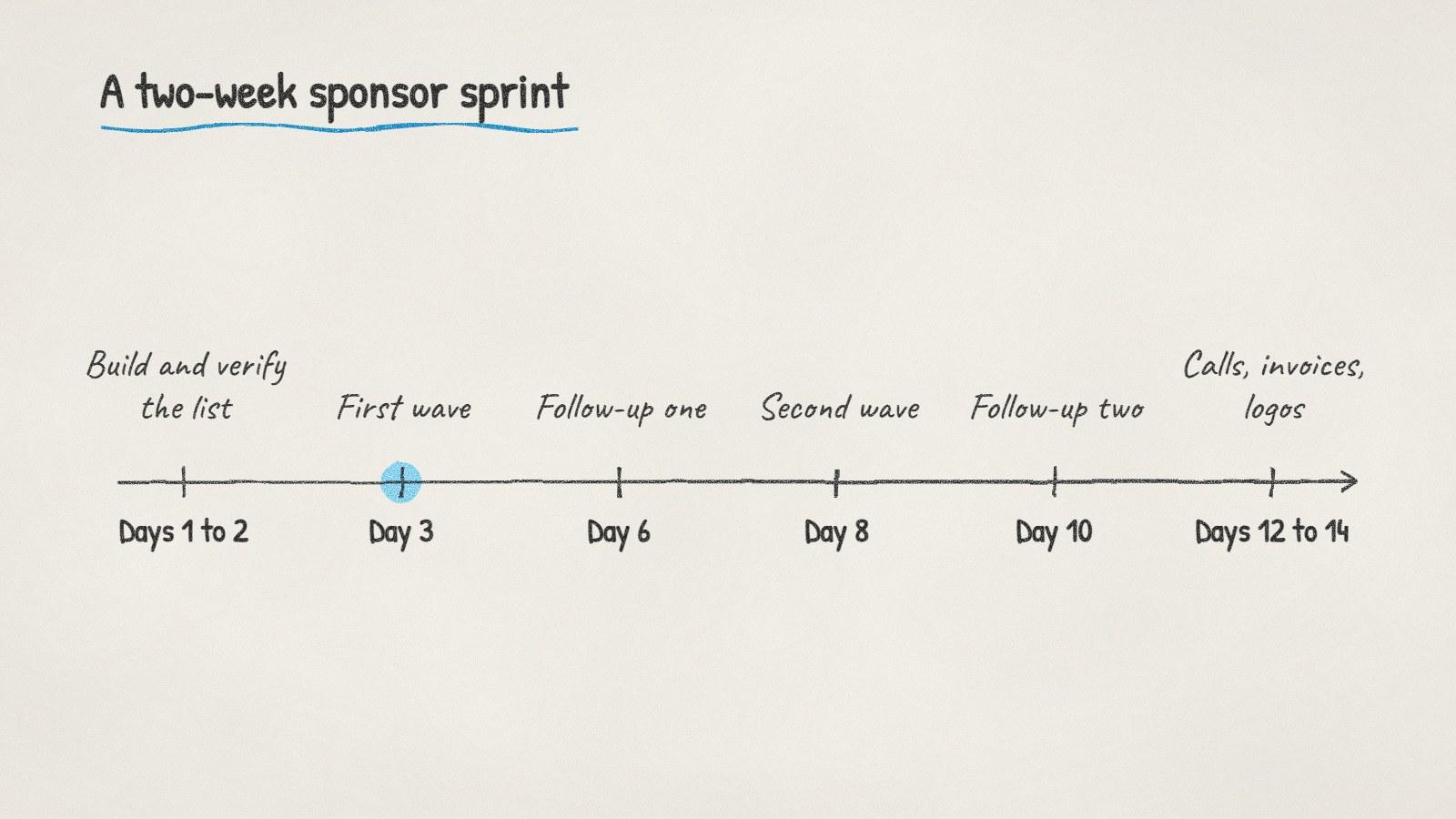
The two-week sprint at a glance.
Using ManyPI for sponsor prospecting
Disclosure: ManyPI is our product. Event organisers use it for exactly this kind of list.
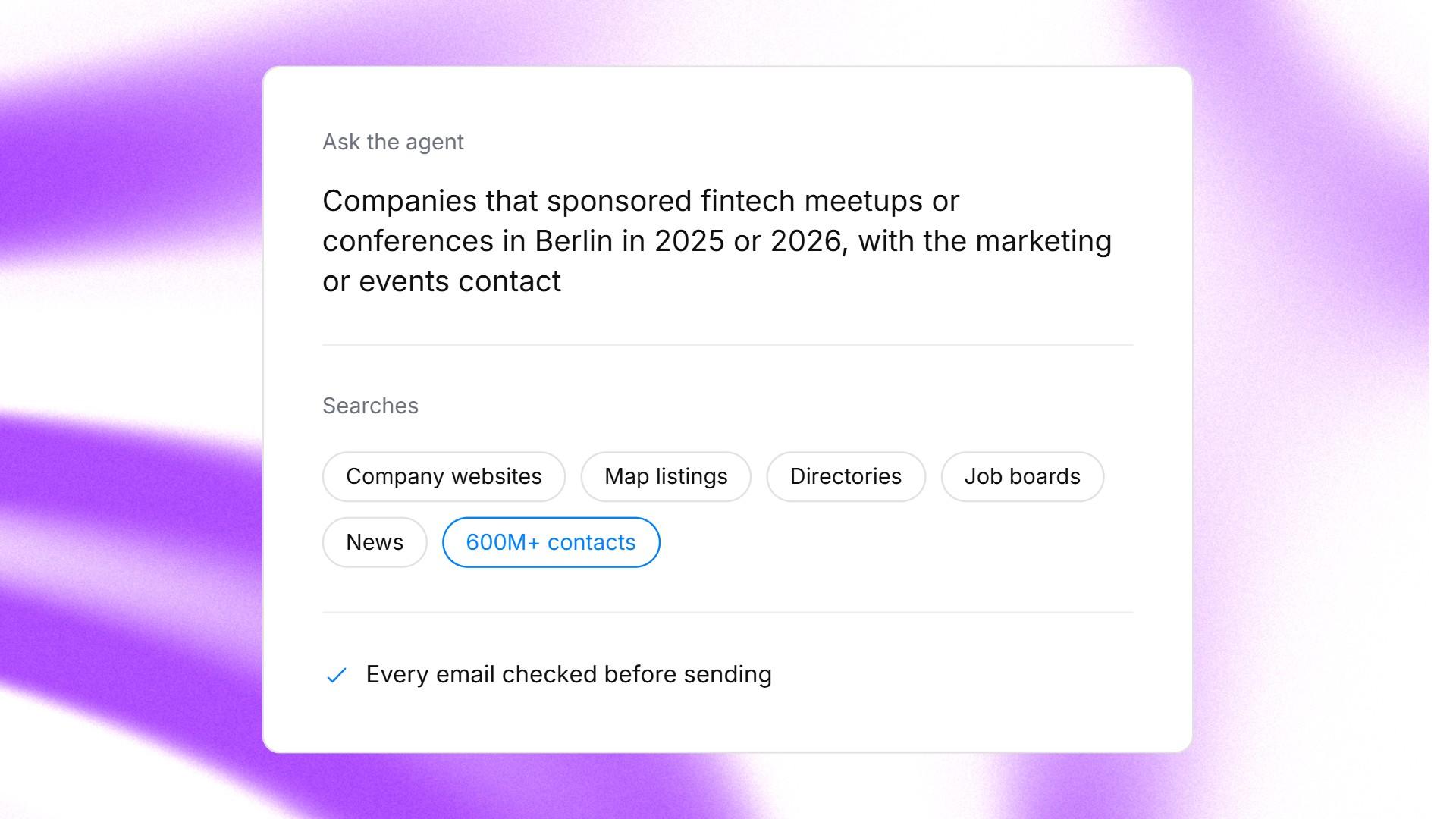
A sponsor search described in one sentence in ManyPI.
You can describe the list in plain words, for example "companies that sponsored fintech meetups or conferences in Berlin in 2025 or 2026, with the marketing or events contact", and the agent reads sponsor pages and company sites to build it, noting where each lead came from. For businesses near the venue, Map Search lets you draw an area on a map and save the businesses inside it. Every email is checked before sending, and sequences go out from your own inbox and stop the moment a sponsor replies.
The event organizers page shows the full setup. The free plan finds 50 leads with no card, which is enough to test the first wave.
Whatever tool you use, start by listing ten comparable events and opening their sponsor pages. Within an hour you'll know who your realistic sponsors are, and that list is worth more than any sponsorship database you could buy.
Written by
Ole Mai
Founder / ManyPI