


TL;DR
Buy a lead database when your buyers fit standard filters like title, industry, size and country. Buy an AI lead agent when what makes a good lead isn't a filter, such as hiring or a new location.
Describe your ideal customerBuy a lead database if you can describe your buyers with standard filters, such as job title, industry, company size and country, and you want a lot of them quickly. Buy an AI lead agent if the thing that makes someone a good lead isn't a filter: they're hiring for a specific role, they just opened a second location, they use a certain tool, or they're a small local business that databases barely cover. The first job is static filtering. The second is live research. Plenty of teams need both, and some tools now do both.
Lead database vs AI lead agent: what each one does
Lead database | AI lead agent | |
|---|---|---|
How you search | Filters and dropdowns | A sentence describing your ideal customer |
Where the data comes from | Records collected in advance and refreshed on a schedule | The live web at the moment you ask, often plus a database |
Speed | Results in seconds | Minutes for a researched batch |
Strongest at | Job titles at companies with a clear industry and size | Signals and niches that no filter captures |
Weakest at | Small local businesses and anything that changed recently | Pulling thousands of generic contacts cheaply |
How it usually charges | Credits per contact revealed or exported, or annual contracts | Credits for the research, per search or per lead |
The split is about the question you're asking. "Who's the head of finance at these 500 companies?" is a lookup. "Which accounting firms in Ohio are hiring a second tax manager?" is research.
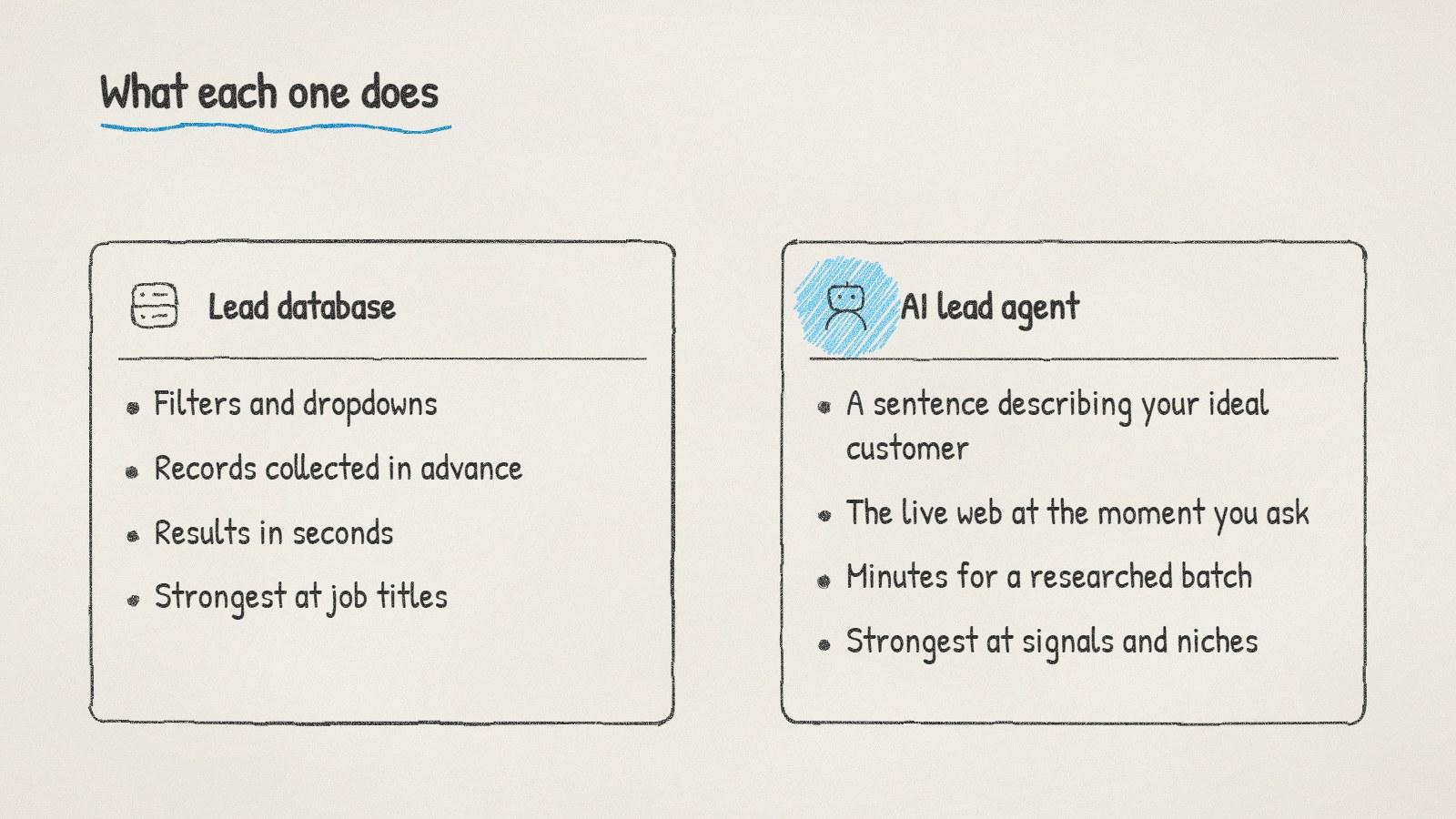
A lead database filters records collected in advance. An AI lead agent researches the live web when you ask.
Choose by the job
The job | Better fit | Why |
|---|---|---|
Marketing leads at software companies with 50 to 200 staff | Lead database | Title and company size are both standard filters |
Refreshing contacts at accounts you already sell to | Lead database | A fast lookup by company |
Companies hiring their first sales rep | AI lead agent | Job posts change weekly and aren't a database field |
Independent shops selling a specific product | AI lead agent | The product lives on their website, not in an industry code |
Local trades in one county | AI lead agent or a map search | Many small businesses have little presence beyond their own site and map listing |
A one-off list of a few thousand standard contacts | Lead database | Volume at a low cost per record |
If most of your rows land in one column, buy that. If they split, you're choosing between two tools and one that does both.
Why freshness matters for either one
People move. The US Bureau of Labor Statistics found that the median wage and salary worker had been with their current employer for 4.1 years in January 2026. Contact lists go out of date as people move on. A database record is as fresh as its last refresh. An agent reads what's published now, but can still find an address that has gone dead since.
So whichever you buy, check every email against the mail server before you send, and ask the vendor these questions:
When was this record last updated? A date beats "regularly".
Can I see where a fact came from? A link to the job post or web page lets you check it.
How are emails checked? Against the receiving server, or guessed from a pattern?
What does an empty search cost? Narrow research can return few results and still use credits.
The database-or-agent question gets asked often in r/sales and r/LeadGeneration, and the right answer usually turns on how niche the buyer is.
Doing it with ManyPI
Disclosure: ManyPI is our product.
ManyPI's agent covers both jobs from one sentence. Describe your ideal customer, for example "Software companies in Texas hiring their first sales rep, with the founder's email", and it searches the live web, including company sites, map listings, directories, job boards and news, plus a database of 600M+ contacts. For local businesses, Map Search lets you draw an area on a map and get the businesses inside it, using data from OpenStreetMap. Every email is checked against the receiving mail server before a campaign can use it.
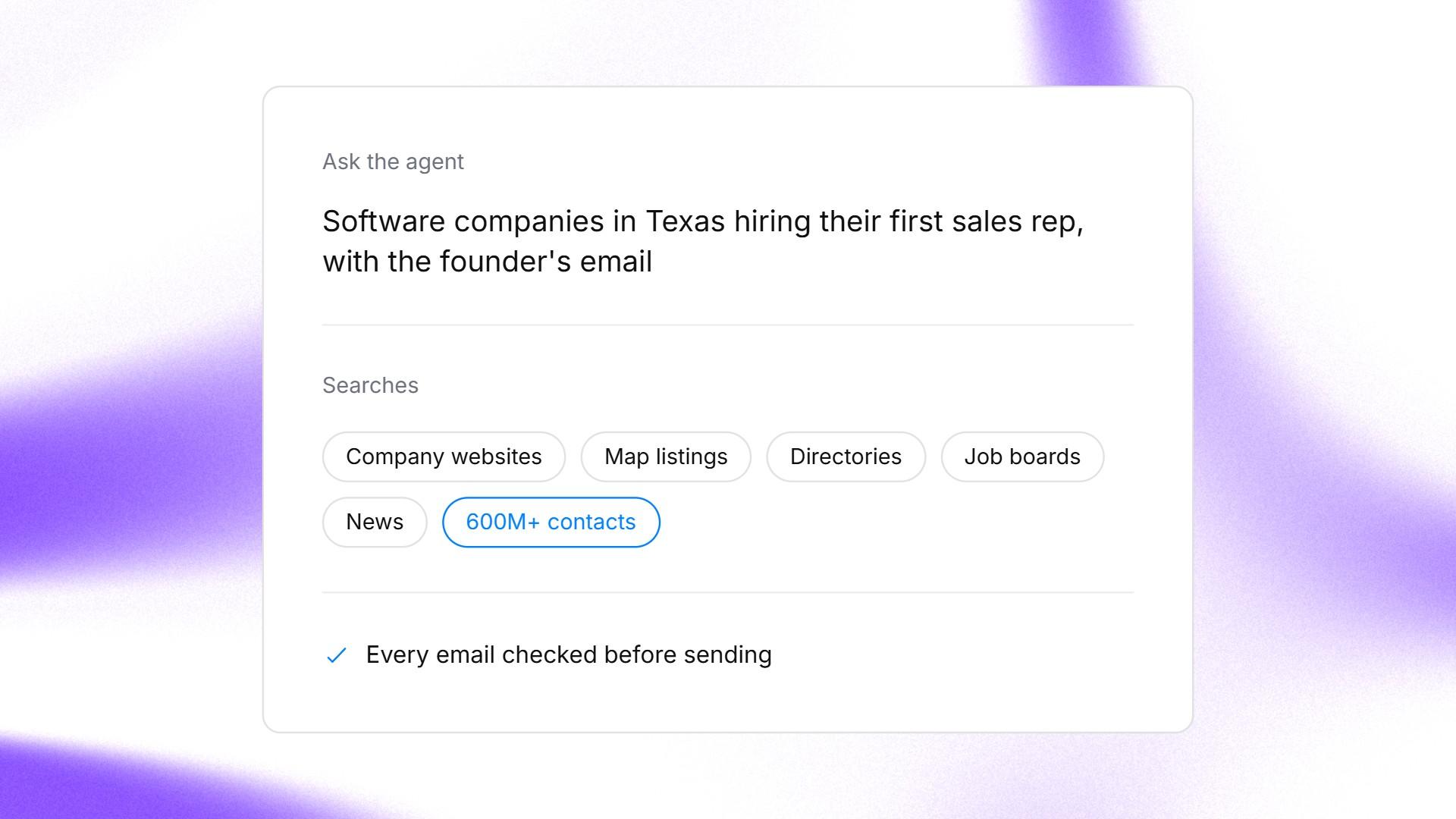
A hiring-signal search typed into the ManyPI agent.
The lead generation page shows a search from start to finish, and our guide to finding companies that are hiring goes deeper on one of the signals a database can't hold.
Where this stops applying: if your whole market is a few hundred named accounts you already know, you don't need either. A spreadsheet and an email finder will do.
Written by
Bastian W.
Content Manager / ManyPI