

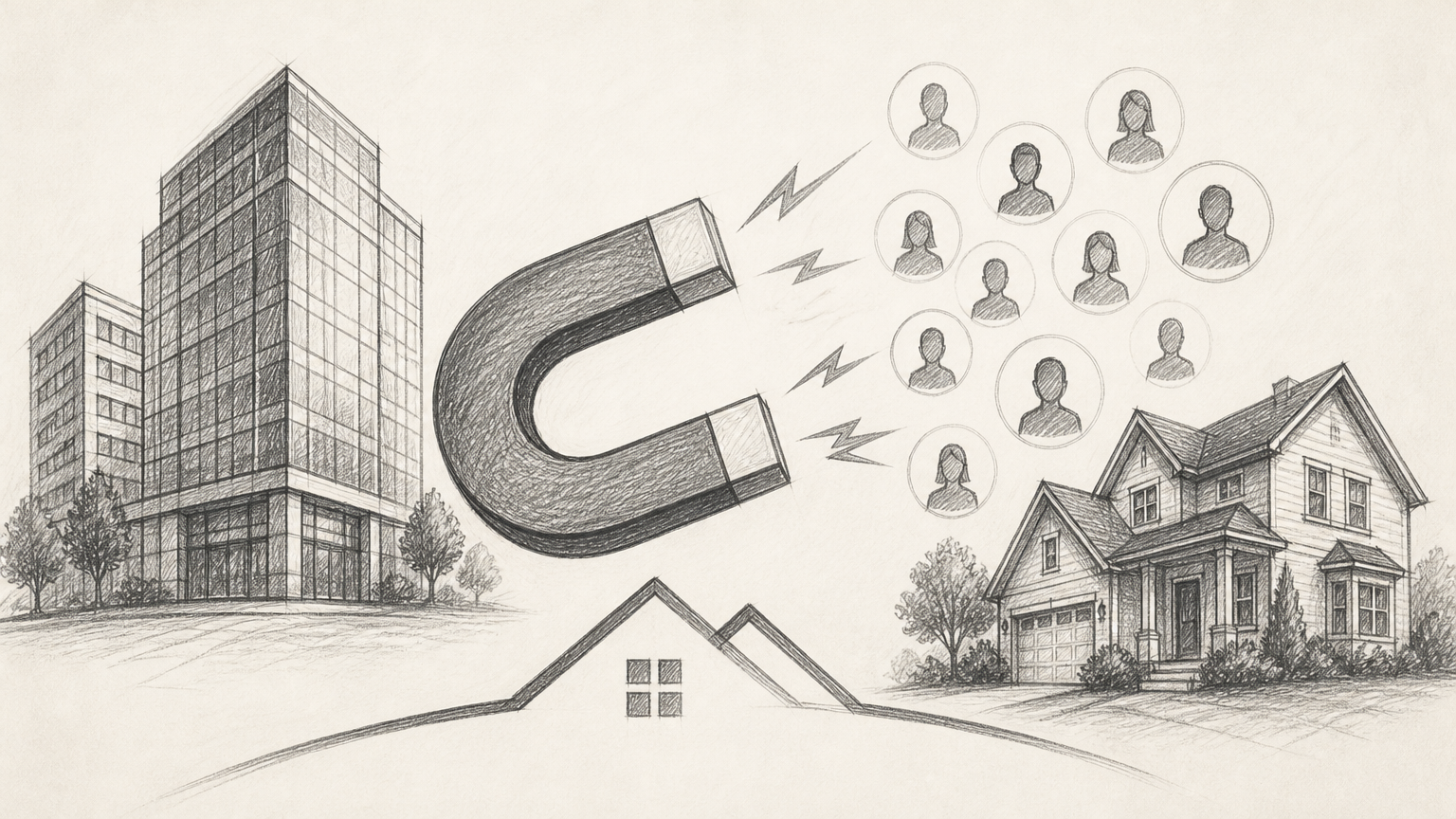
Lead generation looks simple from the outside. Find prospects, start conversations, close deals. But for real estate agents, that logic breaks fast.
A residential agent and a commercial agent are both selling property, yet the way they attract leads, qualify interest, and convert opportunities is fundamentally different. One business runs on volume, speed, and local visibility. The other runs on precision, relationships, and longer deal cycles. Treat them the same, and your pipeline gets noisy, expensive, and unreliable.
If you want better results, you need a lead generation strategy built for the market you actually serve. This is the real difference between commercial and residential real estate lead generation, not just where leads come from, but how buyers think, how sellers choose agents, and how trust gets earned. Get that right, and your marketing becomes far more efficient.
body 0 4b7bff3f-27c3-450e-8158-dc068f9cde10
What Lead Generation Looks Like for Commercial and Residential Real Estate Agents
Lead generation for real estate agents is the process of attracting potential buyers, sellers, landlords, tenants, investors, or decision-makers and moving them into a sales conversation. The goal is simple: create a steady pipeline of people who are likely to transact.
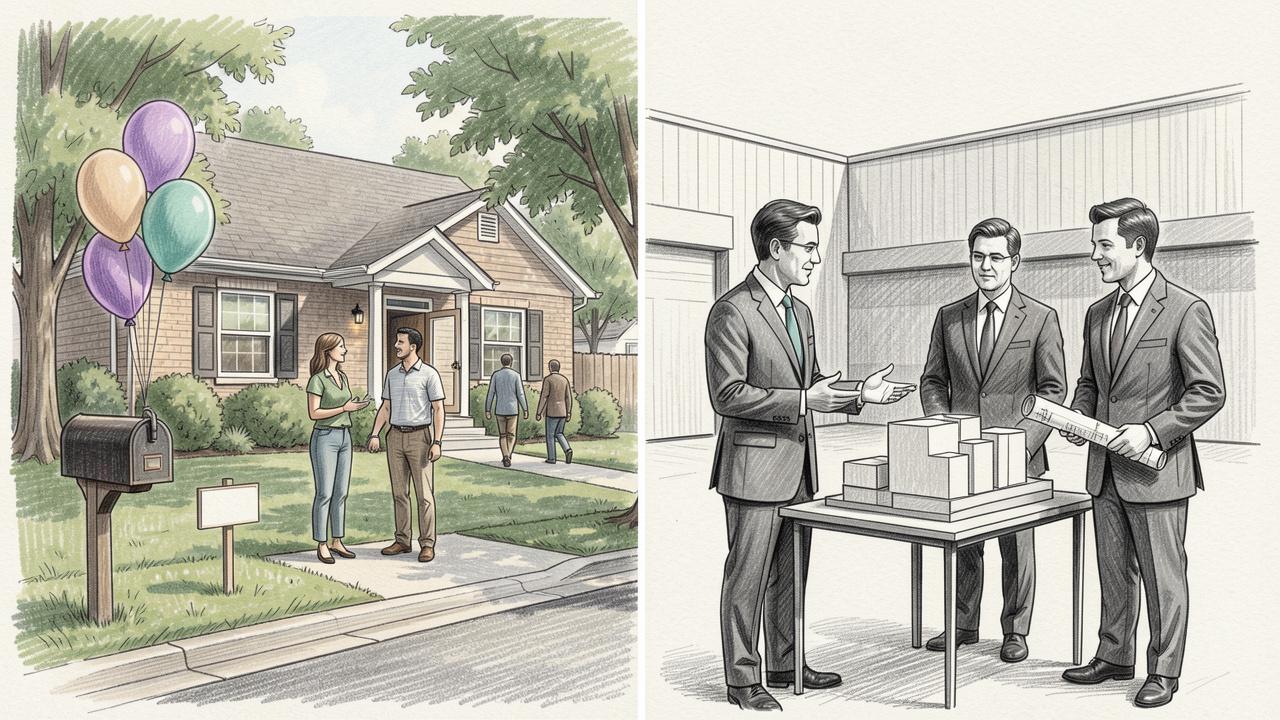
That said, the mechanics are very different between sectors. Residential real estate lead generation typically targets individual consumers. Think homeowners, first-time buyers, move-up buyers, downsizers, and renters. These leads often come from search, social media, referrals, portals, local ads, open houses, and direct response campaigns. Emotion plays a major role, and timing is often tied to life events like marriage, kids, divorce, relocation, or retirement.
Commercial real estate lead generation, by contrast, is usually aimed at businesses, investors, landlords, developers, and institutional decision-makers. The audience is smaller. The deal sizes are larger. The sales cycle is longer. And the lead is rarely a single person making an emotional purchase. It is often a group of stakeholders evaluating risk, return, location strategy, lease terms, financing, and future value.
This is why lead generation for commercial versus residential real estate agents cannot rely on the same channels, messaging, or qualification methods. A Facebook ad that performs well for a local home valuation offer may do almost nothing for an industrial leasing broker. Likewise, a relationship-driven outreach campaign to investors may be far too slow to sustain a residential buyer pipeline.
The Core Difference Is Intent
In residential, many leads begin with broad intent. Someone is browsing listings. Someone is curious about home values. Someone wants to know what their monthly payment might be. You often capture attention before the person is fully ready.
In commercial, intent tends to be narrower but more complex. A lead may be exploring a 1031 exchange, searching for a warehouse with specific clear-height requirements, or evaluating office consolidation across multiple markets. Fewer inquiries come in casually. The upside is that well-qualified leads can be far more valuable.
Transaction Style Shapes the Funnel
Residential funnels are usually shorter and wider. You need more top-of-funnel activity because not every lead is serious, finance-ready, or committed to an agent. Follow-up speed matters, consistency matters, and reviews, local branding, and repeated visibility matter.
Commercial funnels are narrower and deeper. You may work fewer leads at a time, but each one requires more context, more diligence, and more trust. Lead nurturing becomes less about quick conversion and more about staying relevant over months, sometimes years.

body 1 6aad735c-454a-4ff2-a9c3-f1b48d23fbb5
Key Aspects of Lead Generation for Commercial vs. Residential Agents
The biggest mistake agents make is copying tactics across categories without adjusting for audience behavior. Good lead generation starts with market fit. Channel fit comes second.
Audience Size and Targeting
Residential real estate gives you a broad audience. In almost every market, there are always people considering a move, checking prices, or testing affordability. That makes broad targeting viable, especially when paired with hyperlocal messaging. A campaign focused on one zip code, one school district, or one property type can generate steady inbound interest.
Commercial real estate has the opposite problem. The audience is smaller and often harder to identify. You are not marketing to everyone who might someday move. You are targeting owners, operators, investors, business leaders, asset managers, and tenants with specific space or capital needs. That means your targeting has to be sharper from day one.
For commercial agents, lead quality usually matters more than lead quantity. One conversation with a qualified investor can outperform a month of weak inbound traffic. For residential agents, a healthy business often depends on managing a larger volume of mixed-intent leads and filtering aggressively.
Lead Sources and Channel Performance
Residential lead generation is channel-heavy. Search ads, listing portals, Google Business profiles, social content, open houses, neighborhood farming, local SEO, and email campaigns can all work well when executed consistently. The best residential systems are built to catch demand wherever it appears.
Commercial lead generation is more relationship-centric and research-driven. Referrals still matter, but so do direct outreach, local market intelligence, owner databases, networking, thought leadership, and account-based prospecting. Content can work, especially market reports, cap rate commentary, leasing trend analysis, and investment insights, but it needs to speak to business outcomes rather than lifestyle aspirations.
Area | Residential Real Estate Lead Gen | Commercial Real Estate Lead Gen |
|---|---|---|
Primary audience | Consumers, homeowners, buyers, renters | Investors, owners, tenants, developers, businesses |
Typical intent | Personal move, life event, home search | Financial return, operational need, portfolio strategy |
Lead volume | Higher volume, mixed quality | Lower volume, higher potential value |
Sales cycle | Shorter to medium | Medium to long |
Best channels | Portals, social, local SEO, PPC, open houses, referrals | Direct outreach, referrals, niche content, networking, database prospecting |
Decision drivers | Emotion, timing, affordability, neighborhood | ROI, lease terms, cash flow, risk, location strategy |
Follow-up style | Fast, frequent, automated where possible | Consultative, personalized, research-backed |
Messaging Has to Match the Buyer Mindset
Residential messaging tends to perform best when it is simple, immediate, and personal. Home valuation offers, new listing alerts, neighborhood updates, and first-time buyer guides work because they connect with questions people are already asking. The language can be direct and emotionally resonant, as long as it stays credible.
Commercial messaging needs more specificity. General promises rarely convert sophisticated prospects. A business owner looking for retail space wants evidence that you understand traffic patterns, lease structures, co-tenancy, and trade area dynamics. An investor wants useful information, not slogans. If your messaging does not signal expertise quickly, serious prospects move on.
This is where many lead generation campaigns fail. They generate attention without earning trust. In residential, that may still create appointments if your follow-up is strong. In commercial, it usually does not.
Speed Matters in Residential, Relevance Matters in Commercial
Residential leads often cool off quickly. A buyer who requests information on a listing expects a response now, not tomorrow afternoon. The first agent to engage, answer clearly, and stay organized often wins. Automation helps here. So do instant alerts, routing rules, and structured follow-up sequences.
Commercial prospects usually care less about speed alone and more about whether your outreach is worth their time. They respond to relevance. That might mean referencing a recent lease expiration, a likely disposition event, a zoning change, or a market shift affecting their asset class. Fast is good. Specific is better.
Data Quality Changes Everything
For both segments, lead generation is only as strong as the data underneath it. But the type of data that matters differs.
Residential agents need accurate contact capture, source tracking, response-time visibility, geographic tagging, and behavior signals. Which ad drove the inquiry? Which neighborhood pages convert? Which follow-up sequence books appointments? The goal is to reduce leakage in a high-volume environment.
Commercial agents need structured firmographic and property-level intelligence. Who owns the asset? When does the debt mature? Which tenants are expanding? Which properties have long-held ownership and unrealized value? Better data leads to smarter outreach, stronger qualification, and fewer wasted touches.
Brand Trust Plays Out Differently
In residential real estate, trust is often public and local. Reviews, testimonials, signs in the neighborhood, social proof, and visible activity matter. Prospects want to see that you are active, responsive, and deeply familiar with the area.
In commercial real estate, trust is often private and cumulative. It comes from market knowledge, transaction history, introductions, and the ability to speak credibly about economics, operations, and strategy. A polished brand helps, but expertise closes the gap.
How to Build the Right Lead Gen Strategy for Your Market
The right strategy starts with a hard truth: there is no universal real estate lead generation playbook. There is only the playbook that fits your transaction type, average deal size, market conditions, and available resources.
Start With Your Ideal Lead Profile
Before you spend on ads, content, or outreach, define what a good lead actually looks like. This sounds obvious. Most teams skip it.
For residential agents, that may mean choosing a clear niche such as first-time buyers in a specific suburb, luxury sellers in one school district, or investors buying small multifamily properties. Narrowing your focus makes your message sharper and your channels easier to prioritize.
For commercial agents, the definition needs to be tighter. Pick a property type, owner profile, tenant category, or transaction use case. Office leasing for medical tenants is not the same as industrial investment sales. Retail landlord representation is not the same as multifamily acquisitions. The more precise your ideal lead profile, the more useful your marketing becomes.
Match the Funnel to the Deal Cycle
A residential funnel should remove friction. Make it easy for people to request information, book a call, get listing alerts, or ask for a valuation. Then respond fast, qualify cleanly, and nurture consistently. The process should feel light, helpful, and immediate.
A commercial funnel should create confidence. Your goal is not just to collect contacts. It is to start serious conversations with the right stakeholders. That often means offering insight before asking for a meeting. Market snapshots, owner-specific observations, investment analyses, and targeted outreach tend to work better than generic lead forms.
Use Content Differently in Each Segment
Content is not optional anymore. But its job changes by audience.
For residential agents, content should answer common local questions in plain language. Pricing trends, neighborhood comparisons, mortgage shifts, seller timelines, staging advice, and school-area market updates can all attract search traffic and support conversion. The best residential content is practical and locally anchored.
For commercial agents, content should position you as a market operator, not just a marketer. Write for decision-makers. Focus on vacancy trends, lease economics, market absorption, cap rate movement, development pipeline shifts, and owner opportunities. This is less about clicks and more about credibility. Fewer readers can still mean better deals.
Build Systems for Follow-Up, Not Just Capture
Generating a lead is the easy part. The hard part is staying organized long enough to convert it.
Residential agents need fast-response systems with clear status tracking. Every inquiry should land somewhere structured. Every follow-up should have a next step. If your lead gen depends on memory, your conversion rate will suffer.
Commercial agents need workflow discipline of a different kind. Outreach history, ownership notes, tenant requirements, underwriting context, and relationship mapping all matter. A long-cycle lead that disappears for six months is not dead. It is dormant. The system should reflect that.
How to Get Started With Lead Generation for Commercial and Residential Real Estate
If you are building from scratch, keep the setup tight. Do not launch five channels at once. Start with one audience, one offer, and one conversion path.
A Simple Starting Framework
Use this sequence to get moving:
Define your niche: Choose the audience and transaction type you want more of.
Pick one lead source: Select one primary channel, such as local SEO for residential or targeted outreach for commercial.
Create one core offer: Use something relevant, like a home valuation, market report, tenant requirement brief, or investor opportunity update.
Set up follow-up: Build a clear process for response, qualification, and nurturing.
Track outcomes: Measure lead quality, response rate, meetings booked, and closed business.
This approach works because it forces clarity. You can always expand later. What hurts most teams is scattered activity that never compounds.
Early Wins for Residential Agents
If you work in residential, your fastest path is usually local visibility plus disciplined follow-up. That could mean optimizing your local search presence, publishing neighborhood pages, running targeted listing or valuation campaigns, and building a review engine that reinforces trust. None of that is glamorous. It works because it aligns with how people actually choose an agent.
Open houses can still perform well when treated as lead capture opportunities rather than weekend rituals. Community partnerships can also punch above their weight. Mortgage brokers, contractors, stagers, and local business owners often influence decisions long before a formal home search begins.
Early Wins for Commercial Agents
If you work in commercial, start by owning a narrow lane. Pick a market segment where you can become known for insight. Then build a prospect list that reflects that focus. Outreach should be informed, not generic. Show that you know the property, the ownership context, or the tenant landscape.
A sharp commercial agent often gets more traction from twenty high-quality conversations than from two thousand ad impressions. Publish useful analysis. Send tailored notes. Stay visible with purpose. Over time, this compounds into trust, referrals, and off-market opportunities.
What to Measure First
Many agents measure the wrong thing. They focus on raw lead count because it is easy to see. But volume without conversion is just cost.
Track the metrics that reflect business value. A short scorecard is enough to start:
Metric | Why It Matters for Residential | Why It Matters for Commercial |
|---|---|---|
Response time | Strong predictor of contact and appointment rates | Important, but secondary to message relevance |
Lead-to-meeting rate | Shows funnel quality and follow-up strength | Shows whether targeting is accurate |
Meeting-to-deal rate | Reveals qualification quality | Critical for evaluating long-cycle ROI |
Source-to-close rate | Identifies your best channels | Helps justify research-heavy prospecting efforts |
Cost per qualified lead | Keeps paid channels efficient | Prevents wasted spend on low-fit outreach |
If you measure only impressions or clicks, you will optimize for activity instead of results. That is how lead gen programs stay busy and stay weak.
Common Mistakes Agents Make When Comparing Commercial and Residential Lead Gen
One common mistake is assuming commercial is just residential with larger properties. It is not. The buyer behavior, data needs, and trust signals are different. The funnel must reflect that.
Another mistake is over-automating too early. Residential lead gen benefits from automation, but only when the follow-up still feels timely and human. Commercial lead gen benefits from systems too, yet templated outreach can destroy credibility if it ignores context. Automation should support relevance, not replace it.
A third mistake is trying to copy whatever another top producer is doing without understanding why it works for them. A residential team in a high-turnover suburb and a commercial broker specializing in industrial acquisitions are playing different games. You need strategy that fits your lane, not borrowed tactics that look impressive on social media.
Conclusion
The real difference in lead generation for commercial and residential real estate agents comes down to audience, intent, and sales cycle. Residential lead generation usually rewards speed, consistency, local visibility, and high-quality follow-up. Commercial lead generation rewards precision, expertise, targeted outreach, and long-term relationship building.
If you want better results, stop treating real estate leads as one category. Define your market clearly. Build a funnel that matches how your prospects actually make decisions. Then track what turns conversations into closed business.
Your next step is simple: pick one segment, one channel, and one offer. Tighten the system around it. When lead generation fits the way your market buys, everything gets easier, from prospecting to conversion to growth.
This is the real difference between commercial and residential real estate leads: not just where they come from, but how they think, what they need, and how you earn their trust.
Click here to find out more about How Real Estate Companies Find High-Quality Leads.
Written by
Bastian W.
Content Manager / ManyPI