


TL;DR
Tools for a lean RevOps stack at a small company, found on Reddit in r/RevOps and r/SalesOperations. ManyPI is first because leads and deals live in one place, with outreach in between. Google Sheets, Data Studio, Zapier and a written data dictionary follow.
Put leads and deals in one placeA lean RevOps stack has one home for each job and one record for each customer. At a small company that usually means fewer tools, not better ones, because every extra tool is another place where the same contact can disagree with itself. These are the tools for a lean RevOps stack we found on Reddit, in r/RevOps and r/SalesOperations. ManyPI is first because prospecting and deals sit in one account, with outreach in between. The other four are general-purpose tools and one habit that hold the rest together.
The quick list
# | Option | Best for | Cost | Watch out for |
|---|---|---|---|---|
1 | Leads and deals in one account | Free plan, then from $25 a seat a month | No Salesforce connection | |
2 | Google Sheets | Planning targets and territories | Free with a Google account | Turns into a second CRM if you let it |
3 | Data Studio | Reports and dashboards from your data | Free | Only as good as the data behind it |
4 | Zapier | The few connections you can't avoid | Free tier, then paid plans | Every automation is something to maintain |
5 | A written data dictionary | Agreeing what each field and stage means | Free | Needs one owner |
1. ManyPI
Small sales teams often end up with one tool to find leads, another to check emails, a third to send, and a CRM on top. ManyPI covers those jobs in one account, so a lead has one record from the moment it's found to the moment it's a deal.
The agent finds leads from a one-sentence description, searching the live web plus a database of 600M+ contacts. Every email is checked against the receiving mail server before a campaign can use it. Campaigns send from your own inboxes, and replies are read inside ManyPI. The built-in CRM holds deals in a kanban pipeline, with tasks and reminders.
If your team already lives in another CRM, ManyPI pushes contacts and notes to HubSpot, Pipedrive, Attio or Close. It doesn't connect to Salesforce. You can bring existing contacts in from a CSV, or from HubSpot, Apollo, Instantly, lemlist or Smartlead. If you run several brands or sell for clients, each brand gets its own site, inboxes, leads and campaigns. Pro includes three brands and Business has no limit.
The free plan includes up to 50 leads the agent finds and 50 email validations a month, with no card. Starter is $25 a seat a month, or $21 billed yearly.
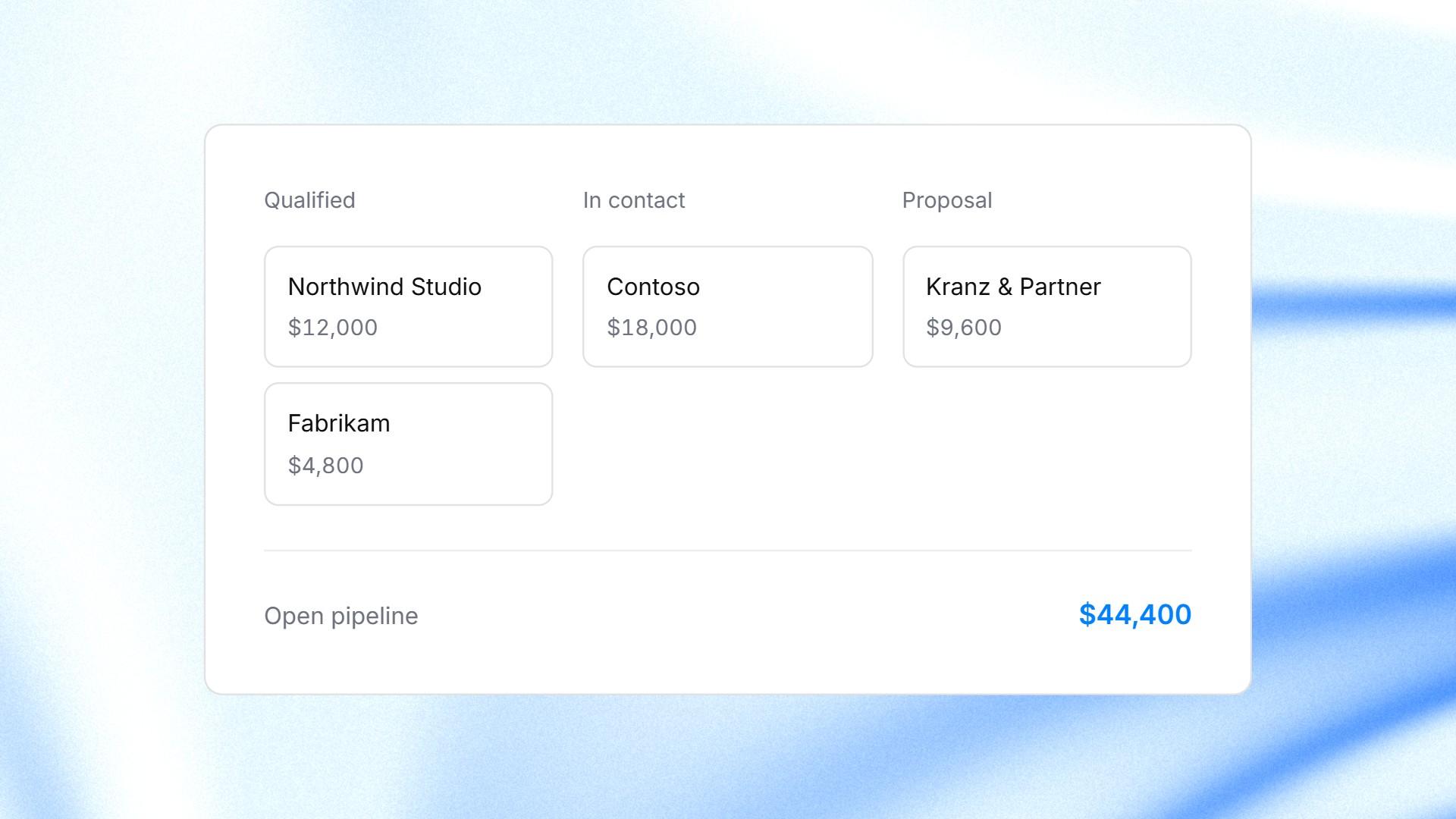
Deals in ManyPI's built-in pipeline. Sample data.
2. Google Sheets
Every small RevOps setup has a spreadsheet somewhere, and that's fine for planning. Google Sheets is where targets and territories are easiest to share and argue about.
The risk is that it becomes a second CRM. Once reps start keeping contact notes in a sheet, you have two versions of the truth. Keep planning in the sheet and customer records in the CRM.
3. Data Studio
Google's free reporting tool, Data Studio, turns data into shareable dashboards. For a small team it's enough for a weekly pipeline view and a monthly look at where deals came from.
A dashboard can't fix messy data. If stages mean different things to different reps, the chart will look precise and still be wrong. That's what item 5 is for.
4. Zapier
Even a lean stack has a few gaps, such as sending a form submission to the CRM or posting a closed deal in a team chat. Zapier connects apps without code, and it comes up in Reddit discussions as the glue most small teams reach for first.
Each automation is a small piece of software someone has to maintain. When one breaks quietly, records stop updating and nobody notices for weeks. Keep the list short and write down what each one does.
5. A written data dictionary
The cheapest RevOps tool is a one-page document that defines your fields and stages. What counts as a qualified lead? When does a deal move to "Proposal"? Who owns a contact after a meeting? Which source gets credit for a deal?
It takes an afternoon to write and saves arguments every week after. It needs one owner, though, or it drifts out of date the first time the process changes.
How to cut a stack down
Most stacks grow one tool at a time and never shrink. Here's a simple audit you can run in an hour, with the questions in the order to ask them.
Question | What to do with the answer |
|---|---|
Which jobs does each tool do? | List them side by side and mark every job done in two places |
Where does a contact's record live? | Pick one home and make everything else read from it |
Which tools did someone open last week? | The ones nobody opened are the first to cancel |
What breaks if a tool goes? | Move that job before you cancel, never after |
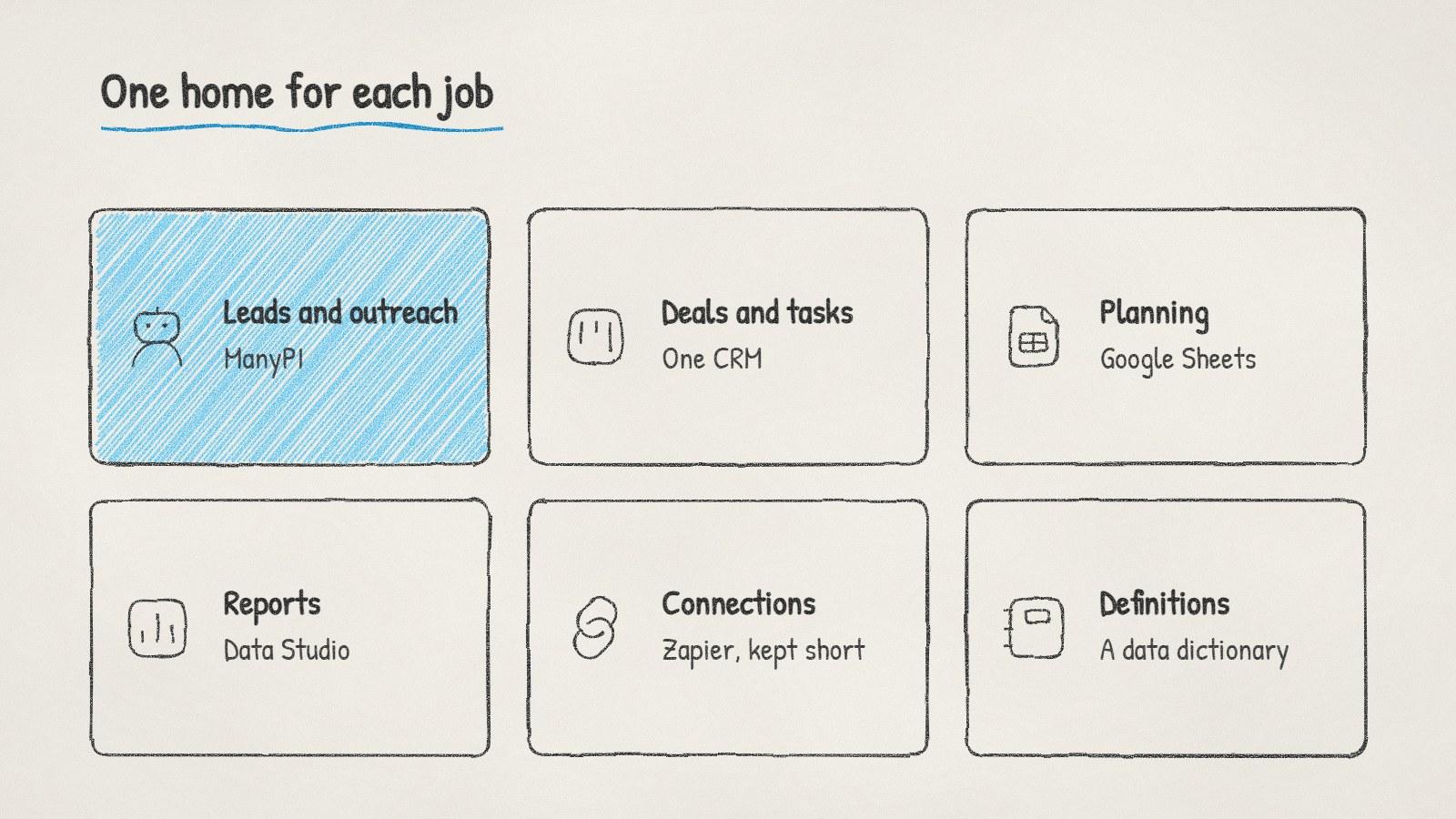
A lean stack with one home for each job.
Before you merge records from several tools, clean them. Our free lead list cleaner collapses duplicates, and our roundup of simple CRMs for cold outreach helps if the CRM itself is the tool to replace.
Where to read more on Reddit
Subreddit | What it's about | What to search there |
|---|---|---|
r/RevOps | Revenue operations: tools and data | tool consolidation, lean stack, source of truth |
r/SalesOperations | Sales ops work, from CRM hygiene to reporting | small team tech stack, CRM cleanup |
Where this stops applying: once you have several sales teams with different motions, one tool for everything gets harder to defend. Until then, every tool you don't add is one less thing to keep in sync.
Written by
Bastian W.
Content Manager / ManyPI