


TL;DR
New businesses choose an accountant, bank, insurer and website in their first weeks. Company registries list them as they're formed: filter out shells, find the founder's contact, and reach out within a month of incorporation.
Find leads with ManyPIA business in its first month is buying a lot at once: an accountant, a bank account, insurance, a website, a way to take payments. Many of those choices stick for years. If you sell any of them, the best time to show up is right after the company is formed, before the founder has asked a friend for a recommendation.
Company registries publish new registrations as they happen, and in some countries searching them is free. The work is in filtering out the shells and finding a way to reach the people who are actually starting something.
Where new registrations show up
Source | What it gives you | Cost |
|---|---|---|
UK Companies House advanced search | Every new company, filterable by incorporation date, location and industry code | Free |
US Secretary of State business searches | New LLCs and corporations, state by state | Free to search, bulk data sometimes paid |
County and city business licences or DBA filings | Local trading names and sole proprietors | Varies, often public |
Health, liquor and building permits | New restaurants, shops and clinics | Public in many places |
New map listings | Businesses that have opened their doors | Free |
In the UK, the Companies House advanced search lets you filter by incorporation date and location without an account. Each search shows the first 10,000 results, so Companies House suggests narrowing by date range to reach the rest.
In the US it depends on the state. Every Secretary of State has a business search, but how well it filters by formation date varies a lot. Some states sell bulk files of new filings, and several commercial providers resell that data.
Filter out the noise
A raw list of new registrations is full of companies that will never buy anything from you. Before you look for contacts, remove:
Holding companies and property vehicles. Names ending in "Holdings" or "Properties", with an investment or real estate industry code, rarely need what most vendors sell.
Shells registered at a formation agent's address. When hundreds of companies share one registered office, that address belongs to the agent, not the business.
Dissolved or strike-off companies. Check the status, since some close within months.
What's left should be companies with an industry code that matches real trading activity, and ideally a domain or website you can find by searching the name. Those are the founders actually opening for business.
What new businesses buy first
Need | Who sells it | Roughly when |
|---|---|---|
Accountant and bookkeeping | Accounting firms, bookkeepers | In the first weeks, often before the first invoice |
Business bank account | Banks, fintech accounts | Immediately |
Insurance | Brokers and insurers | Before trading, or before signing a lease |
Website and domain | Designers, agencies, site builders | First month or two |
Payments | Merchant services, payment providers | Before the first sale |
Payroll | Payroll providers, accountants | When the first employee starts |
If you sell something further down this list, you can afford to wait a few weeks. If you sell banking or accounting, earlier is better.
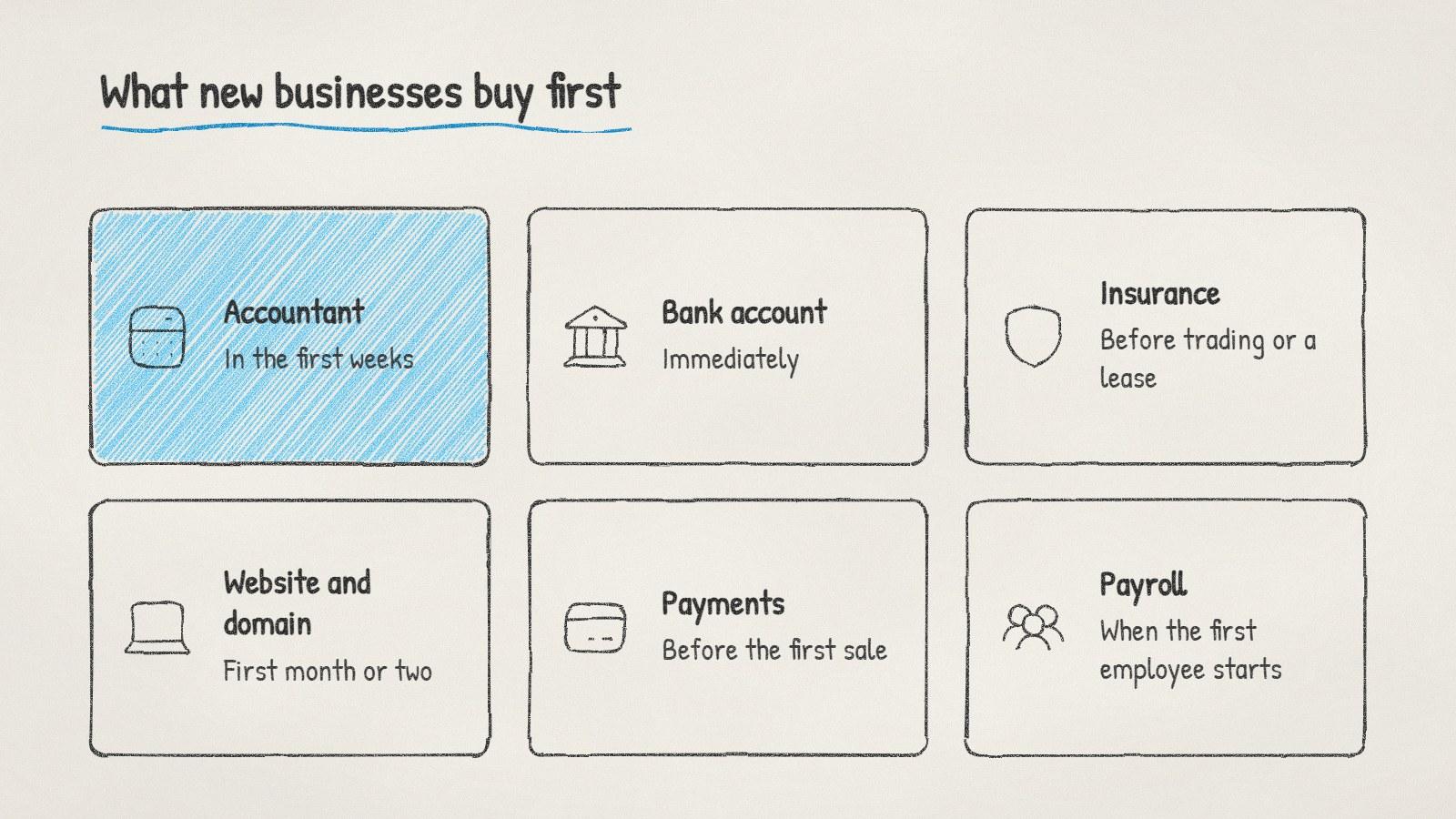
Roughly when a new business makes each of its first purchases.
Finding a way to contact them
Registries give you the company name, the registered address and the names of directors or members. They rarely give you an email or phone number.
From there, search for the company name to find a website or domain. A brand-new company often has a holding page or a single-page site with a contact address. The founder's email usually follows a simple pattern on that domain. Verify every address before sending, because new domains sometimes have no mailbox set up yet.
On the rules: in the UK, limited companies and LLPs count as corporate subscribers, and the ICO's guidance allows marketing emails to them without prior consent, as long as you identify yourself and offer an opt-out. Director names are still personal data under UK GDPR, so you need a lawful basis and should be able to say where you found them. In the US, CAN-SPAM applies.
What to say
Mention that they've just started, and offer something useful for that stage rather than a generic pitch:
Hi [Name], congratulations on setting up [Company] last month. [One thing founders at this stage usually have to sort out, from your own clients' experience.] I put together a short checklist for [type of business] in their first year, covering [one or two specifics]. Want me to send it over? No sales call attached.
A useful checklist or guide earns a reply far more often than "we'd love to be your accountant". The sales conversation can come second.
Doing it with ManyPI
Disclosure: ManyPI is our product.
The fastest route is to export new registrations from the registry, filtered and cleaned as above, and import the CSV into ManyPI. The agent then finds each company's website and the founder's or director's email, and checks every address against the receiving mail server before a campaign can use it. Campaigns send from your own inbox and stop the moment someone replies.
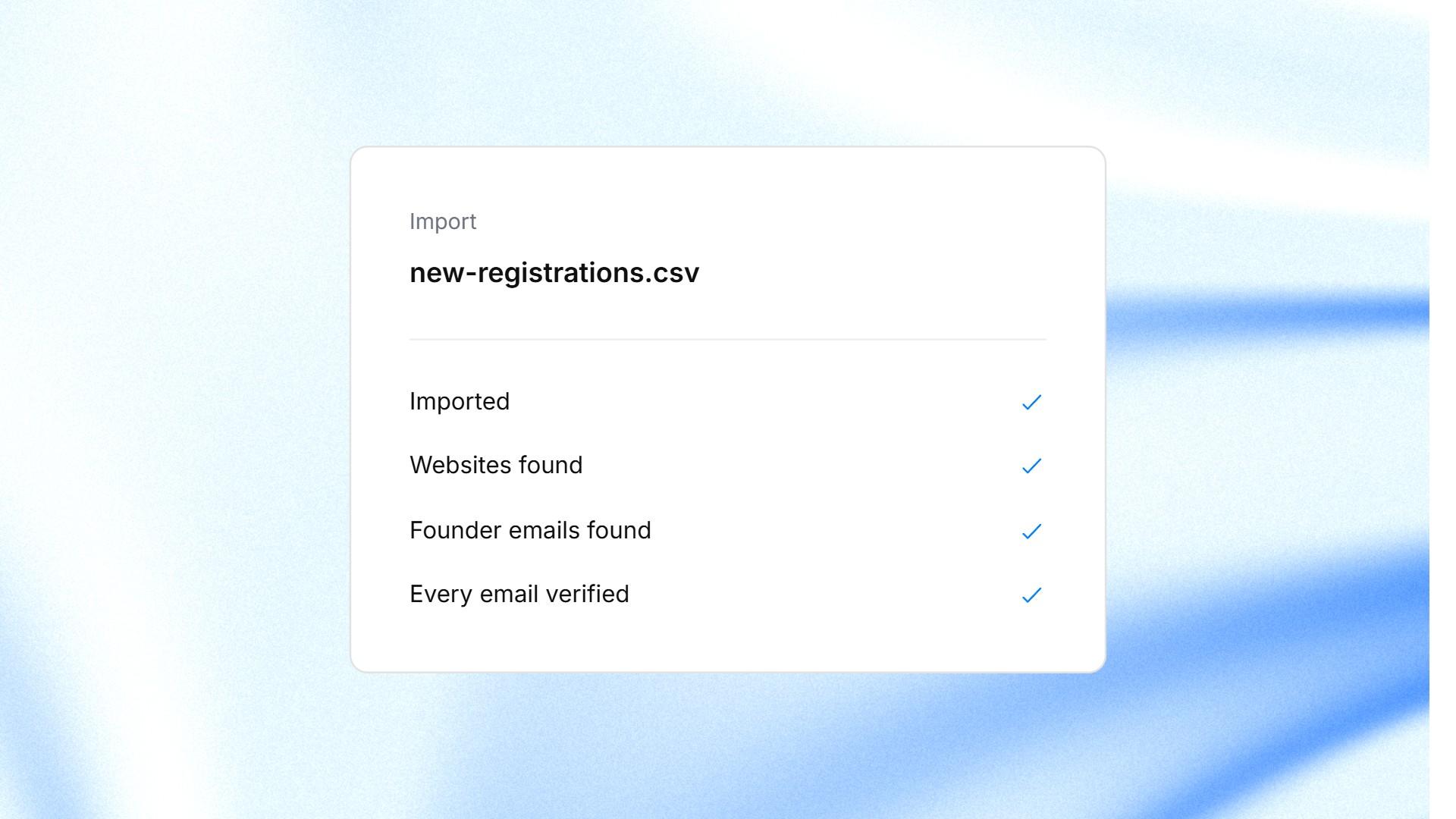
A registry export brought into ManyPI, with websites and founder emails found and checked.
If you'd rather catch businesses as they open their doors, Map Search lets you draw an area and save every business in it. Run the same area again a month later and filter to businesses not yet in your leads, and what's left is mostly new. The lead generation page shows how the pieces fit, and the free plan finds 50 leads with no card.
A warning before you scale this: new businesses get a lot of email in their first month. Send to fewer, better-filtered companies, and make the first message genuinely helpful. You want to be the email they're glad they got, not one of ten pitches in the same week.
Written by
Ole Mai
Founder / ManyPI