


Your growth model is not just a go-to-market choice. It shapes your pricing, onboarding, support load, sales motion, and even how your product gets built.
That is why the debate around product-led growth versus sales-led lead generation for SaaS matters so much. Pick the wrong primary motion, and you create drag everywhere. Customer acquisition gets expensive, conversion stalls, and sales and product pull in opposite directions.
Pick the right motion, or combine both with intent, and you create leverage. The product qualifies demand, sales closes bigger accounts, and marketing stops chasing vanity leads and starts building pipeline that actually converts.
What Is the Difference Between Product-Led Growth and Sales-Led Lead Generation for SaaS?
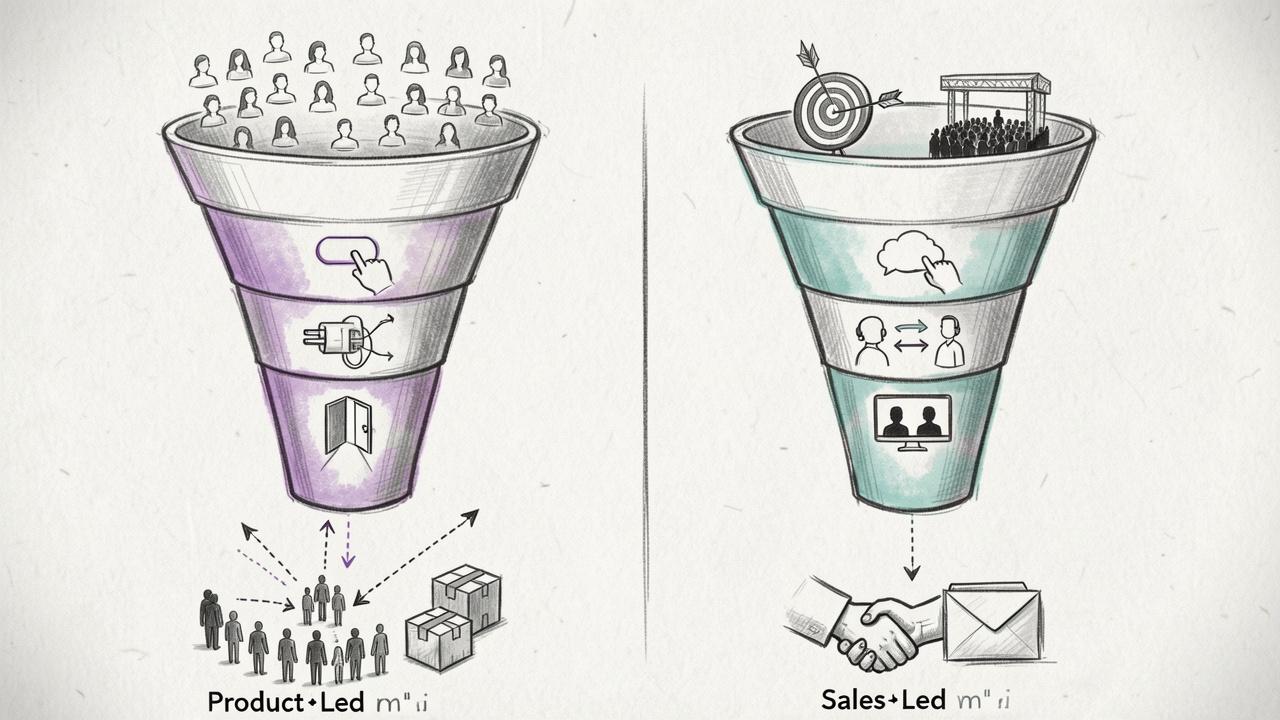
At a high level, product-led growth (PLG) means your product does the heavy lifting in acquisition, activation, conversion, and expansion. Prospects sign up, try the product, reach value quickly, and often buy with little or no human intervention. The product is not just what you sell, it is also how you sell.
body 0 0a27f2dd-f5a0-46c5-a15d-56388e205877
Sales-led lead generation, by contrast, relies on people and process to create and convert demand. Marketing and outbound teams generate leads. Sales development qualifies them. Account executives run demos, manage stakeholders, negotiate contracts, and close deals. The product matters, but it usually appears later in the buying journey.
For SaaS companies, this is not a simple either-or choice. It is a question of which motion leads, which one supports, and which one fits your market reality. A self-serve analytics tool for developers will not grow the same way as enterprise security software with a six-figure annual contract and a procurement review.
Product-led growth, in plain terms
In a PLG model, your funnel starts inside the product. A user lands on your site, signs up for a free trial or freemium plan, invites teammates, and experiences value before talking to anyone. If the onboarding works and the product solves a real problem fast, usage becomes pipeline.
This model works best when your product has a short time-to-value, low setup friction, and clear user-level benefits. Slack, Notion, Figma and many modern developer tools used this motion well. A single user can start small, prove value, and expand organically into a team or department.
Sales-led lead generation, in plain terms
In a sales-led motion, growth starts with targeted outreach, paid acquisition, partnerships, events, content capture, or account-based marketing. Instead of asking the prospect to discover value alone, your team guides them through it.
That matters when the product is complex, the purchase is expensive, or the buyer is not the day-to-day user. Think infrastructure software, compliance platforms, fintech systems, or data products that require integration before they become useful. In those cases, sales is not friction, sales is translation, coordination, and risk reduction.
The real difference is not product versus sales
Too many teams frame this as a culture war. Product wants self-serve, sales wants more demos, and marketing wants more leads. None of that helps.
The real difference is this: where does trust get built, and when does value become obvious? In product-led SaaS, trust often comes from immediate hands-on use. In sales-led SaaS, trust often comes from guided discovery, stakeholder alignment, proof of ROI, and managed implementation.
That is the core lens to use, not fashion or what worked for another startup. Your growth motion has to match how your buyers buy.
Key Aspects of Product-Led Growth vs Sales-Led Lead Generation for SaaS
The strongest way to evaluate product-led growth against sales-led lead generation for SaaS is to compare how each model handles the core parts of growth: acquisition, activation, conversion, expansion, and economics.
Acquisition looks cheaper in PLG, but only if activation is strong
PLG often appears more efficient at the top of the funnel. Users can sign up without waiting for a demo. Content, SEO, communities, integrations, and word-of-mouth drive traffic into self-serve onboarding. That can create a lower apparent cost per lead.
But there is a catch. If users do not reach value quickly, you are not generating demand, you are just collecting signups.
A sales-led funnel usually acquires fewer leads, but they are often more intentional. Someone booked the demo. Someone replied to outbound. Someone requested pricing. The volume is lower, but the buying signal is stronger. That can mean higher conversion rates later, even if acquisition costs look worse upfront.
Activation is where PLG wins or fails
body 1 37574478-0c15-45c8-bbc4-403783875c74
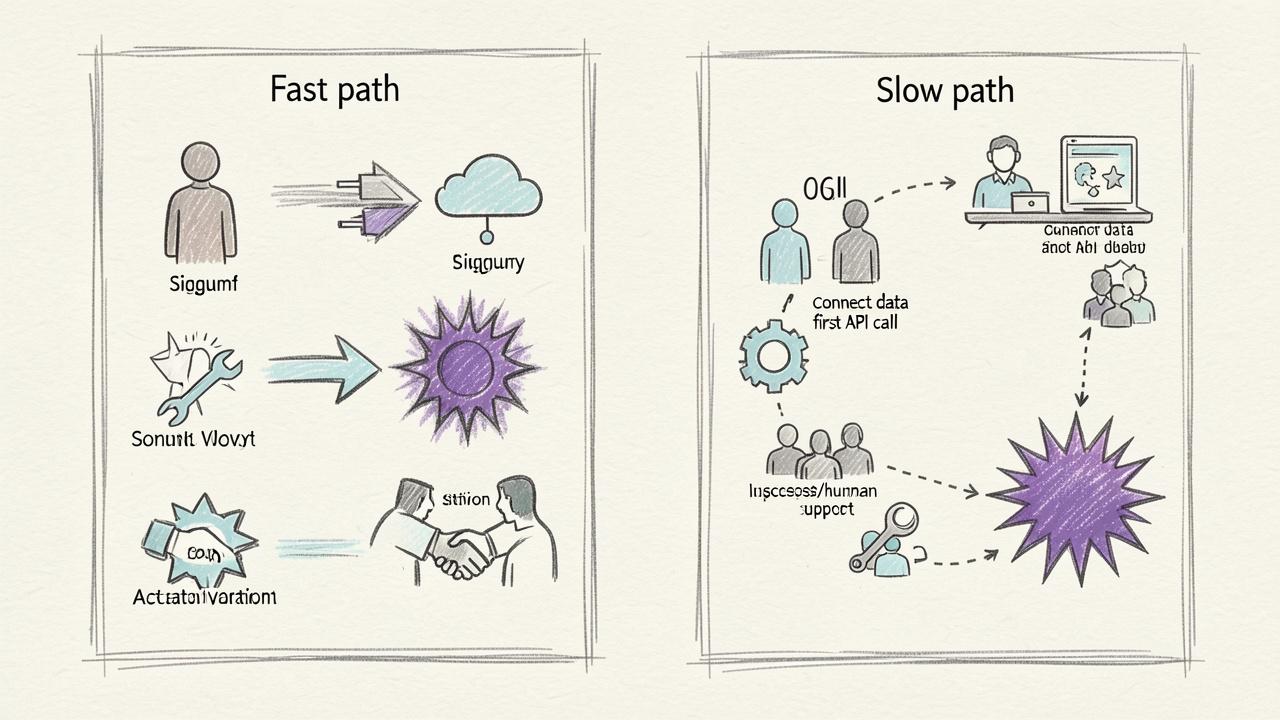
In product-led SaaS, activation is everything. If a user cannot get from signup to first value fast, the motion breaks. It does not matter how elegant your homepage is or how much traffic you generate.
Activation means different things depending on the product. For a developer tool, it might be making the first API call or syncing the first repository. For an analytics platform, it might be connecting a data source and generating the first dashboard. For a collaboration product, it might be inviting teammates and completing one shared workflow.
Sales-led companies still care about activation, but they can compensate for product friction with people. A good onboarding specialist or solutions engineer can help the customer get set up, align use cases, and prevent early drop-off. That support is expensive, but it is often necessary for high-value deals.
Conversion depends on price, risk, and buyer complexity
PLG performs best when individual users can adopt and buy with low organizational risk. Lower-priced tools, team software, and bottoms-up products fit naturally here. The faster someone can understand the value and swipe a card, the more PLG works in your favor.
Sales-led lead generation performs better when the purchase decision includes multiple stakeholders, budget approval, security review, legal review, or migration planning. In those situations, self-serve conversion often stalls because the product may be clear to the user but not to procurement, finance, or IT.
That is why many SaaS companies adopt a hybrid motion. Users enter through the product. Once usage, seat count, or account activity crosses a threshold, sales steps in. Product creates intent, sales captures expansion. This is often the most practical model for B2B SaaS.
Expansion is often stronger when PLG and sales work together
PLG is excellent at creating natural expansion signals. You can see team invites, feature adoption, usage depth, workspace growth, and account-level engagement in real time. Those signals are gold.
Sales-led teams are excellent at turning those signals into revenue. They can map stakeholders, package enterprise features, negotiate annual contracts, and close broader rollouts. Without that human layer, many high-potential accounts remain stuck on small plans.
This is where many startups miss the opportunity. They think PLG means no sales. It does not. It means the product creates the wedge, and sales then amplifies the revenue outcome.
The economics are different, not universally better
PLG can lower customer acquisition cost over time, but it demands serious investment in onboarding, in-app education, lifecycle messaging, instrumentation, pricing design, and support systems. It is not a cheap motion, it simply shifts cost from headcount-heavy selling to product and growth infrastructure.
Sales-led lead generation carries higher direct personnel costs, but it may produce larger contract values, faster enterprise trust, and more predictable revenue in certain markets. If one account is worth $50,000 to $250,000 per year, spending money on account executives and solutions engineers can make complete sense.
Here is a cleaner comparison:
Dimension | Product-led growth | Sales-led lead generation |
Primary driver | Product usage and self-serve adoption | Human outreach, qualification, and demos |
Best fit | Low-friction, fast time-to-value SaaS | Complex, high-ticket, multi-stakeholder SaaS |
Top-of-funnel volume | Higher | Lower |
Lead intent clarity | Often weaker at signup, stronger with usage data | Stronger earlier if demo or outreach is qualified |
Activation dependency | Extremely high | High, but support can offset friction |
Sales cycle length | Shorter for self-serve plans | Longer, usually more structured |
Average contract value | Often lower at entry, expands over time | Often higher at close |
Expansion motion | Usage-led, often bottoms-up | Relationship-led, often top-down |
Key risk | Lots of signups, little conversion | Expensive pipeline generation with slow close rates |
Metrics tell you which motion is actually working
A lot of teams say they are product-led because they offer a free trial. That is not enough. A product-led motion only works if users move through meaningful product milestones.
For PLG, the important questions are simple. What percentage of signups activate? How long does it take them to reach first value? How many invite teammates? What share converts without sales help? Which behaviors predict paid conversion and retention?
For sales-led SaaS, the focus shifts. Which channels produce qualified pipeline? How fast are leads contacted? What is the demo-to-opportunity rate? What is the win rate by segment? Where do deals stall? How long is payback on acquisition spend?
The best SaaS teams do not argue philosophy. They instrument both motions well enough to see reality.
Team structure changes based on the model
PLG requires a deep partnership between product, growth, lifecycle marketing, customer success, and analytics. You need event tracking, funnel visibility, onboarding experiments, pricing tests, and a clean view of user behavior. Product managers and growth marketers become central revenue operators, not just feature shippers.
Sales-led growth needs strong handoffs between marketing, SDRs, account executives, and post-sale teams. Messaging consistency matters. Qualification criteria matter. CRM discipline matters. So does account intelligence.
If your internal operations are weak, both motions break in different ways. PLG produces silent churn. Sales-led growth produces bloated pipelines and forecast misses.
How to Get Started With Product-Led Growth or Sales-Led Lead Generation for SaaS
The right place to start is not with a template. Start with your buyer, your product, and your sales reality.
First, match the motion to your market
Ask three direct questions. Can a user experience meaningful value on their own? Is the product easy enough to adopt without heavy implementation? Can one person start using it before the company formally buys it?
If the answer is mostly yes, PLG deserves serious consideration. If the answer is mostly no, forcing a self-serve motion will just create churn and confusion.
Now flip the lens. Does your average deal require security review, legal approval, multiple stakeholders, custom packaging, or integration support before value appears? If yes, a sales-led model is likely necessary, even if you still use the product for trials and proof.
Second, define your activation point
If you want a product-led engine, you need one hard definition: what action proves the user has reached first value? Not visited a dashboard. Not clicked around. Real value.
This single definition sharpens everything. Onboarding gets clearer. Lifecycle emails become more relevant. Product analytics become useful. You can finally separate empty signups from qualified product demand.
For sales-led teams, define the equivalent milestone inside the pipeline. It may be a completed discovery, a technical validation, or a successful proof of concept. The goal is the same, identify the moment the opportunity becomes real.
Third, pick one primary motion, then add support
Many startups hurt themselves by trying to build full PLG and full enterprise sales at the same time. That sounds ambitious, but in practice it splits focus, confuses pricing, and creates internal conflict.
Instead, choose a lead motion. If PLG leads, design self-serve onboarding, in-product prompts, usage-based qualification, and lifecycle conversion paths first. Then add sales assist where account behavior justifies it.
If sales leads, invest in targeting, positioning, outbound quality, demo execution, and customer proof. Then use the product to accelerate evaluation and shorten the path to trust.
A simple decision framework helps:
If this is true | Your likely primary motion |
Users can adopt alone in minutes or hours | Product-led growth |
Value appears only after setup, integration, or training | Sales-led lead generation |
One user can start, but broader rollout needs approval | Hybrid, PLG plus sales assist |
Contract value is high and buying risk is high | Sales-led, with product proof points |
Fourth, instrument handoffs between product, marketing, and sales
This is where many good strategies fail. Teams do not agree on when a user becomes a lead, when a lead becomes product-qualified, or when sales should engage.
Set clear thresholds. For example, sales might engage when an account reaches a usage limit, adds multiple users, connects a critical integration, or views enterprise pricing. Product and marketing should know exactly what those signals mean. Sales should trust them.
That alignment turns scattered usage data into pipeline. Without it, PLG becomes a pile of dashboard screenshots nobody acts on.
Fifth, test packaging and pricing against the motion
Your pricing model should reinforce how you grow. Freemium, free trials, usage-based pricing, and transparent tiers often support product-led adoption because they reduce commitment and let users scale naturally.
Custom pricing, annual contracts, onboarding packages, and enterprise controls support sales-led deals because they align with negotiated buying behavior.
The mistake is mixing signals carelessly. If your website says "start free" but the product is unusable without implementation help, users bounce. If your product is easy to adopt but pricing is hidden behind forms, you introduce friction where none is needed.
Sixth, build a hybrid model only after the basics work
A hybrid approach is powerful, but only when each side does its job. The product must create real usage and qualification signals. Sales must know how to engage without slowing momentum. Marketing must segment messaging for self-serve users and enterprise buyers without sounding like two different companies.
When it works, hybrid is hard to beat. A developer or operator starts using the product. The team adopts it. Usage expands. Sales enters with context, not cold outreach. The conversation starts from proven value, not hypothetical value.
That is a much stronger position than either pure self-serve or pure outbound in isolation.
Conclusion
The choice between product-led growth and sales-led lead generation in SaaS is really a choice about how customers discover value, build trust, and justify purchase. PLG shines when the product can prove itself quickly. Sales-led growth wins when complexity, risk, or deal size demands human guidance. Most serious B2B SaaS companies eventually use both, but one should lead.
Your next step is simple. Audit your buyer journey from first touch to paid conversion. Find where value becomes clear, where deals stall, and where human help actually increases win rate. Then build the motion that fits that reality, not the one that happens to be fashionable.
Written by
Bastian W.
Content Manager / ManyPI