

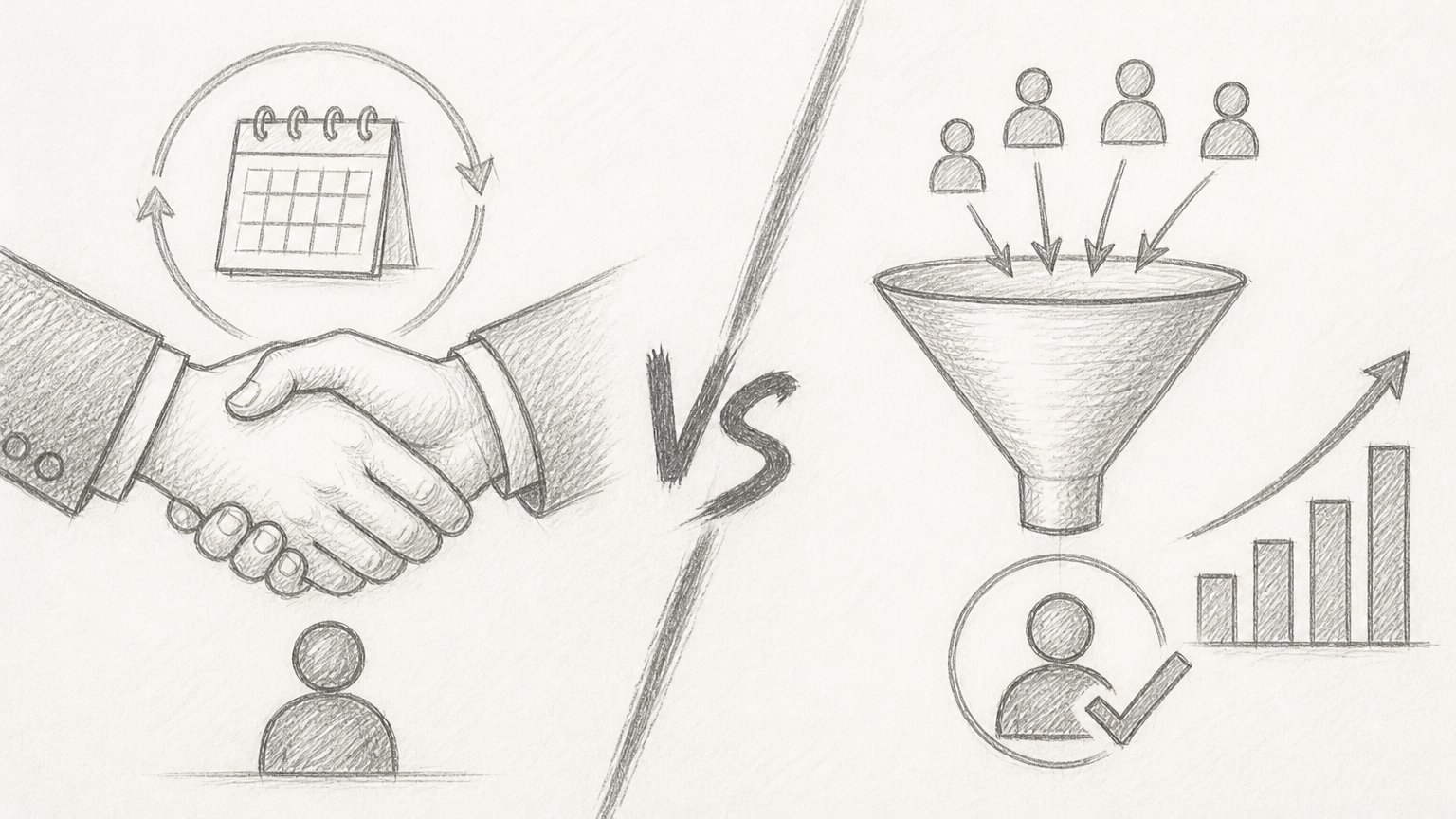
If your lead generation model is wrong, everything downstream gets harder. Sales forecasts slip. CAC gets noisy. Your team spends time managing client expectations instead of building pipeline.
That is why the retainer versus project debate matters so much. If you run lead gen for clients, or you hire an external partner to do it, the pricing model does more than shape revenue. It changes behavior, reporting, campaign depth, and ultimately conversion quality.
The short answer is simple: retainer-based lead generation usually converts better over time, while project-based lead gen can convert faster in narrow, well-defined situations. The better choice depends on your sales cycle, data maturity, offer complexity, and how much testing your funnel actually needs. Most teams underestimate that last part.
Agencies weigh this pricing question in r/agency and r/LeadGeneration.

body 0 6201d867-e16d-4ce7-860a-a7ea31832c15
What Retainer-Based and Project-Based Lead Generation Really Mean
Retainer-based lead generation is an ongoing engagement. The client pays a recurring monthly fee, typically for a defined scope that includes strategy, outreach, optimization, reporting, and continuous iteration. It is built for compounding gains.
Project-based lead generation is fixed-scope work. The client hires a team or agency to complete a specific deliverable, campaign, or lead target within a set timeline. It is built for speed, control, and short-term execution.
On paper, both models can produce leads. In practice, they create very different incentives.
A retainer rewards consistency. The provider can spend time improving targeting, fixing messaging, enriching contact data, tightening qualification rules, and learning from sales outcomes. That matters because lead gen rarely works at full efficiency on the first pass, it improves through repetition.
A project rewards completion. The provider is pushed to deliver the agreed output, often within tight deadlines and without much room for iteration. That can work well when the audience is clear, the messaging is proven, and the client only needs execution. It breaks down when the funnel still has open questions.
Why This Comparison Matters More Than Most Teams Think
A lot of companies compare these models only on price. That is a mistake.
You are not just buying leads. You are buying a system for identifying buyers, reaching them, qualifying them, and feeding your sales motion with signals your team can trust. If your market is crowded, your deal size is high, or your product needs education, conversion quality matters more than raw lead volume.
This is where many project-based engagements disappoint. They may hit a contact count or booking target, yet still fail to create pipeline that closes. The surface metrics look fine. Revenue says otherwise.
Conversion Better, According to What?
Before deciding which clients convert better under a retainer or project structure, define conversion clearly. Different teams use the word loosely.
For most startups and B2B growth teams, the useful sequence looks like this:
Stage | What it means | Why it matters |
|---|---|---|
Lead | A contact that matches basic ICP filters | Good for volume tracking, weak for revenue decisions |
A lead that fits stronger qualification criteria | Helps marketing measure targeting quality | |
SQL or Opportunity | A lead accepted by sales and moved into pipeline | Stronger signal of real buying intent |
Closed-Won Customer | A converted client or account | The only conversion that fully matters |
If you judge success at the top of the funnel, project-based lead gen can look strong. If you judge success by opportunities and revenue, retainers usually gain the advantage because they give enough time to improve fit and intent.
Key Aspects That Decide Which Lead Gen Clients Convert Better
The real answer to the question, which model produces better-converting clients, is not ideological. It is operational. Conversion rates improve when the engagement model matches the complexity of the market.
Retainer-Based Lead Gen Usually Wins When Learning Matters
Most lead generation campaigns need tuning. Lists need cleaning. Messaging needs testing. Sales objections need to be fed back into outreach. Segments that looked promising on paper often underperform once the campaign is live.
A retainer gives you room to make those corrections. That changes outcomes in a big way.
In month one, you might discover that CTOs reply but do not buy, while heads of operations book fewer calls yet convert at a much higher rate. In month two, the campaign shifts. The targeting gets sharper. The copy reflects actual objections. The meeting rate may stay flat, but the pipeline quality rises.
That is the core advantage of a retainer. It supports feedback loops. Better loops create better conversions.

body 1 42760b01-8d8e-473b-85a1-0a63f72ca7be
Project-Based Lead Gen Wins When the Brief Is Already Tight
Project-based work can outperform a retainer in very specific conditions. Usually, that happens when the client already knows exactly who they want, what message works, and what outcome defines success.
Think of a company launching into a new geography with a validated outbound playbook. Or a data vendor that needs a one-time list build and outbound sprint around a time-sensitive offer. In those cases, speed matters more than long-term optimization.
The project model also works well when internal teams are strong. If your product marketing, sales ops, and SDR management are already mature, an external provider may only need to plug into a clear machine. There is less need for strategic discovery because the answers already exist.
The problem is that many teams think they are in this category when they are not.
Client Quality Depends on Sales Cycle Length
The longer the sales cycle, the stronger the case for a retainer.
Short-cycle offers can survive rougher targeting. If a low-friction service converts quickly and the price point is modest, a project campaign may still generate acceptable returns. The margin for error is larger.
High-ticket B2B sales do not work like that. If your deals involve multiple stakeholders, security reviews, procurement, demos, and legal, the first conversation has to be much better qualified. Bad-fit meetings are expensive. They waste calendar time, reduce morale, and distort your funnel data.
Retainer-based lead gen tends to produce better-fit prospects in these environments because the campaign can evolve around real sales feedback, not just initial assumptions.
Data Quality Has a Bigger Impact Than Most Teams Admit
Lead generation is only as strong as the data underneath it. Contact accuracy, account enrichment, buying signals, firmographic filters, and CRM hygiene all shape conversion.
A project model often underinvests here. Not because providers are careless, but because fixed-scope work pushes them toward output efficiency. There is less commercial incentive to rebuild segments, verify every source, or create stronger enrichment logic unless that work is explicitly scoped.
A retainer supports deeper data work. That can include ongoing verification, disqualification rules, account scoring, reply analysis, and CRM feedback mapping. Those details are not glamorous. They do convert better.
For technical teams, this matters even more. If your product serves developers, platform engineers, or data leaders, shallow segmentation fails fast. These buyers respond to relevance, not volume. You need targeting built around stack, team maturity, infrastructure pain, and timing. That level of specificity is hard to get from a one-off brief.
Incentives Shape Behavior, and Behavior Shapes Results
This is the part buyers often miss. Pricing models influence execution.
Under a retainer, the provider benefits by keeping the client, improving results, and preserving trust over time. That usually leads to more realistic planning, better reporting discipline, and stronger collaboration with sales.
Under a project, the provider benefits by finishing the agreed scope efficiently. That can still produce excellent work, but it naturally prioritizes delivery over learning. If early assumptions are wrong, there is often friction around changing direction.
Neither model is morally better. But they are behaviorally different. And in lead gen, behavior compounds.
The Best Conversion Model Depends on Funnel Stability
A stable funnel can handle project work. An unstable funnel usually needs a retainer.
If your offer is established, close rates are predictable, your ICP is clear, and your sales team consistently turns qualified meetings into pipeline, then lead gen becomes more of a throughput problem. Project-based support can be enough.
If your funnel is still being figured out, a project can hide the real issue. You may blame poor lead quality when the actual problem is message-market fit, unclear qualification, or weak handoff between marketing and sales.
A retainer is better at surfacing and correcting those problems because it creates continuity. You can trace patterns over time instead of judging success from a single campaign snapshot.
Retainer vs Project Lead Gen, Side-by-Side
The difference becomes clearer when you compare the two models across the factors that influence conversion.
Factor | Retainer-Based Lead Gen | Project-Based Lead Gen |
|---|---|---|
Primary goal | Continuous pipeline growth | Fixed deliverable or short-term campaign |
Optimization window | Ongoing, with room for testing | Limited to project timeline |
Best for | Complex offers, long sales cycles, evolving ICP | Clear briefs, proven messaging, short sprints |
Data refinement | Stronger over time | Often limited by scope |
Sales feedback integration | High | Moderate to low |
Reporting depth | Usually more strategic and trend-based | Usually milestone-based |
Speed to launch | Slightly slower at the start | Often faster |
Lead quality over time | Typically improves month by month | Can plateau quickly |
Budget predictability | Stable monthly cost | Defined project cost |
Risk | Longer commitment if fit is poor | Less commitment, but less learning |
This table explains why asking which model converts better without context is incomplete. The better question is this: which model gives your team the highest probability of producing sales-accepted pipeline, given the current state of your funnel?
Where Retainers Commonly Outperform Projects
Retainers tend to produce stronger conversion outcomes when the lead gen motion depends on iteration.
When Your ICP Is Broad on Paper but Narrow in Reality
Many companies start with an ICP that sounds precise but is still too loose. They target "mid-market SaaS" or "data-driven companies" and expect that to be enough. It is not.
Actual conversion often happens in a much smaller pocket. Maybe the best-fit accounts are B2B SaaS firms between 100 and 400 employees, with a recently hired VP of Data, using a modern warehouse, and actively hiring analysts. That insight usually emerges from testing, not assumptions.
A retainer lets you narrow toward what is real. Project work often stops before that refinement pays off.
When Messaging Needs to Be Built From Live Market Feedback
Good outbound messaging is rarely written once. It is shaped by opens, replies, objections, no-shows, demo notes, and closed-lost analysis.
Retainer engagements can absorb that learning. Copy evolves. Positioning gets sharper. Qualification criteria become stricter. This is how average lead gen becomes reliable lead gen.
Project-based campaigns may test some messaging, but they often lack enough runway to convert those learnings into a more profitable system.
When Multiple Teams Need to Stay Aligned
Lead gen is not just a marketing task. It touches RevOps, sales, data, product marketing, and sometimes founder-led sales too.
If your handoffs are messy, a fixed project can create more noise than value. Leads arrive, but definitions are unclear. Follow-up timing is inconsistent. CRM statuses are unreliable. Nobody is sure what "qualified" means. Conversion suffers.
A retainer gives your teams time to create shared definitions and improve process. It supports alignment, and alignment improves close rates.
Where Project-Based Lead Gen Can Convert Better
Project-based lead gen is not the weaker model by default. It is simply more conditional.
When You Need a Controlled Test
A project is often the smartest way to validate a channel, segment, or market before committing to a longer engagement.
If you want to test outbound into a new vertical, a short project can tell you whether reply rates are viable, whether the offer lands, and whether your sales team can convert meetings from that audience. You contain spend while gathering signal.
In this scenario, better conversion is not just closed revenue. It is quality learning per dollar spent.
When the Offer Is Simple and Urgent
Some campaigns are built around a narrow offer with a clear timeline. Event-driven prospecting. Product launch outreach. Re-engagement of dormant accounts. Territory-specific list activation.
Here, the project model can be highly efficient. The scope is known. The timeline is finite. The message is stable enough to execute without months of tuning.
That does not mean every urgent campaign should be project-based. It means urgency favors focus, and projects are often better at forcing focus.
When You Need Specialized Execution, Not Strategy
Sometimes the strategic work is already done. You know the ICP. You have conversion data. Your internal team has the sequence, landing pages, offer positioning, and qualification framework locked in.
What you need is execution capacity: list building, enrichment, outbound ops, meeting setting. A project can fit perfectly here because you are not paying for a discovery-heavy engagement when discovery is no longer the bottleneck.
How to Tell Which Clients Are More Likely to Convert Before You Choose a Model
The best buyers ask a harder question than retainer versus project. They ask, what conditions make conversion likely in the first place?
Look at Funnel Maturity First
If your funnel is immature, choose the model that buys learning.
That means a retainer in most cases. Early-stage teams often need to discover who responds, who buys, what objections stall momentum, and what signals correlate with real deal creation. A recurring engagement gives you enough cycles to separate noise from pattern.
If your funnel is mature, a project can work because the unknowns are smaller.
Look at Your Feedback Infrastructure
Do you have a clean handoff from marketing to sales? Are opportunity stages trustworthy? Can you trace booked meetings to pipeline and closed-won revenue? Does someone review lost reasons in a structured way?
If the answer is no, a project may underperform simply because nobody can learn from it fast enough. Retainers do better in environments where measurement needs to improve alongside outreach.
For data teams, this point should stand out. If your attribution is loose and your qualification logic is inconsistent, you are not evaluating lead gen. You are evaluating a foggy version of it.
Look at Internal Bandwidth
A project sounds lower-effort, but that is not always true.
If the provider has to rely on your team for constant clarification, approvals, targeting adjustments, and sales feedback, a short project can become rushed and chaotic. Retainers spread that load over time and create working rhythm.
If your team is already overloaded, the higher-conversion option is often the one that creates operational breathing room, not just lower initial cost.
How to Get Started With the Right Lead Gen Model
Choosing between retainer-based and project-based lead generation gets easier when you assess your situation honestly. Not aspirationally. Not based on how mature you want the funnel to be. Based on how it works today.
Start With One Diagnostic Question
Ask this: Do you need answers, or do you need output?
If you need answers, choose a retainer. You are still learning the market, the message, or the qualification model. The engagement needs room to adapt.
If you need output, a project may be enough. You already know what works and simply need more execution against a proven playbook.
That one question cuts through a lot of confusion.
Define Success at the Opportunity Level
Do not buy lead gen against top-of-funnel vanity metrics alone. Set success criteria at the opportunity stage whenever possible.
A booked meeting is not proof of quality. Even positive reply rates can be misleading. Ask whether the engagement will be measured by meetings, sales-accepted leads, opportunities, or revenue influence. The closer you get to pipeline, the more honest the evaluation becomes.
This is especially important when comparing clients that convert under different pricing models. Retainers often look more expensive until you measure downstream impact. Then the math changes.
Scope the Unknowns Before You Sign
Before committing to either model, clarify four things:
Question | Why it matters |
|---|---|
How clear is the ICP? | Low clarity favors a retainer because targeting will evolve |
How proven is the messaging? | Unproven messaging needs iteration, not just launch |
How long is the sales cycle? | Longer cycles raise the cost of bad-fit leads |
How strong is sales feedback? | Better feedback supports better optimization |
Those four variables explain a large share of conversion differences between retainer and project lead gen.
Run a Smart First Engagement
If you are unsure, there is a practical middle path. Start with a tightly defined initial phase that behaves like a structured learning sprint, then convert into a retainer if the campaign needs ongoing optimization.
That first phase should focus on signal collection, not just activity. You want to learn which segments respond, which personas convert to real pipeline, and which objections repeat. If the answers are clear and stable, project work may continue to make sense. If the answers keep evolving, a retainer becomes the rational next step.
This approach protects budget without forcing a false binary too early.
Common Mistakes That Distort Conversion Results
A lot of teams think they are evaluating lead gen models when they are really measuring setup mistakes.
One common error is comparing a fresh project campaign against a mature retainer campaign. That is not a fair test. The retainer has already absorbed months of learning. Of course conversion looks better.
Another mistake is judging a retainer too early. Ongoing lead gen often improves after the first cycles of testing and feedback. If you expect month-one efficiency from a campaign that is still discovering fit, you may cut the higher-performing model before it compounds.
The third mistake is confusing more leads with better leads. High activity can feel productive. It is not the same as qualified pipeline. If your SDRs are busy but your win rates are soft, the model is not working well enough.
Which Model Usually Converts Better?
For most B2B companies selling considered purchases, retainer-based lead generation converts better over time. It creates the conditions that conversion actually depends on: iteration, targeting refinement, sales feedback, and process continuity.
For narrow campaigns with clear inputs and short timelines, project-based lead gen can convert better in the short term. It is often faster to launch, easier to budget, and effective when the work is execution-heavy rather than discovery-heavy.
That is the real answer. Not one model always wins, but one model usually fits the underlying problem better.
If your funnel still needs learning, choose the structure that supports learning. If your funnel is already proven, choose the structure that scales execution cleanly.
The next step is simple. Audit your current funnel honestly. Look at ICP clarity, messaging maturity, sales cycle length, and feedback quality. Then pick the model that matches reality. That is how you improve conversion, not just lead volume.
Click here to find out more about Lead Generation for Marketing Agencies.
Written by
Bastian W.
Content Manager / ManyPI