

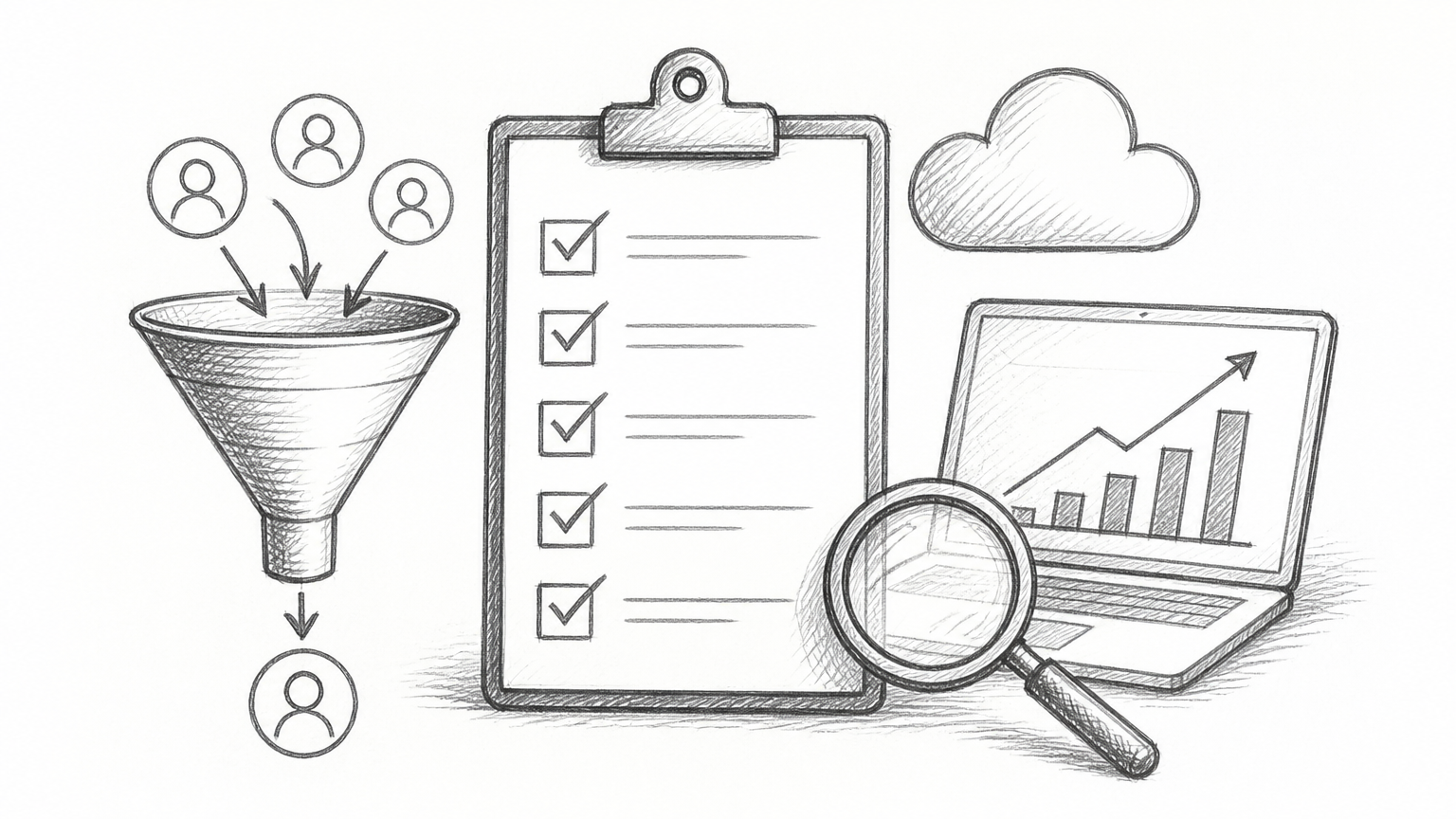
Your pipeline is not broken. Your SaaS lead generation checklist probably is.
Most teams do not fail because they lack tools. They fail because demand capture, outbound, website conversion, qualification, routing, and follow-up all live in separate motions. Marketing drives traffic. Sales sends sequences. Product builds a free trial. Ops patches the gaps. Leads leak anyway.
A good checklist fixes that. It turns lead gen from a set of disconnected tactics into a repeatable system. If you are building or scaling a SaaS motion, this guide gives you a practical checklist you can use to find better-fit prospects, convert more of them, and move them into pipeline with less waste.
What Is a SaaS Lead Generation Checklist?
A SaaS lead generation checklist is a structured way to audit and improve the steps that turn attention into pipeline. It covers the full path: who you target, how you attract them, what happens when they land on your site, how you qualify them, and how quickly you act on buying signals.
That matters more in SaaS than in many other businesses. You are not usually selling a one-time product with a short decision cycle. You are selling recurring value, often to multiple stakeholders, with onboarding, adoption, and retention tied to the original acquisition fit. Weak lead gen creates more than low volume. It creates the wrong pipeline.
A strong checklist also forces alignment across teams. Marketing can see whether campaigns bring in qualified demand. Sales can see whether outreach matches the ideal customer profile. Product and growth teams can see whether the trial or demo path reduces friction or adds it. Data teams can measure where the system slows down.

body 1 d357e94d-83b4-4a2b-adf1-1a84bdb4b7b0
Think of it as an operating document, not a static template. Your checklist should evolve as your pricing changes, your customer base matures, and your go-to-market motion shifts from founder-led selling to a more specialized revenue engine.
Key Aspects of a SaaS Lead Gen Checklist
The best SaaS lead generation checklist starts with focus. If you are trying to sell to everyone, your messaging will blur, your channels will sprawl, and your conversion rates will collapse. Start with a clear ideal customer profile, then pressure-test it against actual revenue, retention, and expansion data.
You should know which segments close fastest, stay longest, and create the least support burden. A startup selling workflow software to ten-person agencies has a very different lead gen model than a B2B platform selling security tooling to enterprise IT. The checklist must reflect that reality.
Confirm Your Ideal Customer Profile
Before you spend more on traffic or outbound, verify that your ICP is specific enough to guide execution. Industry and company size are only the beginning. You also need to understand buyer role, urgency, trigger events, technical maturity, current stack, and budget logic.
A vague ICP creates vague campaigns. For example, “SaaS companies” is not a target market. “Series A to C B2B SaaS companies with sales teams of 20 to 100 reps, using multiple data tools, and struggling with lead routing speed” is the start of one. The more precise you are, the easier it becomes to write copy that sounds relevant instead of generic.
Tighten Your Value Proposition
Once your ICP is clear, your value proposition needs to answer a simple question, why should this buyer care right now? Not in theory. Not eventually. Right now.
Strong SaaS messaging is outcome-first. It names a pain, a bottleneck, or a missed opportunity in language the buyer already uses. Then it ties your product to a measurable improvement. Save “AI-powered” or “all-in-one platform” for later, if at all. Buyers care about shorter sales cycles, cleaner reporting, fewer manual steps, faster onboarding, lower churn, and better team output.
If your homepage headline could fit fifty competitors, it is too weak. If your category page does not match the intent of the searcher who lands there, it is too vague. If your outbound message reads like a template, it will perform like one.
Audit Channel-to-Message Fit
Lead gen breaks when the message stays the same across every channel. Search, outbound email, paid social, review sites, partner referrals, and content marketing all bring in leads with different levels of awareness and intent. They should not all see the same pitch.
High-intent search traffic often needs proof and a clear conversion path. Cold outbound needs a sharp trigger and a reason to reply. Educational content should frame the problem, build trust, and help the reader self-qualify. Product-led channels should remove friction and create a fast path to value.
This is where many teams waste budget. They push one generic asset into five channels, then blame the channel when conversion drops. The checklist should force you to inspect message-channel fit, not just channel spend.
Check Your Website Conversion Path
Your website is not just a brand asset. It is a conversion environment. Every important page should guide the visitor toward a next step that matches their level of intent. That might be a demo, a free trial, a pricing view, a comparison page, or a high-value downloadable resource.
Too many SaaS sites ask for too much, too soon. A visitor in research mode does not always want to “book a call.” A ready-to-buy visitor should not need six clicks to find pricing, integrations, or security details. Friction kills momentum.
Look closely at your forms, navigation, CTA placement, page speed, social proof, and mobile experience. If users cannot tell what the product does in a few seconds, the problem is not traffic quality. It is clarity.
Review Lead Capture and Qualification Logic
Capturing more leads is not the same as creating more pipeline. Your checklist should distinguish between conversion volume and sales-ready demand.
That means reviewing what happens after the form fill or sign-up. Are you collecting enough information to route leads intelligently? Are you over-gating with long forms that reduce conversion? Are you using progressive qualification over time? Are high-intent actions, such as viewing pricing multiple times or inviting teammates, treated differently from low-intent content downloads?
This is where marketing, sales, and ops need shared definitions. A lead, an MQL, a PQL, and an SQL should not mean different things in different dashboards. If they do, attribution and forecasting become unreliable fast.
Verify Speed to Lead and Follow-Up
A lead gen system is only as strong as the handoff. You can have excellent targeting and sharp conversion pages, but if follow-up is slow or inconsistent, qualified demand cools off.
Speed matters because buyer intent decays quickly. Someone who requests a demo while evaluating vendors expects a fast response. Someone who signs up for a trial and gets no in-app guidance may never activate. Someone who replies to outbound and waits two days for a response may move on entirely.
Your checklist should examine response time, routing rules, SDR capacity, automation logic, and what the prospect receives in the first hour, first day, and first week. In SaaS, first-touch follow-up is not an operational detail. It is part of conversion.
Measure What Actually Predicts Revenue
Vanity metrics are everywhere in lead gen. Clicks, impressions, traffic spikes, and raw lead counts can make the dashboard look healthy while pipeline quality deteriorates.
You need to track metrics that connect to revenue. That includes visitor-to-lead conversion, lead-to-opportunity rate, opportunity win rate, payback period, trial-to-paid conversion, [sales cycle] length, and segment-level retention. For some SaaS models, product usage signals should sit next to marketing data because activation often predicts monetization better than campaign source alone.
A useful checklist pushes your team to ask harder questions. Which channels bring leads that close? Which personas convert but churn? Which campaigns look efficient at the top of funnel but create low-value customers later?
A Practical SaaS Lead Gen Checklist
Use this as a working audit. Keep it tight. If you cannot answer yes confidently, you have work to do.
ICP clarity: You can define your best-fit customer by industry, size, role, urgency, and buying trigger.
Message fit: Your homepage, ads, emails, and landing pages speak to the same core pain, adapted to channel intent.
Offer alignment: You have the right conversion path for different buyer stages, such as demo, trial, pricing, or educational content.
Page conversion: Key pages have clear CTAs, strong proof, low friction, and fast load times.
Lead qualification: You distinguish casual interest from sales-ready demand with clear criteria.
Routing logic: Leads go to the right owner based on segment, geography, product line, or behavior.
Speed to lead: High-intent leads receive immediate or near-immediate follow-up.
Nurture coverage: Non-ready leads enter useful sequences instead of disappearing into the CRM.
Attribution quality: You can trace pipeline and revenue back to credible source data.
Revenue measurement: You review conversion quality, not just top-of-funnel volume.
How to Get Started With a SaaS Lead Generation Checklist
Do not start by adding channels. Start by finding the leak.
The smartest first move is a simple funnel audit. Pull the last 60 to 90 days of data and map the path from first touch to opportunity to closed-won. Then break it down by segment, source, and offer type. You are looking for asymmetry. Where does intent appear but conversion stalls? Where do leads pile up without follow-up? Which campaigns generate names but not meetings?
Start With One Funnel, Not the Whole Business
Most teams try to fix everything at once. That usually creates more noise. Pick one meaningful path, such as paid search to demo request, outbound to booked meeting, or free trial to paid conversion. Then audit that path end to end.
This gives you cleaner learning. If conversion improves, you know what changed. If it does not, you can inspect the weak point without guessing. One funnel, measured well, beats five funnels changed at random.
Interview Recent Wins and Losses
Your CRM has data. Your buyers have context. You need both.
Look at recent closed-won deals, stalled opportunities, and no-shows. Ask what triggered the search, what alternatives they considered, what confused them, and what nearly stopped the purchase. Patterns will show up fast. Often the best lead gen improvements come from sharper positioning, simpler offers, or better proof, not more spend.
This is especially useful for technical buyers. Developers, RevOps teams, and data teams often care about implementation effort, integration depth, reliability, and data structure in ways generic marketing copy misses. If your message ignores those concerns, qualified prospects may bounce even if the product fits.
Align Sales, Marketing, and Data Definitions
A lot of lead gen friction is semantic. Marketing says a campaign worked because lead volume rose. Sales says it failed because meetings were weak. Data says neither side defined success consistently.
Fix that early. Agree on stage definitions, handoff rules, response times, and source attribution logic. Document them. Make dashboards reflect those definitions. When everyone reads the same funnel the same way, optimization gets faster and less political.
A simple comparison helps here:
Area | Weak setup | Strong setup |
ICP | Broad, aspirational target | Specific segment tied to revenue and retention |
Messaging | Generic product claims | Pain-first, persona-specific outcomes |
CTAs | One action for all visitors | Stage-matched paths for different intent levels |
Qualification | Form fills counted equally | Behavioral and firmographic scoring |
Follow-up | Manual, delayed, inconsistent | Automated routing with fast human response |
Reporting | Traffic and lead counts only | Pipeline, conversion quality, and revenue impact |
Improve the Conversion Environment Before Buying More Traffic
If your website converts poorly, more traffic just scales the waste.
Review your main landing pages, pricing page, demo flow, and sign-up sequence. Remove unnecessary fields. Clarify the value proposition. Add customer proof where objections happen. Surface integrations, security, and implementation details if those are common blockers. Shorten the distance between curiosity and confidence.
Small changes can matter a lot in SaaS. A stronger CTA, a better onboarding prompt, or clearer proof for a technical evaluator can shift downstream pipeline quality more than a new campaign launch.
Build Nurture Around Buyer Readiness
Not every lead should go to sales immediately. That is normal. What matters is whether you have a smart path for leads who are interested but not ready.
Good nurture is not just drip email. It is progressive education tied to stage and use case. Someone evaluating categories may need problem-framing content. Someone comparing vendors may need migration proof, ROI evidence, or technical validation. Someone in a free trial may need activation guidance based on in-product behavior.
Treat nurture as part of lead gen, not a separate afterthought. In SaaS, many deals are won because the right information showed up at the right point in the decision cycle.
Common Mistakes That Break SaaS Lead Gen
One of the most common mistakes is chasing volume before fit. It feels productive because dashboards move. But if those leads do not convert, activate, expand, or retain, the system is underperforming where it matters.
Another frequent problem is overcomplicating the stack. Teams add enrichment, scoring, scheduling, chat, outbound, automation, analytics, and product data tools without a clear operating model. More software does not create better lead gen on its own. Clean process beats bloated tooling.
There is also a messaging trap. Many SaaS companies describe what the product is instead of what the buyer gets. Features matter, especially for technical audiences, but only after the business problem is clear. If your copy starts inside your product instead of inside the buyer's pain, response rates will suffer.
Finally, many companies ignore the middle of the funnel. They spend heavily to generate awareness and optimize the close stage obsessively, but neglect the conversion path between first interest and serious evaluation. That is where qualification logic, proof, nurture, and speed to lead do their best work.
Conclusion
A strong checklist for SaaS lead generation does not just help you get more leads. It helps you get the right leads, move them faster, and convert them with less friction. That is the real job.
Start with one funnel. Audit it honestly. Tighten ICP, sharpen the message, fix the conversion path, and measure what leads to revenue. Then repeat. Your next step is simple, take this checklist, score your current motion, and identify the one bottleneck that is costing you the most pipeline today.
Learn more about SaaS Lead Generation.
Written by
Bastian W.
Content Manager / ManyPI