


TL;DR
The FDIC's BankFind Suite lists every insured bank with assets and website, and NCUA publishes quarterly data on every federally insured credit union. Filter by size and state, then email the executive who owns your category.
Find banks with ManyPIBanks and credit unions are some of the easiest buyers in the US to list, because their regulators publish where they are and how big they are. For banks, use the FDIC's BankFind Suite. For credit unions, use the National Credit Union Administration's quarterly call report data. Filter both by asset size and state, and you have every institution you could sell to. The work is in reaching the right executive and getting through vendor due diligence, which is the part fintech and compliance sellers tend to underestimate.
Where the data lives
Source | What it covers | What you get |
|---|---|---|
FDIC-insured banks and savings institutions | Name, location, total assets, website, established date, history of mergers. Free, with an API | |
Federally insured credit unions | Quarterly files with each credit union's details and financials, plus branch and ATM locations | |
Institution websites | Both | Leadership pages, board lists, careers, press releases |
State banking regulators | State-chartered institutions | Charter applications and mergers |
On the scale: the FDIC data we queried on 12 November 2026 listed 4,212 active insured institutions, and 3,164 of them had total assets under $1 billion. NCUA's second quarter 2026 data summary counted 4,214 federally insured credit unions. So there are two markets of roughly the same size, and most institutions in both are small.
Banks or credit unions?
They buy many of the same things, but the lists and the language differ:
Banks | Credit unions | |
|---|---|---|
Regulator data | FDIC BankFind Suite | NCUA call report data |
Owned by | Shareholders | Members |
Customers are called | Customers | Members |
What a pitch should talk about | Growth and deposits | Member service, member growth |
Write "members" to a credit union and "customers" to a bank. It's a small thing, and getting it wrong tells the reader you're running one generic list.
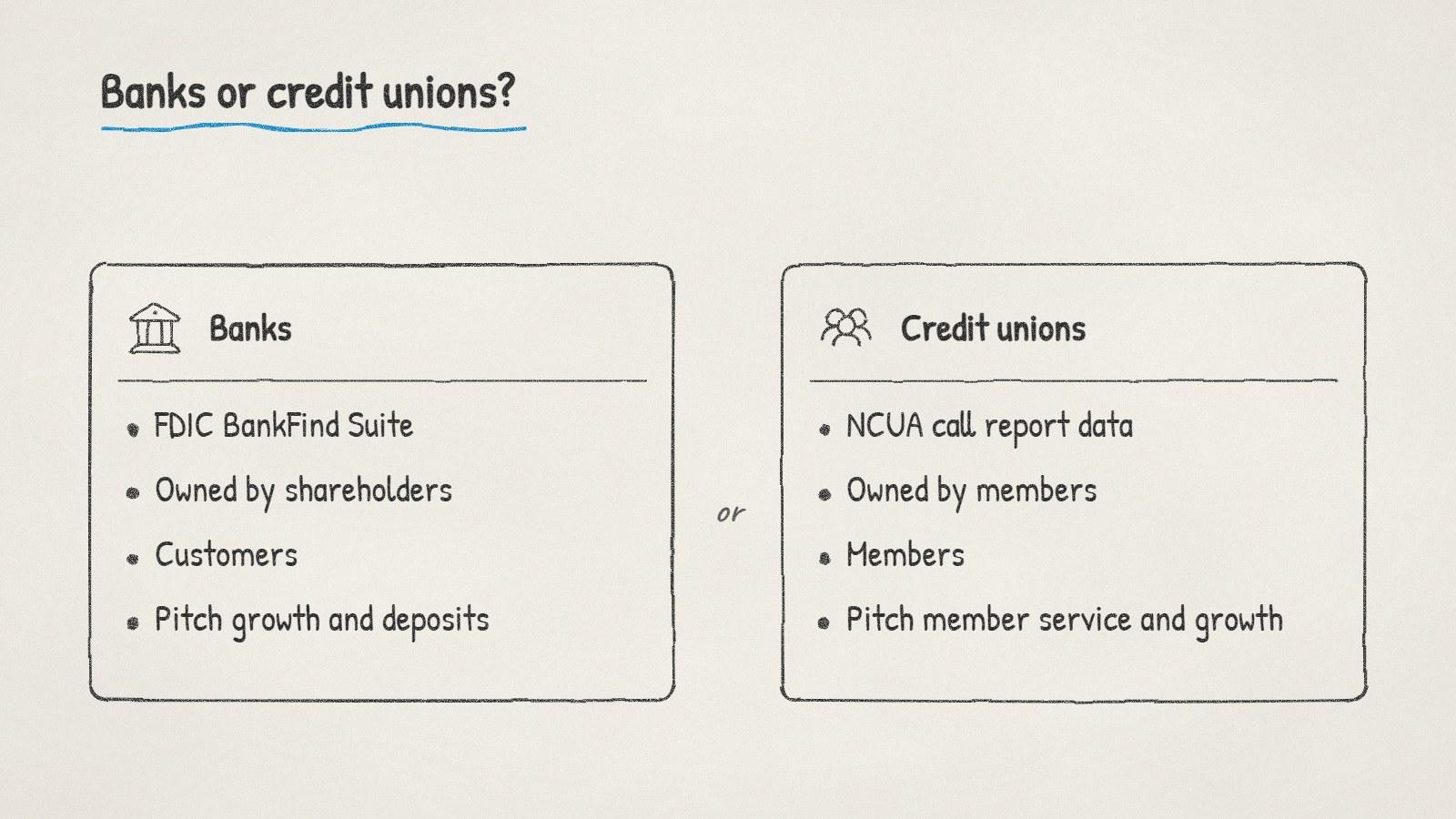
Banks and credit unions come from different regulators and different files.
Filter by size
Asset size predicts how an institution buys better than anything else in the files. As a rule of thumb, not a published threshold:
Total assets | Who usually decides | How they buy |
|---|---|---|
Under $500 million | The CEO, with one or two senior officers | Quickly, often on a referral or a peer's recommendation |
$500 million to $10 billion | Department heads, with a vendor management process | Formal due diligence, sometimes a committee |
Over $10 billion | Specialist teams and procurement | Requests for proposals and long security reviews |
Who to contact
Role | What they usually own |
|---|---|
CEO or president | Strategy and any big purchase. At small institutions, nearly everything |
Chief lending officer | Loan origination and lending software |
Chief information officer or IT director | Core banking systems and security |
Chief compliance or BSA officer | Compliance software and audits |
Marketing director | Marketing and member or customer growth |
Chief financial officer | Vendor contracts and anything that touches the balance sheet |
Bank and credit union websites usually list senior management. If what you sell plugs into the core banking system, find out which core they run first. Our guide to finding companies that use a specific software covers how.
Expect vendor due diligence
Federal regulators expect banks to manage the risk of their vendors. The federal banking agencies, the FDIC among them, set this out in their 2023 interagency guidance on third-party relationships, and credit unions face similar expectations from NCUA. In practice, a yes from the executive is the start of a review of your security and your financials. Have a short security summary and your standard documents ready before the first call, and the review goes faster.
Fintech founders and credit union staff ask about selling into and working with these institutions in r/fintech and r/creditunions.
What to say
Hi [Name], I was looking at [institution]'s [specific signal: a new branch in Ames / a job post for a digital banking manager]. We work with [banks or credit unions] around [asset size] on [what you do], mainly [the problem in their words]. [A proof point you can back up, ideally a similar institution.] Would a short call be useful, or should I send our security summary first?
Peer proof matters a lot here. If a similar institution will act as a reference, say so.
Doing it with ManyPI
Disclosure: ManyPI is our product.
Export your filtered list from BankFind or the NCUA files, import it into ManyPI, and the agent finds the executive you want at each institution, noting where each contact came from. Or describe the list in a sentence, for example "community banks in Iowa with under $1 billion in assets, with the chief lending officer's email", and the agent searches the live web, including institution websites and news, plus a database of 600M+ contacts. Every email is checked against the receiving mail server before a campaign can use it, and sequences go out from your own Gmail or Outlook inboxes and stop on reply. The lead generation page covers the setup.
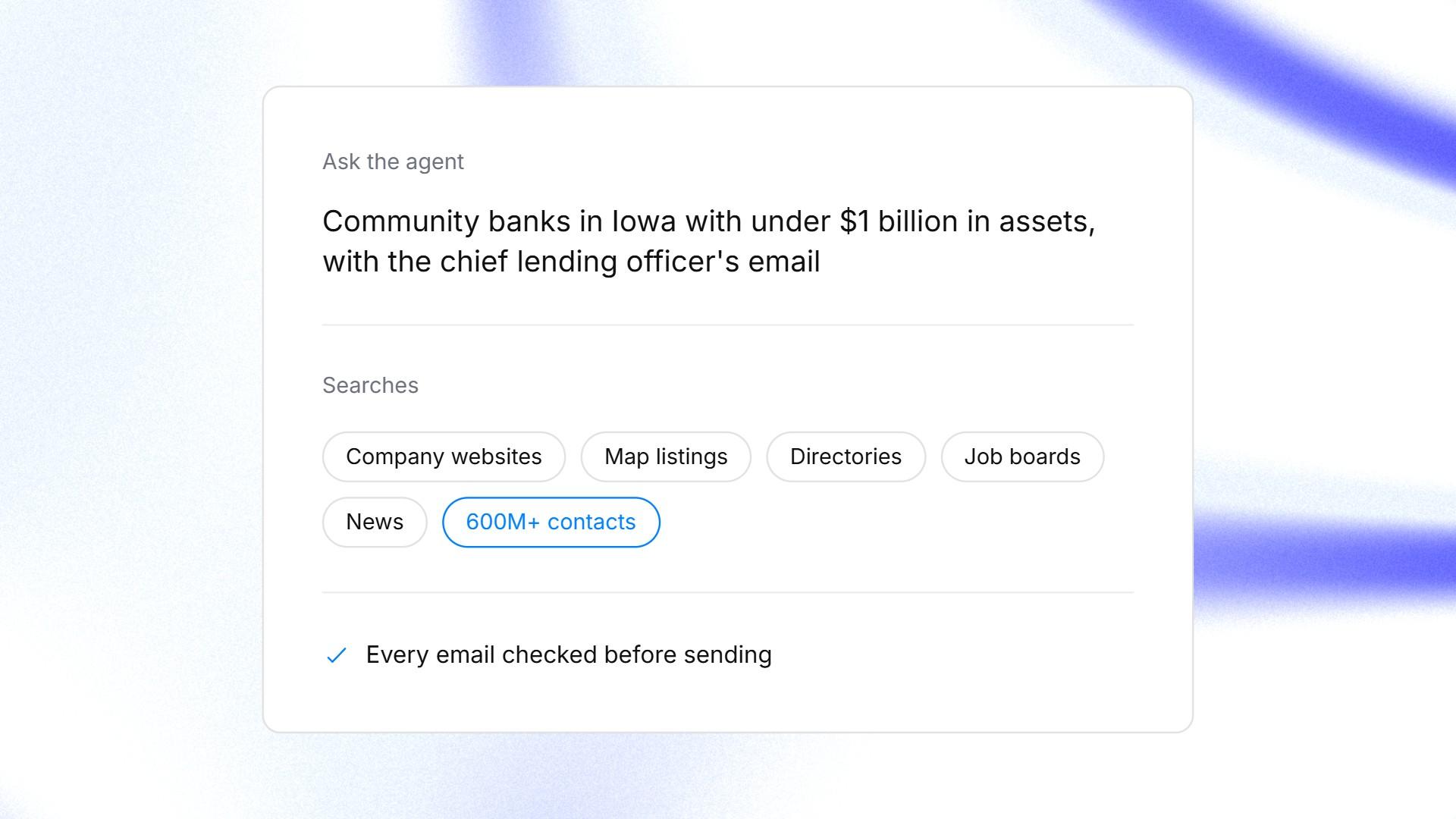
A community bank search typed into the ManyPI agent.
A trap with this market: mergers. Both files change every quarter as institutions combine, and an email to a bank that merged last quarter lands with a team that no longer buys on its own. Check BankFind's history for each institution before a campaign goes out.
Written by
Bastian W.
Content Manager / ManyPI