


TL;DR
Six short cold email templates for web designers pitching local businesses, each built around one problem you found on their site, plus subject lines, a follow-up, a breakup email and the CAN-SPAM basics.
Send your first campaignThe cold emails that sell websites to local businesses are short, name one specific problem with the owner's current site, and ask one small question. "Want me to send a two-minute fix list?" gets replies. "We're a full-service digital agency" doesn't. Below are six templates built that way, for the four situations you'll meet most: an outdated site, no site at all, a slow site, and a demo you've already built.
Web designers compare notes on pitching in r/agency and r/webdev. The advice that holds up is the same everywhere: specific beats clever.
The rules every template follows
Plain text, no images, no attachments. It should read like a note from a person, not a newsletter.
Under 90 words. An owner reading on a phone between jobs gives you about one screen.
One problem. Pick the worst one and save the rest for when they reply.
One ask, and a small one. Permission to send something, not a call next Tuesday.
Their words, not yours. "The number can't be tapped on a phone" beats "suboptimal mobile UX".
Everything in [brackets] is yours to fill in. None of the templates makes a claim for you: if you haven't checked something, don't say it.
Subject lines that fit
Short and lowercase, like a note from a neighbour:
Situation | Subject line |
|---|---|
Outdated site | [Business] site on phones |
No website | [Business] on Google |
Slow site | quick one about [Business] |
Demo built | made you something |
Follow-up | Re: [first subject] |
Skip "Proposal", "Partnership" and anything with "SEO" in it. Owners get those every day.
1. The outdated site
Hi [Name],
I opened [Business]'s website on my phone this morning, and [the problem you saw, e.g. the text was too small to read without zooming].
Anyone looking you up on a phone sees the same thing.
I build sites for [trade]s in [area]. Want me to send a short list of what I'd fix first?
[Your name]
2. No website at all
Hi [Name],
I searched "[service] [town]" and found [Business] on Google Maps with [number] reviews, but no website linked.
The [number] businesses above you in that search each link a website, where people can check prices and service areas before they call.
I could put together a simple one-page site for you. Want to see a rough version first?
[Your name]
3. One problem, filled in for every lead
When you're emailing 50 businesses, write the problem once as a merge field. In ManyPI that field is `{{custom.site_problem}}`, a one-sentence description of the worst problem on each site.
Hi [Name],
I had a look at [Business]'s website and noticed {{custom.site_problem}}.
It's an easy thing to lose a customer over, and an easy thing to fix.
I build websites for [trade]s around [area]. Want me to send over what I'd change?
[Your name]
Read a few of the filled-in versions before you send. A merge field is only as good as the sentence it drops in.
4. The demo you've already built
Building a quick homepage before you pitch is a bet: more work up front for a stronger email. We've covered when it pays off in should you build a free demo website before pitching.
Hi [Name],
I made a quick version of a new homepage for [Business], using your current text and photos: [preview link] (code [six-digit code]).
It works on phones and puts your number one tap away. No strings attached.
If you like the direction, I can tell you what it would take to finish it.
[Your name]
5. The follow-up
Send it three or four days later, in the same thread, with something new:
Hi [Name], one more thing I noticed: [a second, smaller problem, or a competitor detail you can verify]. Happy to send the fix list if it's useful.
6. The breakup
A week after that, close the loop politely. It's an easy email to answer, which is the point.
Hi [Name], I'll stop here so I'm not cluttering your inbox. If a new website comes up later this year, I'm at [email or phone]. Good luck with the [season or busy time].
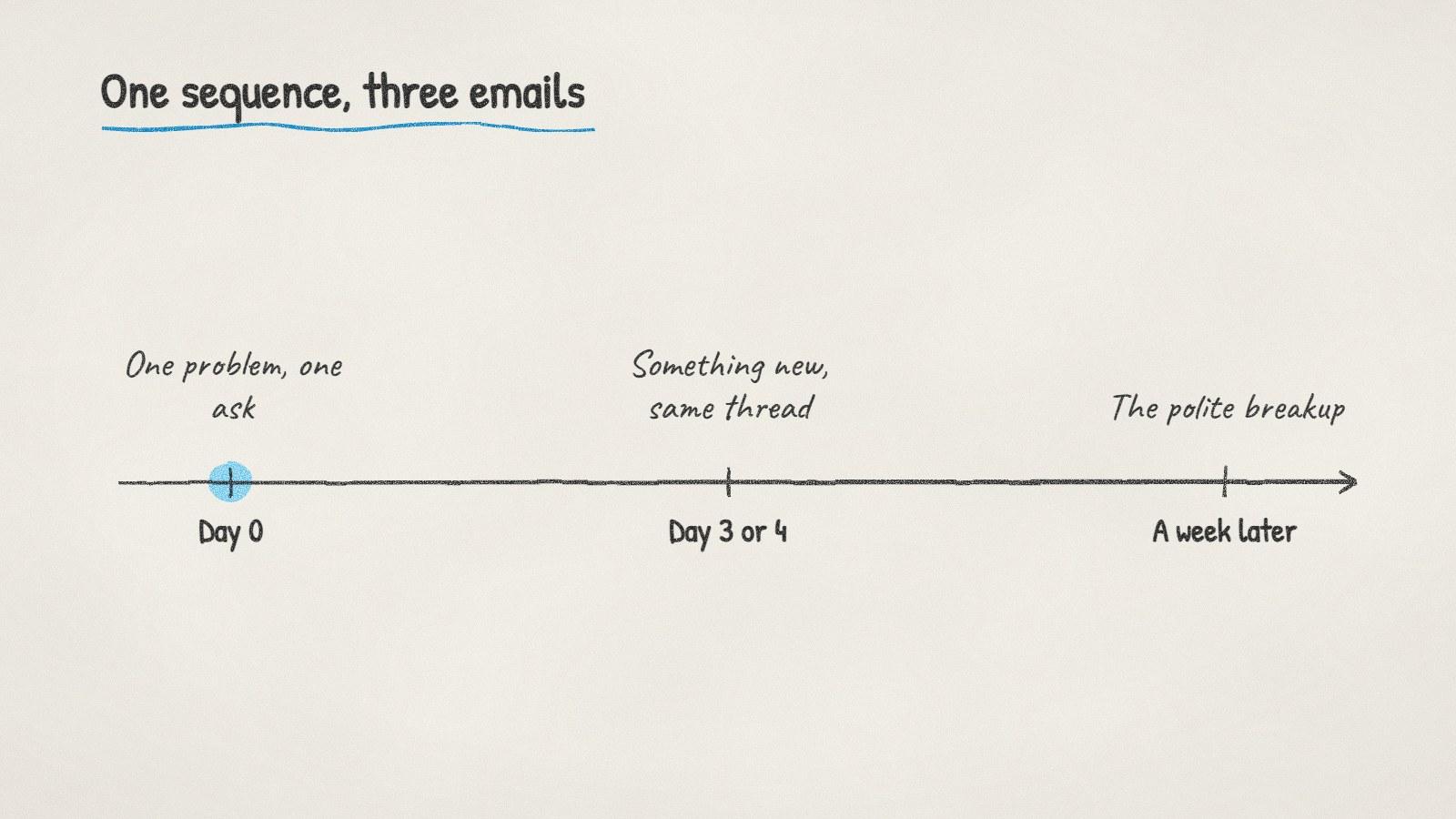
The three emails of a sequence: the first on day 0, a follow-up on day 3 or 4, the breakup a week later.
The legal basics
In the US, the FTC's CAN-SPAM compliance guide applies to business email too. The short version:
Accurate "From" details and a subject line that matches the email.
A valid postal address in the email.
A clear way to opt out, honoured within 10 business days.
Clear identification that the message is an ad, which plain wording can do.
Outside the US the rules differ a lot. In Germany, for example, commercial email to businesses generally needs prior consent, and in the UK sole traders count as individuals. Our guide to B2B cold email laws by country covers the differences. This isn't legal advice: check the rules where your prospects are.
Doing it with ManyPI
Disclosure: ManyPI is our product.
ManyPI sends these as a campaign from your own Gmail, Outlook or SMTP inbox. Every email address is checked before the campaign can use it. Follow-ups go out in the same thread and stop for anyone who replies.
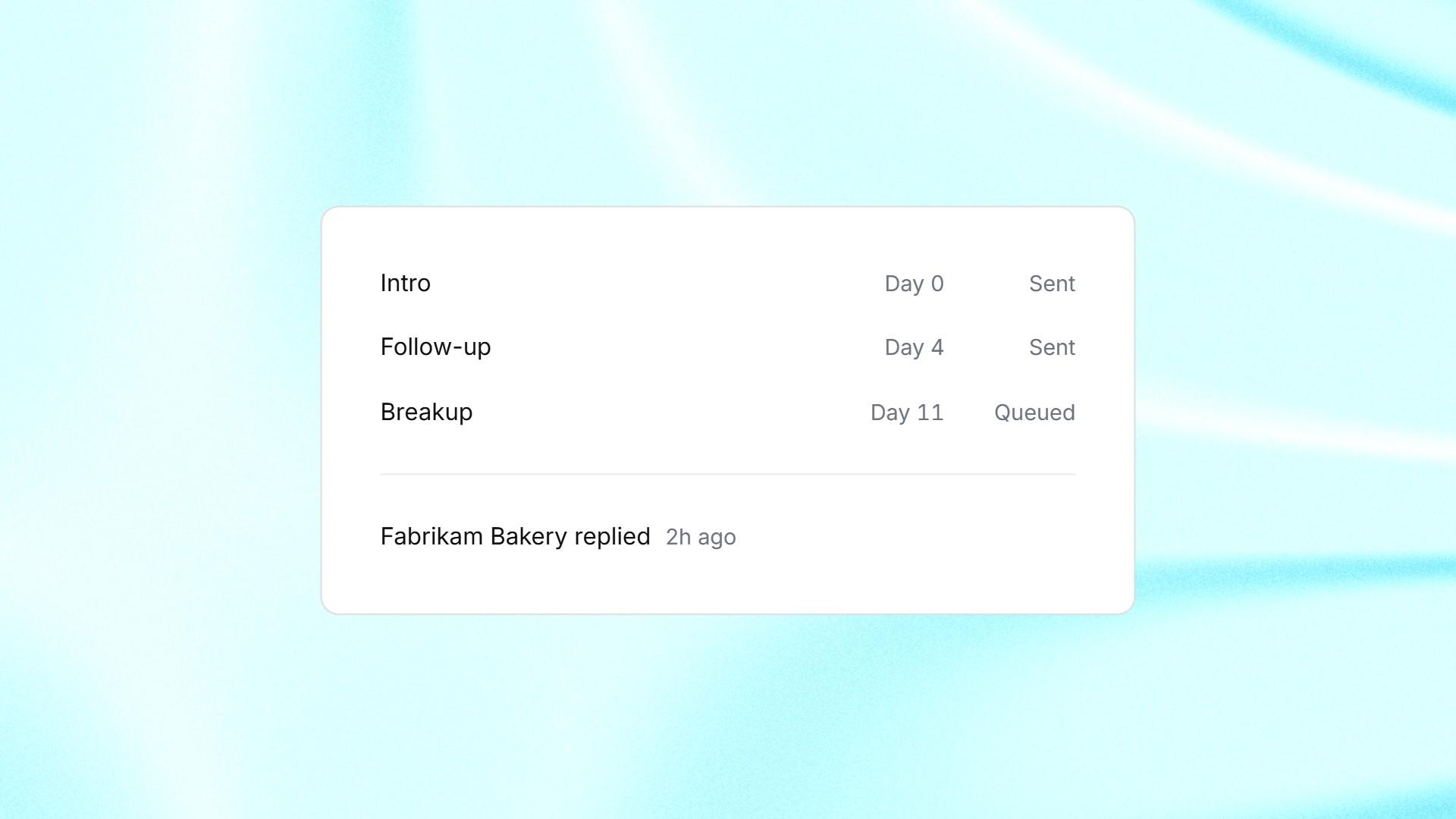
The intro, follow-up and breakup as a three-step sequence in ManyPI, with one owner's reply. Sample data.
The `{{custom.site_problem}}` field comes from Check websites, which scores how outdated each lead's site is and writes the problem in plain words, like "the phone number cannot be tapped to call on a phone". Our guide to finding local businesses with outdated websites shows the scoring.
For template 4, ManyPI Sites makes the demo: paste the business's current domain, and the Agent builds a new site from its text, photos and opening hours. Preview links open with a six-digit code by default, so only someone with the code sees the draft.
The free plan finds leads and checks emails. Sending campaigns needs a paid plan, from $25 a seat a month. See cold email outreach for the setup.
Send ten by hand before you automate anything. If none of the ten gets a reply, the problem is usually the first line, and more volume won't fix it.
Written by
Bastian W.
Content Manager / ManyPI