


TL;DR
When people on Reddit ask how to find local business leads, the same five options keep coming up. ManyPI is first on our list because it turns a map area into a list with owner emails. LinkedIn, Google Maps, Yelp and local directories follow.
Find local businesses on a mapAsk Reddit how to find local business leads and you get the same handful of answers every time: scroll Google Maps, check Yelp, search LinkedIn, or dig through the chamber of commerce. They all work, and they all take hours per list. We found these answers on Reddit, mostly in r/sweatystartup and r/smallbusiness. Here are the five options that come up most in those discussions, with ManyPI first because it does the whole job in one place.
The quick list
# | Tool | Best for | Cost | Watch out for |
|---|---|---|---|---|
1 | A full list of businesses in an area, with owner emails | Free plan, then from $25 a seat a month | Sending needs a paid plan | |
2 | Finding the owner's name once you have the business | Free to search | Many small local businesses barely use it | |
3 | Google Maps | Seeing what's in a neighbourhood | Free | One card at a time, no emails |
4 | Yelp | Restaurants and home services | Free | Patchy outside those categories |
5 | Chamber of commerce directories | Established, community-minded businesses | Free to browse | Only lists paying members |
1. ManyPI
ManyPI's Map Search does what people on Reddit describe doing by hand, without the copying. You draw an area on a map, pick a business type, and get every matching business inside it as a list. The data comes from OpenStreetMap. Filter for businesses with no website, or only the ones with a phone number listed, then save the ones you want and ManyPI finds the owner's or manager's email.
Every email is checked against the receiving mail server before a campaign can use it, so the list doesn't bounce. When you're ready, campaigns send from your own Gmail or Outlook inboxes with follow-ups that stop when someone replies. You can also skip the map and describe the customer in a sentence, like "dental practices in Austin with two or more dentists".
The free plan includes 50 leads and 50 email checks a month with no card. Starter is $25 a seat a month. The Map Search page shows how drawing an area works.
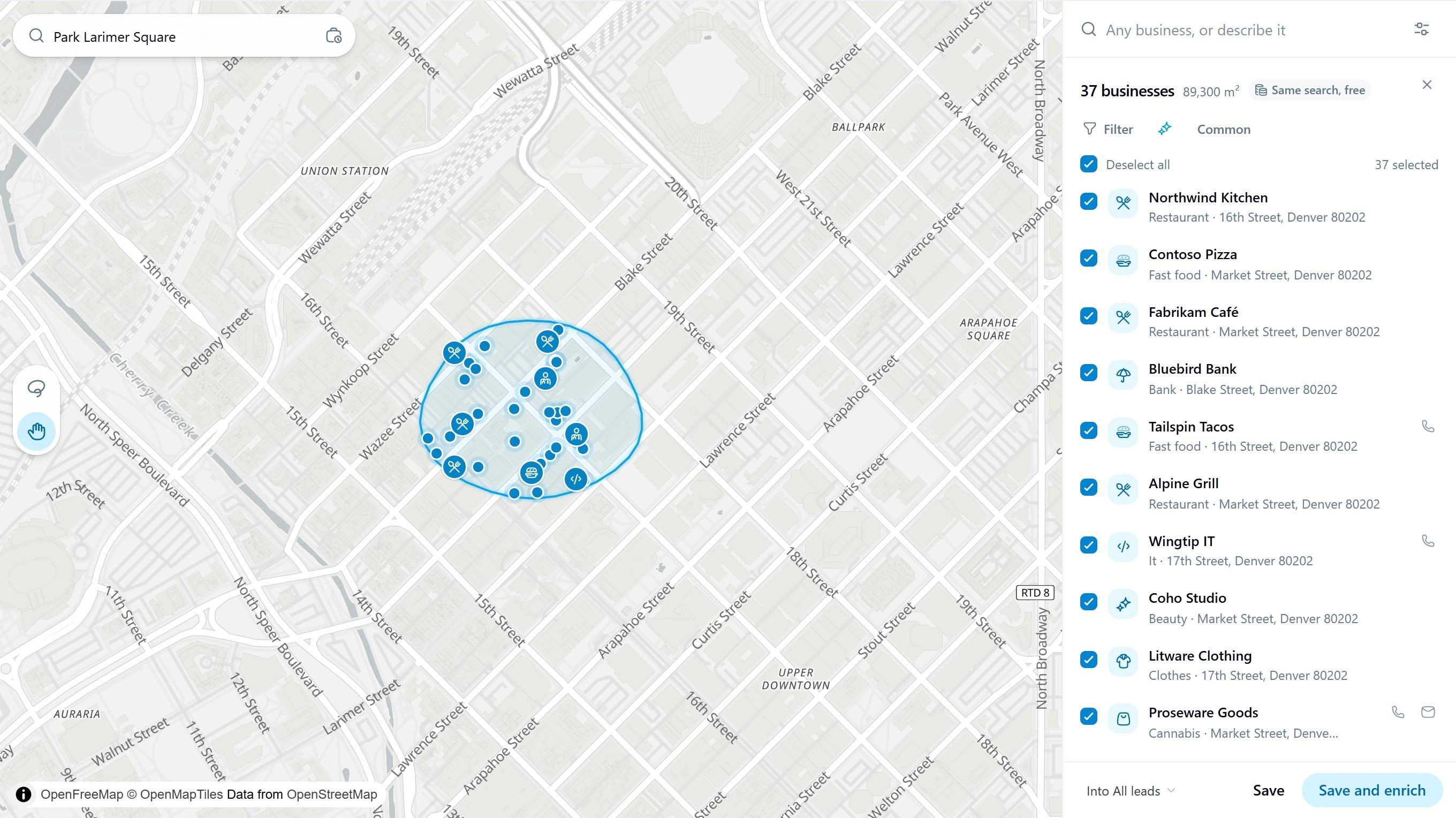
A few blocks of downtown Denver drawn in ManyPI's Map Search, with every business inside listed. Business names are sample data.
2. LinkedIn
LinkedIn comes up on Reddit as the place to find who runs a business once you know it exists. Search the business name and filter people by current company. You'll often find the owner or general manager.
It's weaker as a starting point for local leads. Plenty of salons and contractors have no company page, or one that hasn't been touched in years. And LinkedIn won't give you an email address, so you'll still need to work that out separately.
3. Google Maps
Google Maps is the most common answer in those threads, and it's the obvious place to see what's in an area. Search "plumbers near Denver" and you get names, phone numbers, websites, opening hours and reviews.
The catch is that it's built for finding one place to visit, not for building a list. It shows a limited set of pins for each view, favours the centre of the map, and gives you one card at a time. Copying 200 businesses into a spreadsheet is an afternoon of clicking, and you still won't have a single email address.
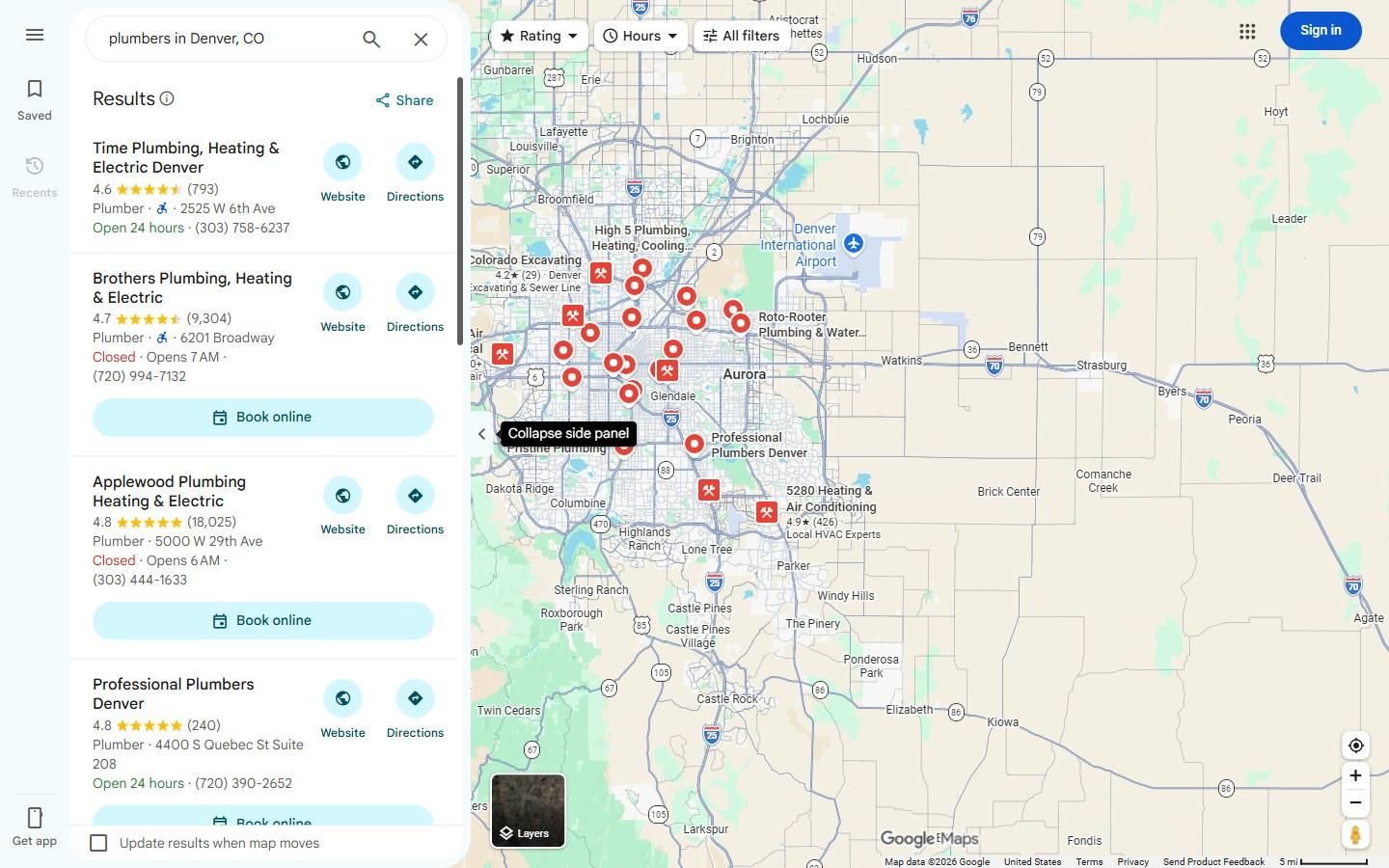
Google Maps results for plumbers in Denver, one card per business.
4. Yelp
Yelp is strongest for restaurants, cafés, bars and home services like cleaners and movers. It comes up for its categories and review counts, which are a rough guide to how established a business is.
Outside those categories it's thin. You won't find many accountants or manufacturers on it. And like Google Maps, it gives you a phone number and a website, not the owner's email.
5. Chamber of commerce directories
Most local chambers of commerce publish a member directory, often with categories and a contact name. These businesses tend to be established and active in their community, which makes them good prospects for local services.
The limit is coverage. A chamber only lists its paying members, which in most towns is a fraction of the businesses there. Use it to find a few good accounts, not to build a complete list.
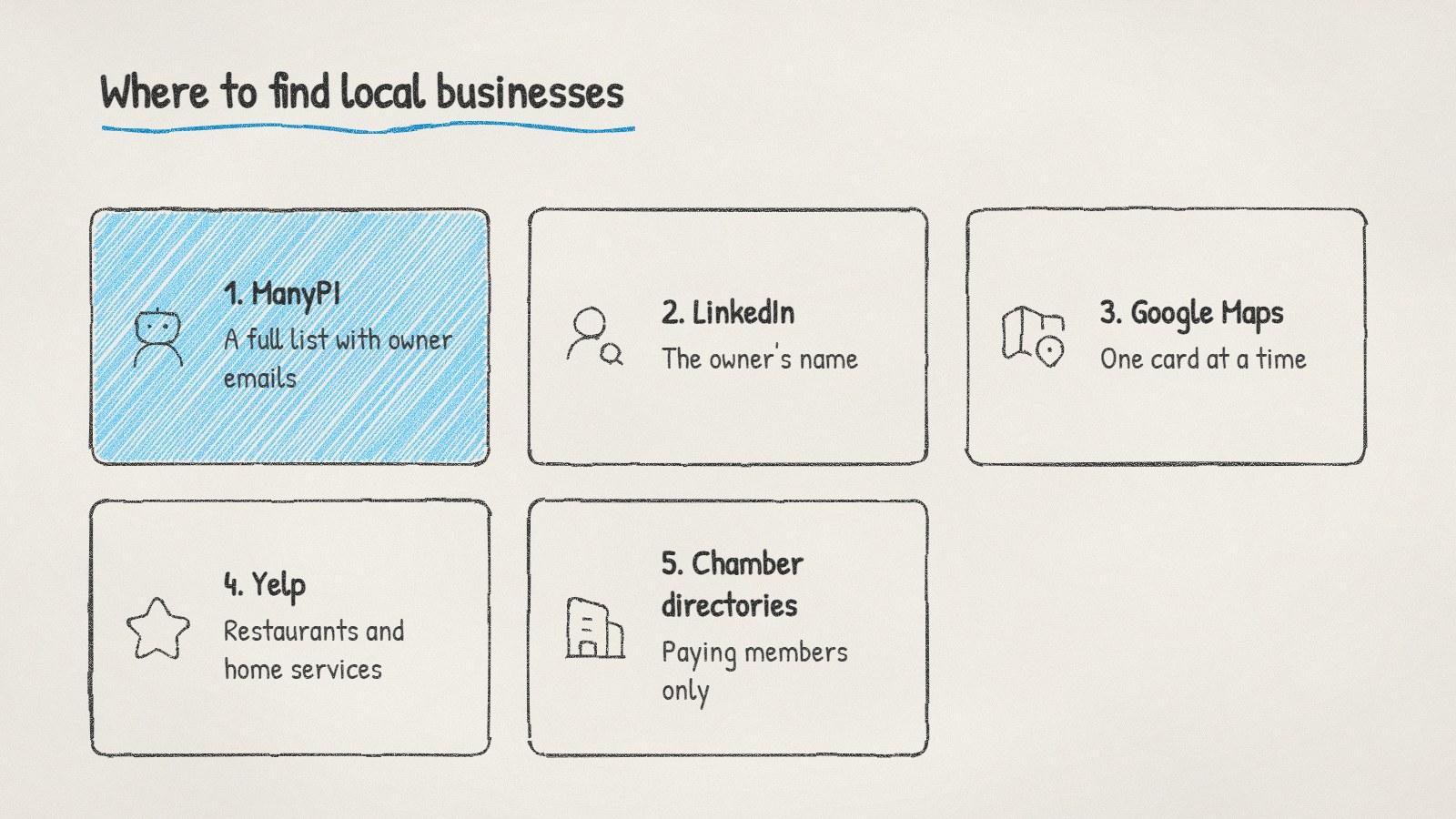
Five places to find local businesses, from a full list to a few named contacts.
How to pick the right one
You need a complete list for an area. Start with a map-based tool. ManyPI gives you everything inside the area you draw, and Google Maps is the free manual version.
You need the owner's name. LinkedIn and chamber directories are where names show up most often. State licence lookups help too for trades and salons.
You need emails. None of the free options give you emails. Either work out each address from the business's website and check it, or use a tool that finds and checks them for you.
You sell to one category. Yelp for restaurants and home services, licence lookups for trades. We've written guides for specific niches, including commercial cleaning leads and local businesses without a website.
Whatever you use, filter before you email. A list of every business in a zip code is a starting point. The ones that match your offer, like no website if you build websites, are the list worth sending to.
Written by
Bastian W.
Content Manager / ManyPI