


TL;DR
ClinicalTrials.gov lists who sponsors each trial, its phase, status and sites. Filter to industry-funded studies that haven't started recruiting, group them by sponsor, then email clinical operations.
Find trial sponsors with ManyPIIf you sell to companies running clinical trials, as a CRO, a site network, a patient recruitment firm or a lab supplier, the best free list is ClinicalTrials.gov. Every study record names its lead sponsor, the phase, the recruitment status, the conditions and the sites. Search for industry-funded trials that are about to start, group them by sponsor, and you have a list of biotech and pharma companies that need vendors in the next few months. Then reach the head of clinical operations, who usually picks them.
Why ClinicalTrials.gov is the list
Most trials of FDA-regulated drugs and devices have to be registered there. Under the 2016 final rule (42 CFR Part 11), the responsible party, usually the sponsor, must register an applicable clinical trial no later than 21 days after enrolling the first participant. Phase 1 drug trials are outside that rule, but many sponsors register them anyway.
That makes the registry an unusually honest buying signal. A record that says "Not yet recruiting" is a company with a funded study and a start date, which still has sites to open and patients to find.
Where to find trial sponsors
Source | What it gives you | Notes |
|---|---|---|
ClinicalTrials.gov search | Studies by condition, sponsor, status, phase and location, with a funder type filter for industry | Free, and results can be downloaded |
The same records in bulk, including lead sponsor class | No key needed. On 12 November 2026 it returned 3,514 industry-sponsored studies marked not yet recruiting, and 10,378 recruiting | |
Trials authorised in the European Union | For sponsors running European studies | |
Company websites | Pipeline pages and press releases | Where names and timelines show up |
Funding news and filings | New rounds and partnerships | A round often comes just before a trial starts |
Our guide to finding recently funded startups covers the funding side, which pairs well with the registry for small biotechs.
Filter by what you sell
Filter | What to pick | Who it suits |
|---|---|---|
Funder type | Industry | Everyone selling to companies rather than universities or the NIH |
Status: not yet recruiting | Studies about to start | CROs, site networks, patient recruitment, lab and kit suppliers |
Status: recruiting | Studies enrolling now | Patient recruitment and retention, especially for studies with many sites |
Phase | Phase 1 through phase 4 | Later phases usually involve more patients and sites |
Condition and location | Your therapeutic area and countries | Specialist CROs and regional site networks |
Once you've downloaded the results, count the studies per lead sponsor. A sponsor with one or two trials is often a small biotech without a big in-house clinical team, which is the profile most likely to outsource. That's a rule of thumb, not a published figure, so check the company's site before you write. A sponsor with hundreds of records is a large pharma company with a formal vendor process.
Also look at the collaborators listed on each record. If a CRO is already named, the sponsor has picked one for that study, and a rival CRO is better off asking about the next one.
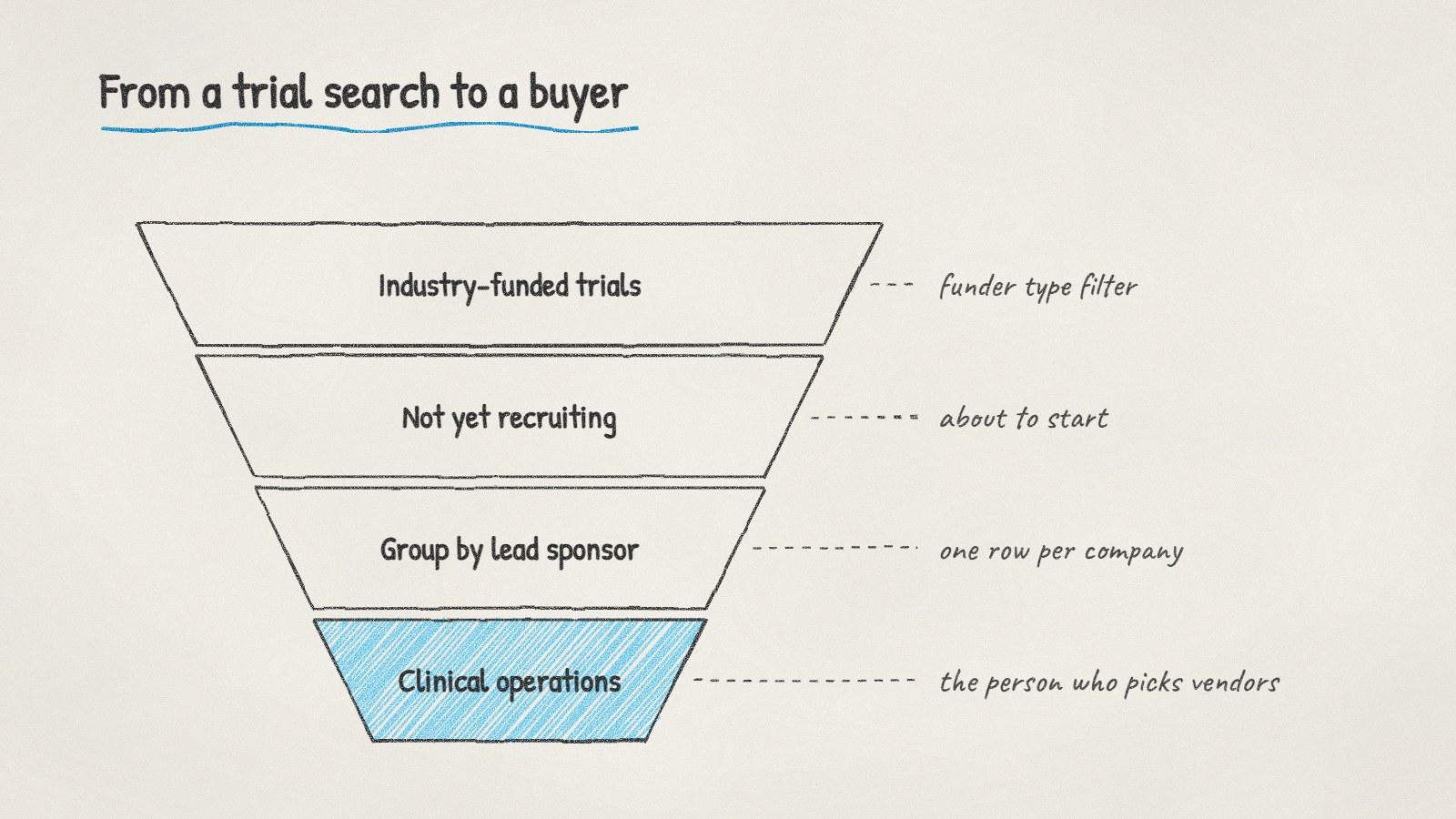
From a ClinicalTrials.gov search to the person who buys.
Who to contact
Role | What they decide |
|---|---|
Head or VP of clinical operations | CRO selection and most trial vendors |
Clinical trial or study manager | Day-to-day vendors on one study |
Outsourcing or vendor management lead | Contracts and preferred vendor lists, at larger sponsors |
Chief medical officer | Study design and, at small biotechs, most clinical decisions |
At a small biotech the CEO or CMO may be the whole clinical team, so start there. At large sponsors, aim at the outsourcing team or the clinical operations lead for the therapeutic area.
One warning: the central contacts listed on a study record are there for patients and sites asking about the trial. Don't put them into a sales sequence. Find the clinical operations lead through the company's own site instead, and our guide to finding a work email address covers that step.
What to say
Reference the study by its NCT number. It shows you've read the record, and it tells the reader which team should answer.
Hi [Name], I saw [Company]'s [phase] study in [condition] ([NCT number]) is listed as not yet recruiting, with sites in [countries]. We help sponsors with [what you do], mainly [the problem in their words, for example finding eligible patients for rare disease studies]. [A proof point you can back up.] Would a short call before your first site opens be useful?
People who run trials compare notes on vendors and site work in r/clinicalresearch and r/biotech, which is a good place to learn the vocabulary before you write.
Doing it with ManyPI
Disclosure: ManyPI is our product.
Download your filtered ClinicalTrials.gov results, keep one row per lead sponsor, and import the file into ManyPI. The agent finds each company's website and the email of the head of clinical operations, noting where each one came from. Or describe the list in a sentence, for example "biotech companies in Boston running phase 2 oncology trials, with the head of clinical operations' email", and the agent searches the live web, including company sites and news, plus a database of 600M+ contacts. Every email is checked against the receiving mail server before a campaign can use it, and sequences go out from your own inbox and stop on reply. The lead generation page covers the setup.
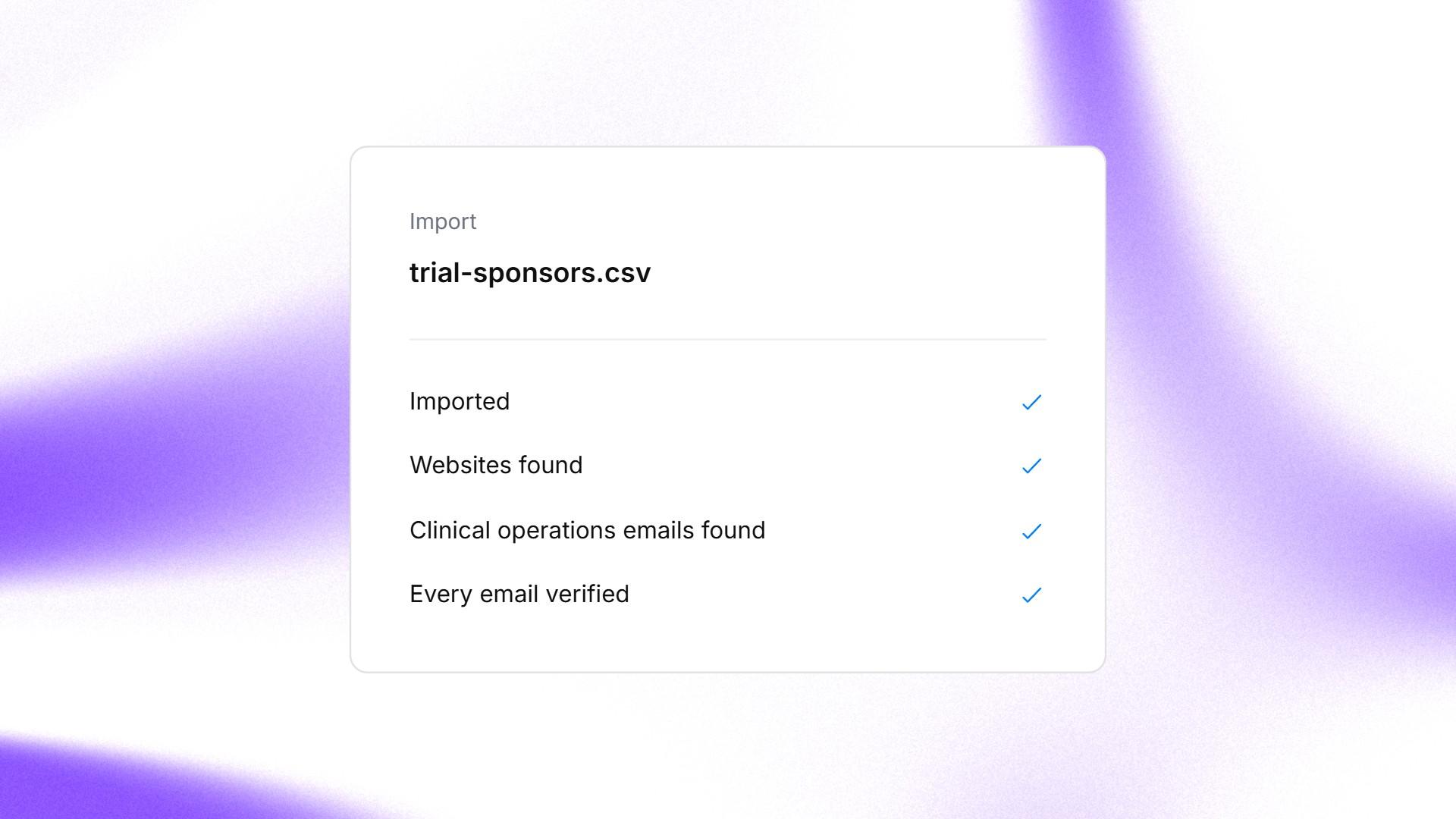
A ClinicalTrials.gov export brought into ManyPI, with websites and clinical operations emails found and checked.
Where this stops working: big pharma. Their trials are in the registry too, but large sponsors usually buy from preferred vendor lists set well before any one study is posted. For them, aim at the outsourcing team months before any specific study, not at the record.
Written by
Bastian W.
Content Manager / ManyPI